in Language, Music | June 1st, 2026 Leave a Comment
I’ve interacted with many entertaining language-learning resources in various classes—from miniseries in Spanish to comic books in French—all geared toward making the unfamiliar language relevant to daily life. Learning counterintuitive pronunciations, parsing a new system of grammar, or memorizing the genders of word after word can be laborious and intimidating in the classroom. Doing so in everyday pop cultural settings, not as much.
When it comes to the teaching of dead languages, the resources can seem less approachable. I certainly appreciate the literary and rhetorical genius of Virgil, Ovid, Horace, Cicero, and Julius Caesar. But during my high school years, I did not always find their work easy to read in English, much less in formal classical Latin. The elation I felt after successfully translating a passage was sometimes dampened as I puzzled over historical notes and glosses that often left me with more questions than answers.
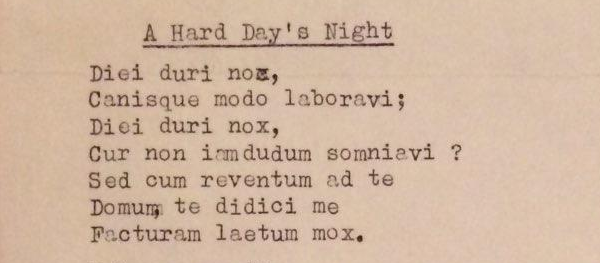
That’s not at all to say that students of Latin shouldn’t be exposed to cultural and historical context or read the finest exemplars of the written language. Only that a break from the heavy stuff now and then goes a long way. Might I submit to Latin instructors one ingenious tool from Eddie O’Hara, former British Labour Party MP and classics teacher? O’Hara passed away in May 2016, and not long after his death, his son Terry O’Hara tweeted these translations of Beatles songs (including two Christmas tunes) his father made in the 60s for his students. At the time, these were the height of pop culture relevance, and, while a far cry from the complexities of the Aeneid, a fun way for Latin learners to relate to a language that can seem cold and imposing.