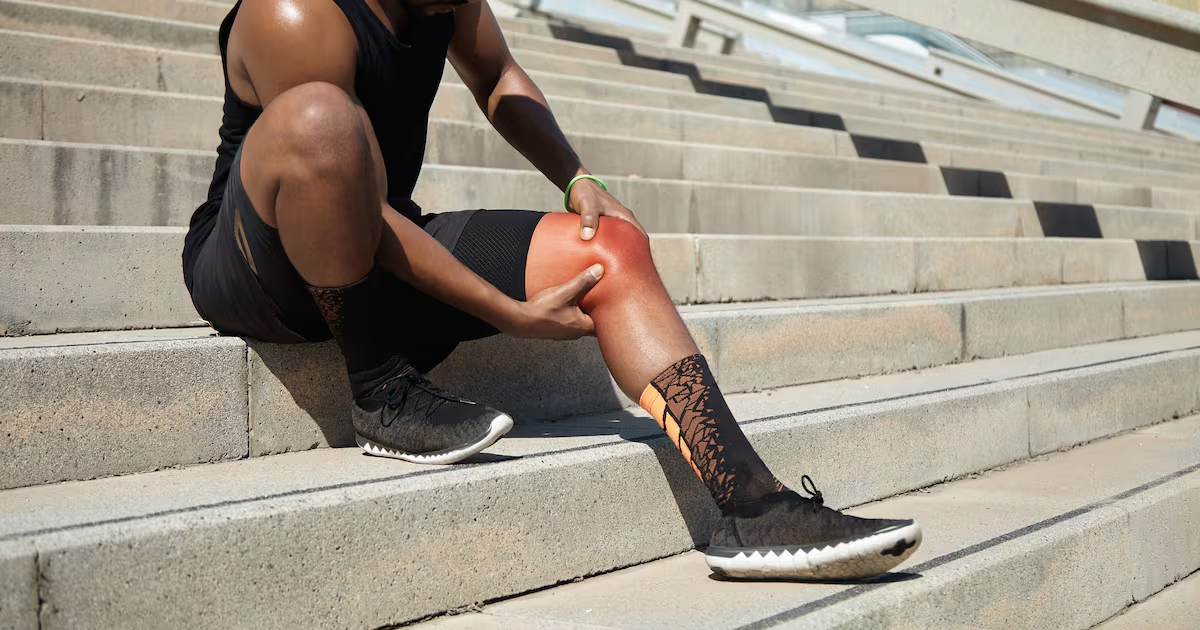
I followed the advice of incorporating strength training but I am afraid I am not built to do it. Is it even possible to use weights or machines in the gym without being in pain?You should never embark on a strength-training programme without the guidance of a professional who can assess your movement patterns and teach you how to perform exercises safely.The Water Cooler strongly suggests that you at the very least invest in professional training until you have developed enough knowledge to do it yourself. And even then, a few booster phases with a trainer each year will keep you honest.There’s pain and then there’s pain. People often moan about something that is better described as the expected “soreness” they often must endure to enjoy the benefits of being stronger, healthier and leaner.Bad pain is a sharp, sudden onset of something debilitating. This is the pain that sends you to hospital and keeps you out of the gym for months.What does expected soreness feel like? Typical stiffness after exercising often results in reduced mobility, where the affected muscles are somewhat sensitive to touch. It usually eases with light movement and some mobility work. It is largely neuromuscular and fluid-related, rather than significant inflammatory damage, and comes from doing extra volume, new exercises or progressive overload.There’s pain and then there’s pain. People often moan about something that is better described as the expected ‘soreness’ they often must endure to enjoy the benefits of being stronger, healthier and leaner.Then there’s the lactic acid burn. When you push near momentary failure, your muscles shift to anaerobic metabolism, which produces lactate (commonly called lactic acid). This contributes to the intense burning or heavy fatigue in the moment and passes when the lactic acid clears. Usually, it will be completely gone within 30-60 minutes.Temporary muscle failure is when you cannot do another rep. It feels heavy, you may start shaking and are likely to feel a burn. That’s when you stop. If you continue, and lose form, you stand the risk of injuring yourself — I’ll talk about my leg press experience in a bit.The next type of soreness has ended many strength-training commitments before they’ve even had a chance to get started. It is called delayed onset muscle soreness (DOMS). If you start a new regimen, radically increase your sets or reps, and focus heavily on the eccentric phase of a lift, you may be setting yourself up for DOMS.It can be agony. It’s that type of gym soreness where you sit on the toilet and can’t stand up again. It’s where you walk like a Tyrannosaurus rex, lest your calves stretch out and make the back of your knees feel as if a soup spoon is being used to scrape out your ligaments.The consensus is that microscopic tears in the muscle fibres and connective tissue trigger inflammation and the onset of repair processes. It is an adaptation signal, where muscles rebuild stronger and become more resilient. It usually starts the next day, peaks at around 48 hours, and can linger and fade over the course of the next few days.I experience DOMS once or twice a year, and it is always after doing a new programme, new exercises, or after doing something stupid, like 20 sets of various calf raises instead of just doing what I was supposed to do.This does not validate the dangerous myth of “no pain, no gain”. You can, and will, enjoy progress without DOMS, but if you do get it, at least you know what it is.Then, there’s bad pain. It’s usually acute and localised and does not follow the predictable DOMS timeline. About a decade ago, I was using the leg press machine, and at the bottom of the movement I heard a loud “pop”. Thankfully, I was able to rack the weights.The partial tear in the rectus abdominis muscle belly ended all running and lifting for about six weeks. That’s an acute injury and it taught me to respect bracing and to stop copying bodybuilding YouTube channels.Bad pain is usually sudden and involves a sharp, stabbing or burning pain that is localised to a specific spot, tendon insertion or joint line. It is not a broad muscle ache. It worsens and is often accompanied by swelling, bruising or visible deformity. Injuries can also develop over time, such as overuse injuries like tendinopathy.Bad pain requires professional diagnosis and treatment, and avoiding this type of injury is exactly why this column started the way it did.
Devlin Brown at the water cooler | Investing in a trainer will lift a weight off the shoulders
Professional guidance when starting a strength-training programme will prevent injuries
749 words~3 min read