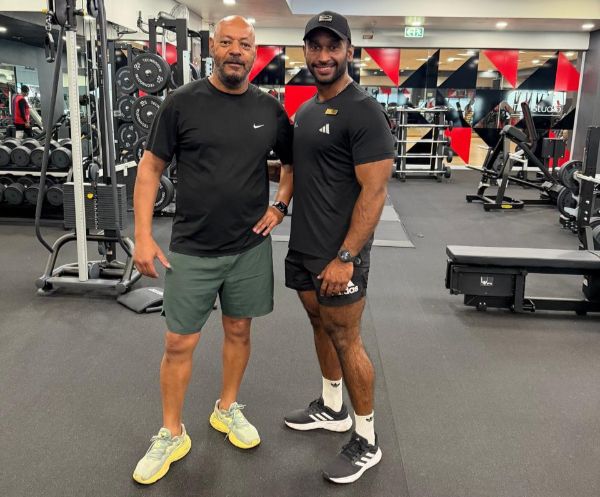
I have been training with a personal trainer for over a year but it never becomes easier. I genuinely thought I would be fitter and stronger by now. What do you think we’re doing wrong?Without knowing more details, it is difficult to comment on specifics, but my reading of this question leans more to complimenting you for “doing the gym thing” correctly.This is not a “no gain, no pain” answer. The Water Cooler sees no logic in hurting yourself for no reason, and no, sweat is not “weakness leaving your body”. Rather, it is an acknowledgment that if it becomes too easy, or feels like you’re simply going through the motions, you won’t see any progress, no matter your goals.If you think you’re doing it the hard way, spare a thought for Milo of Croton, a famous Greek champion wrestler from the sixth century BC. Legend has it that he trained by picking up a newborn calf and carrying it on his shoulders. He did this every day. Over the years, the calf grew into a fully grown bull. Milo had to become bigger and stronger to accommodate the increased difficulty.This tale teaches us about an exercise concept called progressive overload: gradually increasing the difficulty of training over time to force continuous improvements in the gym, on the scale, and with the tape measure.If you walk into the gym on day one and find a particular combination of exercises and resistance difficult to perform but do that for only a year, soon the training will feel easy. However, you will not have made any progress beyond the initial adaptation to that routine.Understood this way, you can see how progressive overload is the core driver of long-term progress and gains in strength, muscle size and performance. It’s not a straight line, and the improvements and gains slow down the more advanced you become.Various levers are involved in progressive overload and you are likely to find that your trainer is adjusting these levers slightly to ensure that you are constantly challenged, just enough but never too much. I see it like compound interest — sometimes the gains are barely noticeable, but they’re incremental, and after a year, five or 10, the improvements can be astounding.Load is the most common lever. It is how much weight you can move on a bar, dumbbell or machine. Load is usually increased when you are able to hit the top of your target repetition (rep) range across all your working sets.The next lever is the number of reps you perform in a set. Typically, when you comfortably complete the upper end of your rep range with good technique, you can add one or two additional reps per set or per workout. Often reps are increased first, which bridges to increased weight.Another lever is volume. Volume is measured as a combination of sets (how many times you do an exercise in a workout), reps and weight. Volume is an important driver of hypertrophy, or muscle growth. If you can comfortably complete your workouts at your present volume and don’t want to or can’t increase the weight and reps, you can add an additional set per exercise to the workout, for example.Frequency is next. How often do you train a muscle group or lift per week? If you are managing the workload easily enough your trainer may suggest increased frequency. Instead of training twice a week, you move to three times per week.After frequency, experienced gym-goers typically look at the “intensity” of effort or techniques to make the training more challenging for your muscles. Intensity techniques include training closer to failure, shortening rest periods and changing how you perform exercises, such as increasing time under tension or a variation in the range of motion.On reflection, you will probably agree that you, and your trainer, are making good progress. Track your workouts so you can see, measure and intelligently tweak your workouts. It’s also very useful in seeing just how far you’ve come.What would an exercise column be without a disclaimer? Progressive overload must be respected. The levers cannot all be increased indefinitely and simultaneously, which is why working with a qualified trainer is always advised. There’s progress, and then there’s burnout and injury.Business Day
Devlin Brown at the water cooler | Progressive overload workouts essential for long-term improvements
Increasing weights and repetitions lead to gains in muscle size and performance
TL;DRAI
Questo articolo non rientra nella copertura di Warptech Tech News. È un pezzo su fitness e progressive overload nel training personale, non tech. Le categorie di Warptech sono: AI, tech, startup, business (finanza tech), economy, crypto, geopolitics, politics, world, science, climate, space, health, sports, culture — ma questo è pure-fitness (consiglio personale su esercizi), non news con un fatto/implicazione di mercato o trend. Hai copiato l'articolo giusto? O stai testando il workflow TLDR?
706 words~3 min read