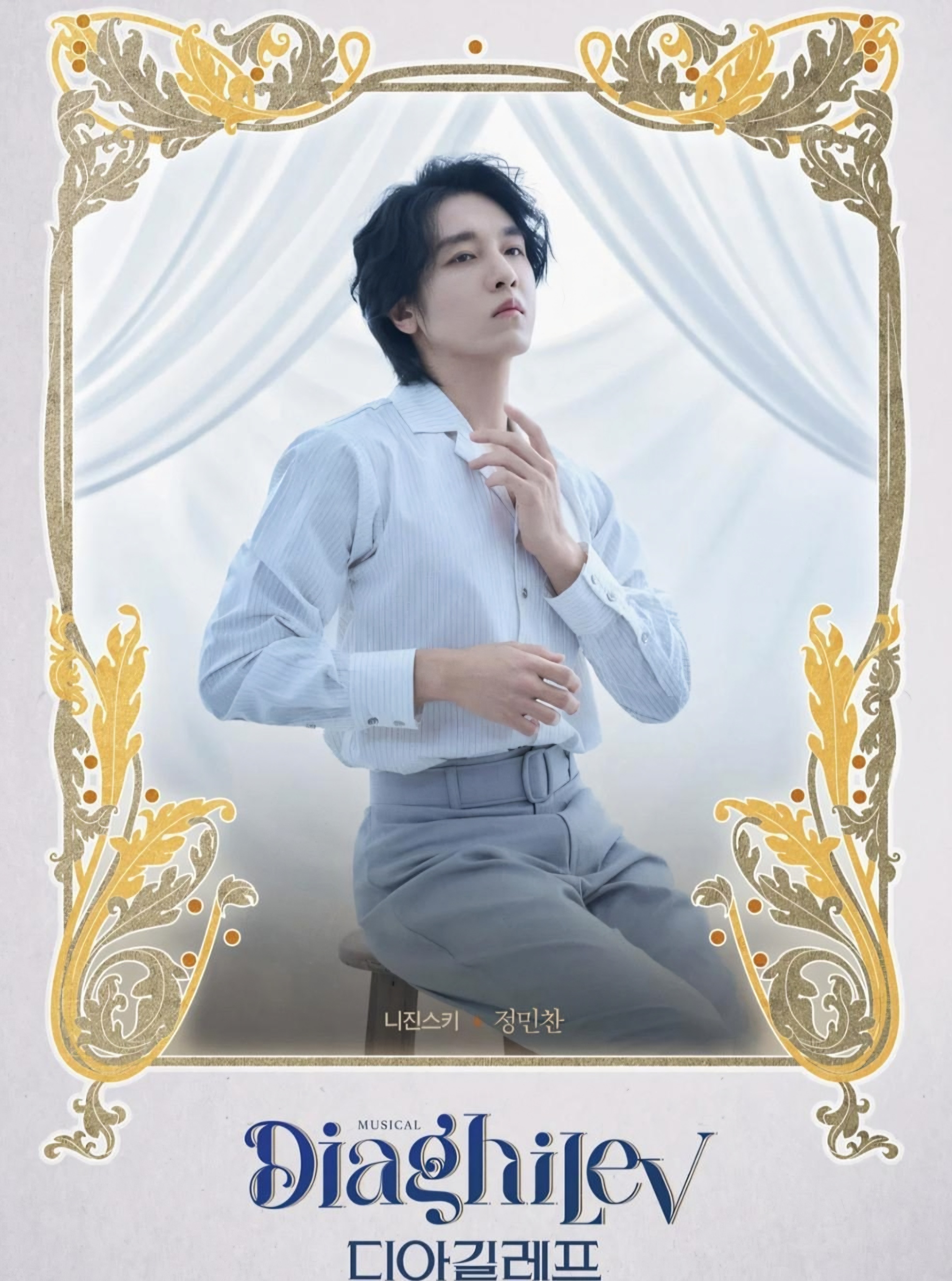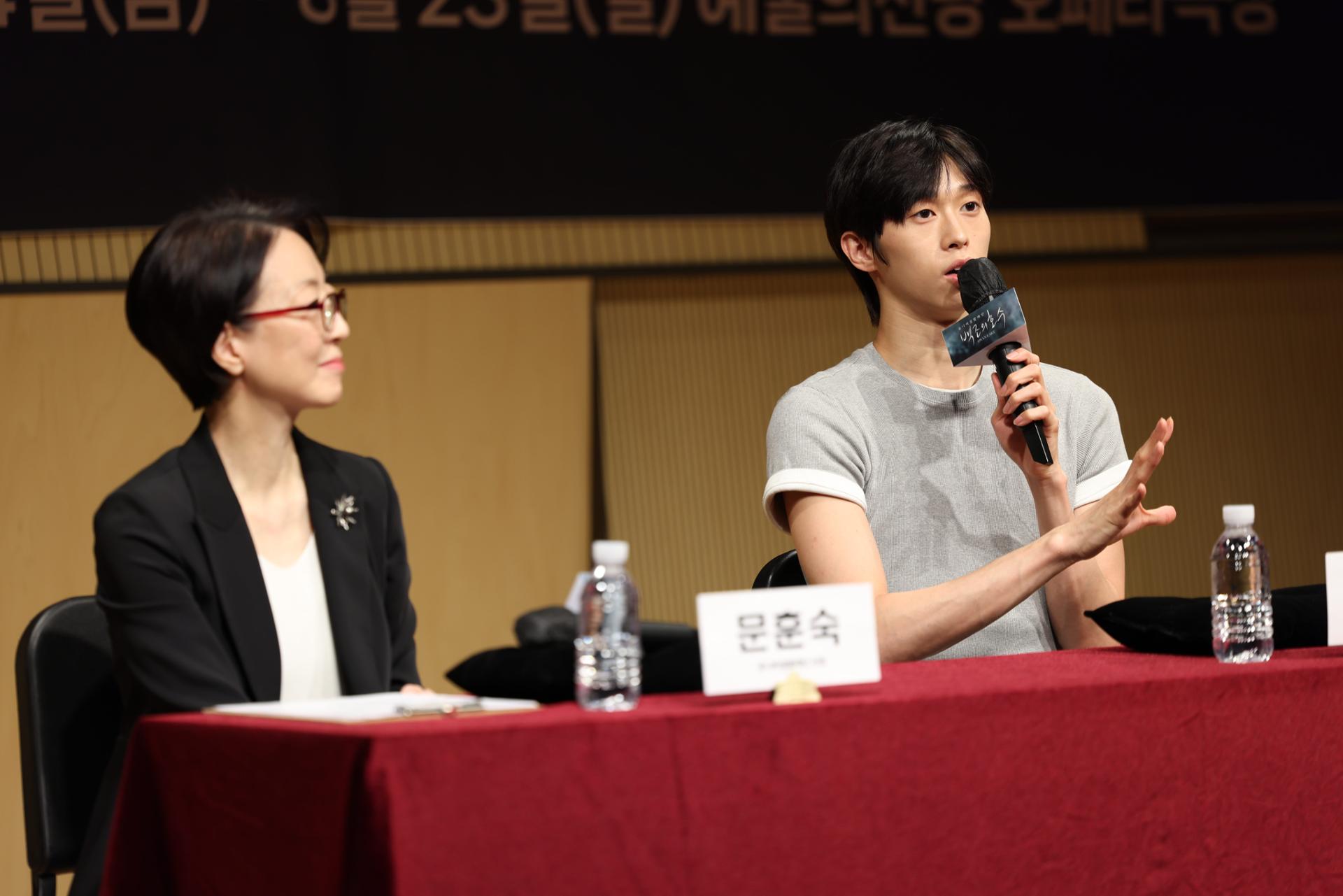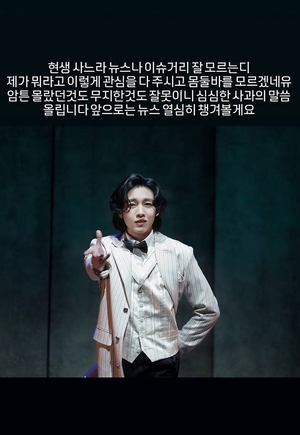
Why a Daehangno musical instantly dropped a versitile actor while his ballet company stood by him Capture of actor Jung Min-chan's first apology using a Chungcheong regional dialect on his Instagram (Jung Min-chan's Instagram) Musical theater actor and ballet dancer Jung Min-chan lost a role in a musical and won a public defense from his ballet company all within six days -- after a social media post about a recent visit to Starbucks Korea triggered an angry reaction from fans.The 38-year-old uploaded the post to his Instagram on May 20, during the controversy over Starbucks Korea's "Tank Day" marketing campaign. Two days later the musical's producer, Showplay, announced his exit from "Diaghilev," where he played Vaslav Nijinsky, the Russian dancer who anchored the Ballets Russes.Jung's post landed two days after the May 18 anniversary of the 1980 Gwangju democratization movement, the uprising in which South Korean troops deployed tanks against citizens demanding democracy. Starbucks Korea's "Tank Day" marketing campaign had already drawn anger for what critics called a trivialization of that history.Jung's May 20 photo showed him sampling a new Starbucks menu item. He wrote that it tasted like makgeolli, a Korean rice wine, and joked that it had left him slightly dizzy.Four days after Jung was dropped from "Diaghilev," Ji, the artistic director of his ballet company, wrote on her social media that not everyone learns about every issue at the same time and that Jung had no idea about the controversy. Jung's post, she wrote, was about a drink that tasted unexpectedly like makgeolli, not the news cycle. Jung had apologized twice and stepped down from the musical, Ji added, and said the criticism online had become "a witch hunt." Shahar, she concluded, would not drop Jung from a single performance.Critics read the timing as a defense of the campaign. Jung said he had not been following the news and apologized for what he called his ignorance. But the first apology was written in a Chungcheong regional dialect he had never used before — a register fans recognized as a mock-apology format used by Ilbe. Ilbe is a notorious online community known for far-right and anti-feminist content and a history of provocative posts that have periodically entered the mainstream discourse.The split response points to the two markets Jung works in. Korea's musical theater industry runs on a "star-and-fan" economy, particularly in Seoul's Daehangno district, where small theaters and long runs amplify fans' power. "Diaghilev" plays a 393-seat house for 11 weeks, offering about 100 performances until June 4.A handful of box-office leads, backed by repeat-attendance fans known as "revolving door audiences," generate the bulk of a show's ticket revenue. When that audience turns on a performer, producers have days, not weeks, before bookings collapse.The pattern traces back to 2010, when "Billy Elliot" opened in Korea without any big-name leads. Five child actors rotated through the title role. The term "revolving door audience" emerged from fans who returned to see all five.Today, committed fans see every cast combination — every pairing, every alternate, every preview. Returns of ten or 20 viewings are common, and some fans see a single production 50 times or more, spending several hundred thousand to several million won per production.The industry has formalized the recognition: the Korean Musical Awards gives an "audience member of the year" prize, which goes to the fan who has watched the most productions in a single year. The 2025 winner saw 110. Jung Min-chan (Shahar) This audience has organized before. They backed Korea's theater #MeToo movement when it erupted in 2018. They have since led campaigns to push actors out of productions over sexual misconduct and other offenses. Jung's exit echoes the pattern.That density of engagement is what gives fans leverage with producers — and what makes producers move fast when the fans turn.One of Jung's longtime fans wrote on Threads on May 24 that she had bought multiple tickets to support him. The Starbucks photo had not been the trigger, she wrote, but the dialect apology was. "Forget the six tickets I still had left. My memories, my Nijinsky...," the fan wrote. "You're the one who abandoned us, not the other way around."Choi Seung-youn, a Korean musical theater critic who studies Daehangno's fan culture, said the response makes sense once you understand who these fans are. The audience, she said, treats consumption as identity — what they patronize is meant to reflect what they consider right. When a performer appears to violate that ethical frame, the fan's own identity is implicated, not just their evening out. "That's why this audience cannot wait," Choi said.Ballet, by contrast, works in shorter runs. Most Korean ballet productions last two to four days, often across a weekend. "The Nutcracker," the year-end exception, runs for about two weeks. There is no extended run for a "revolving door" economy to form around, no rotating cast for fans to chase, no months-long ticket window for a boycott to dent. That gave Ji the room to defend Jung. Showplay had none.Choi worried about what the industry had built. The speed reflected something larger, she said: a broader exclusion culture in Korea, where "a small mistake now buries a person." She understood Showplay's calculation and the fans' anger. But humans, she said, should be allowed to be wrong.Jung was one of three Nijinskys in "Diaghilev." The role rotated among them during the run — triple casting is common in Korean musical theater but rare on Broadway or in the West End — so the show could continue without him. For Jung, the door back to Daehangno seems closed for now.
Cut from a musical, kept by the ballet: how Korea‘s two stage worlds reacted to one actor’s photo at Starbucks
Musical theater actor and ballet dancer Jung Min-chan lost a role in a musical and won a public defense from his ballet company all within six days -- after a s
933 words~4 min read