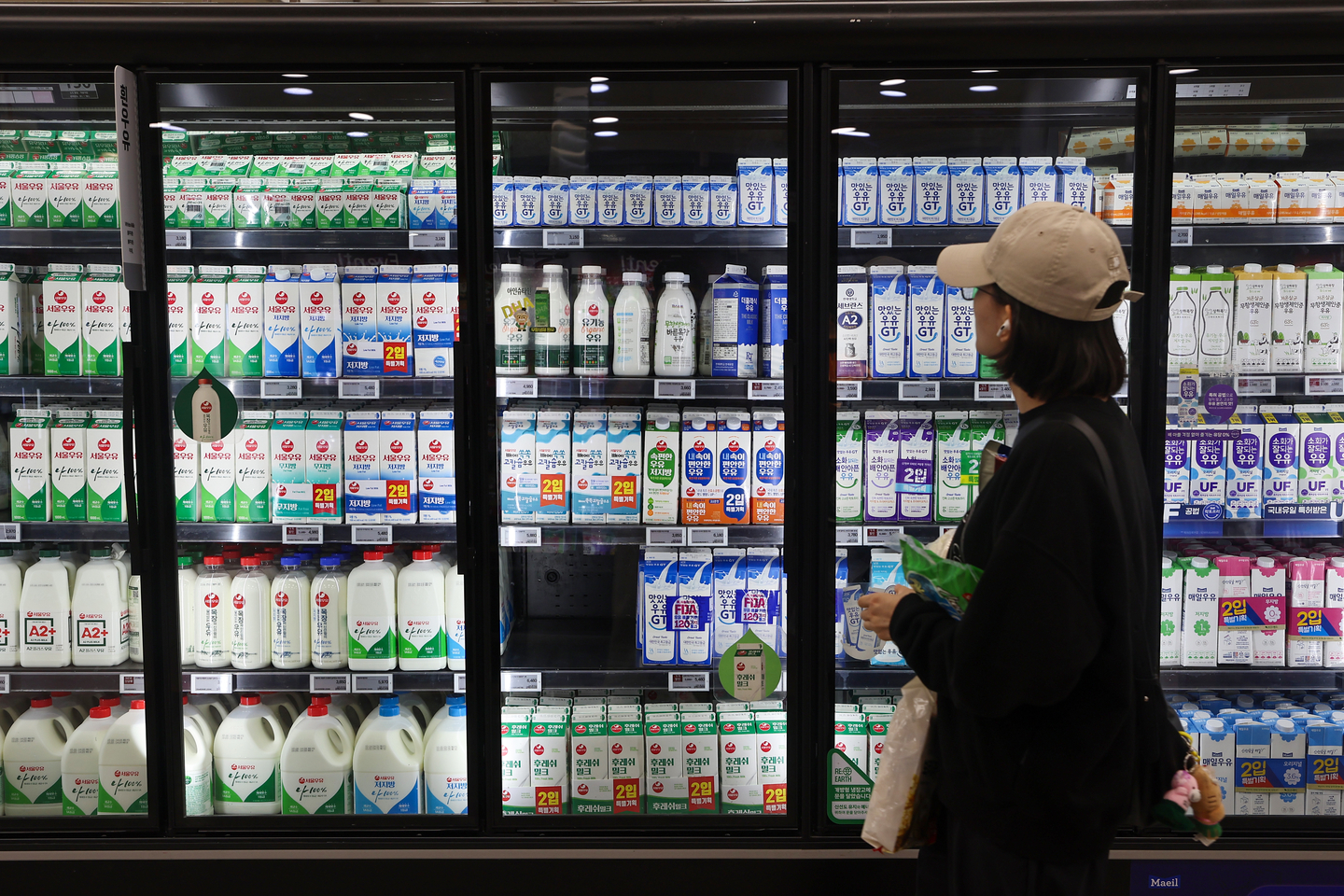
Domestic producers face cheaper foreign competition amid falling milk consumption and rigid pricing rules Milk is displayed at a mart in Seou on March 23. (Yonhap) As tariff-free milk products from the United States and Europe begin to arrive, South Korea's dairy industry is raising concerns that domestic products may not survive competition due to high pricing and excessive local production compared to demand.Koreans consumed 22.9 kilograms of fresh milk per person last year, down 9.5 percent from the previous year and the lowest level recorded in more than four decades, according to data from the Korea Dairy Committee.This trend is thought to reflect broader demographic and lifestyle shifts, including a falling birth rate, the rise of single-person households and growing demand for alternative beverages, the committee explained. Consumers are also increasingly choosing processed dairy products such as cheese, yogurt and ice cream over plain drinking milk.Despite the decrease in demand, prices remain high.According to Global Product Prices, a price comparison platform, South Korea's milk price stood at $3.42 per liter in January, making it the third-most expensive among 78 countries surveyed. Milk prices were lower in the United States at $3.04 per liter, China at $2.06 and Japan at $1.82.The high prices stem partly from Korea's production structure.Unlike major dairy-exporting countries that rely on large-scale farms and pasture-based systems, Korean dairy farms are generally smaller and more dependent on imported feed. Therefore, exchange-rate fluctuations and global grain prices significantly impact production costs.The rigidity of milk pricing is exposing potential issues as tariffs are lifted on imported dairy products. US milk imports became tariff-free earlier this year under a free trade agreement, and tariffs on European milk products are set to be eliminated in July.Imported ultrahigh-temperature milk, particularly from Poland, already sells at roughly half the price of domestic products, making it increasingly attractive to cafes, bakeries and cost-conscious consumers.Korea imported 51,000 metric tons of sterilized milk last year, up more than fortyfold from 1,214 tons in 2016, according to customs data.Industry officials argue that domestic producers are particularly vulnerable because of a quota system introduced in 2002 that requires dairy processors to purchase predetermined volumes of raw milk from farmers at fixed prices.The arrangement was originally designed to stabilize farm incomes, but critics say it no longer reflects changing consumption patterns.Korea currently maintains an annual raw milk quota of approximately 2.05 million tons. Of that amount, only around 1.6 million tons is used for drinking milk. Excess supplies are either processed into products such as milk powder and cheese or discarded, according to the industry.The debate is now centered on negotiations scheduled to begin in June over raw milk quotas and allocation rules. Industry groups are calling for a larger share of milk to be designated for processing use rather than drinking milk and for greater flexibility in determining purchase volumes.
Can Korean milk survive the era of tariff-free imports?
As tariff-free milk products from the United States and Europe begin to arrive, South Korea's dairy industry is raising concerns that domestic products may not
473 words~2 min read