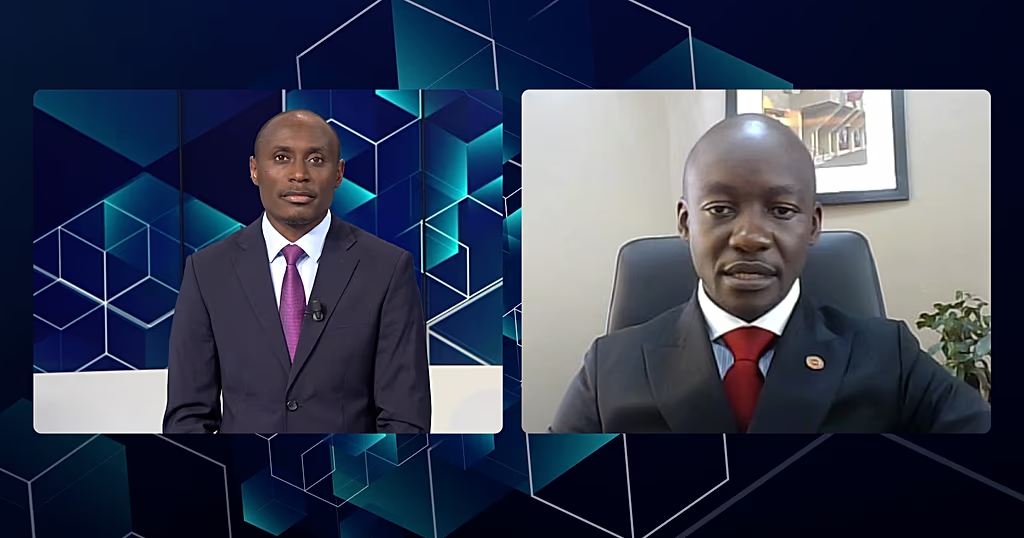
Zimbabwe’s crisis goes far beyond years of economic decline. At its core is collapsing institutional credibility and the steady erosion of public trust.Shifting regional and global pressures are also pushing an already fragile system towards a tipping point.What came through in a recent Gordon Institute of Business Science (Gibs) discussion with Tendai Biti, former finance minister of Zimbabwe; public policy analyst Samkeliso Tshuma; and David Coltart, former education minister and now mayor of Bulawayo, is that slogans and grand promises no longer carry weight. Recovery depends on the state’s ability to rebuild trust, deliver policy certainty, and effective execution. Without that, uncertainty only deepens.Economies do not collapse on their own; institutions fail first. In Zimbabwe, corruption is embedded in procurement, infrastructure delivery and public administration. Inflated tenders and politically connected contracts have weakened state spending and confidence in how the system works.Ordinary citizens are paying the price as hospitals struggle to provide basic medication and more children are pushed out of school by poverty. Meanwhile, displays of elite wealth are hard to ignore, fuelling public anger and eroding trust in institutions meant to serve citizens.These governance failures are now translating directly into rising economic risk. Investor confidence is weakening, with corruption increasingly resembling “state capture on steroids” — a system where a political-business elite depends on proximity to power, particularly ahead of expected constitutional changes designed to extend political influence. Politically connected tender systems reinforce inefficiency and steadily erode long-term competitiveness.In Zimbabwe, corruption is embedded in procurement, infrastructure delivery and public administration. Inflated tenders and politically connected contracts have weakened state spending and confidence in how the system works.Zimbabwe remains resource-rich; however, this wealth is not reaching its people. Strong gold exports, lithium extraction and tobacco revenues have not prevented rising poverty or the deterioration of health care and education. Both investors and citizens now judge countries by how they are governed. Instability within ruling structures, alongside divisions between political and military elites, adds another layer of uncertainty that deters long-term investment and raises perceptions of sovereign risk.Zimbabwe’s migration crisis has become both a symptom and consequence of decades of political exclusion, economic collapse and state failure, forcing millions of citizens to leave in search of survival, dignity and opportunity. The impact has extended far beyond Zimbabwe’s borders, placing growing social and economic pressure on neighbouring countries such as South Africa, where frustrations over unemployment, inequality and poor service delivery have fuelled xenophobic tensions and deepened divisions between many Africans facing similar struggles.Resolving the crisis requires confronting the “political economy of exclusion” that continues to benefit political, military and business elites while marginalising citizens.Zimbabwe is a country gripped by deep reform fatigue, where years of political crisis, institutional erosion and unresolved succession battles have fragmented decision-making, corroded public trust and left the state vulnerable to capture.Constitutional amendments and commissions signal state capacity and persistent delivery failure. Exclusionary political and economic structures remain in place, reinforcing systems that concentrate opportunity among connected elites rather than broadening participation.Survival over reformAcross Africa, democratic institutions are under strain as political leadership prioritises survival over reform. The policy ideas are there, but execution is missing.Currently, significant attention in Zimbabwe is focused on Constitutional Amendment Bill 3, known as CAB3, which is under review and discussion. It proposes extending the president’s term, shifting presidential elections to parliament and centralising more power within the ruling party and the state. For many, public consultation around these proposed changes has been insufficient.State weakness is already feeding through into investment confidence, competitiveness and day-to-day operations. Logistics breakdowns, procurement corruption and failing services mean companies are absorbing the cost of governance failure. Extractive state-business relationships, in turn, undermine credibility and long-term growth.The response by the Zimbabwean business community cannot be passive. Business has a direct stake in pushing for transparency, policy consistency and accountability — not as a matter of principle alone, but because economic viability depends on it. Zimbabwe is a neighbouring country and a strategic trading partner, and its success is vital to the region.Across emerging economies, competitiveness is determined by institutional strength rather than resource endowment. Zimbabwe is a neighbouring country and a strategic trading partner, and its success is vital to the region.These constraints are not unique to Zimbabwe — global shifts are raising the stakes. Democratic erosion is part of a wider turn towards populism, nationalism and authoritarianism across multiple regions. Multilateral support systems, aid structures and even democratic norms are eroding governance. Political challenges in Uganda, Tanzania, Kenya, Malawi and elsewhere place Zimbabwe’s challenges within a broader continental and global reality. In this environment, capital is more cautious and far more governance sensitive. Countries competing for investment must now demonstrate institutional credibility in a more selective global market characterised by industrialisation, energy transition and supply-chain realignment.Reinvention remains possible for Zimbabwe. It has the fundamentals in place — minerals, agriculture, tourism and human capital that, if properly harnessed, could place it among Africa’s wealthiest per capita economies. Its people are resilient, capable and determined, but without credible, accountable governance, those strengths remain underleveraged.Recovery depends on institutions becoming inclusive and responsive again. Countries do emerge from deep crises, but only when trust is rebuilt, capacity is strengthened and execution finally replaces rhetoric.The discussion left more questions than answers. Can political systems in the region genuinely reform themselves, or are they locked into cycles of constitutional manipulation, factional contestation, elite capture and declining democratic trust?Many young people feel excluded from opportunity and are turning to political alignment as a means of survival. Rural youth, if properly engaged and given real economic stake, could become a powerful force for change.It remains to be seen whether Zimbabwe can unwind its perception and realities of its patronage structure to rebuild a state that is credible, capable and inclusive enough to attract investment again. For the region, those that restore trust and execution capacity will remain competitive, while those that do not risk stagnation, capital flight and long-term fragmentation.• Binedell, a professor of strategy and geopolitics, is the founding director of the Gordon Institute of Business Science (Gibs)
NICK BINEDELL | Can Zimbabwe find its way back from the economic abyss?
Recovery is possible, but depends on the state’s ability to rebuild trust, deliver policy certainty, and replace rhetoric with execution
1,006 words~5 min read