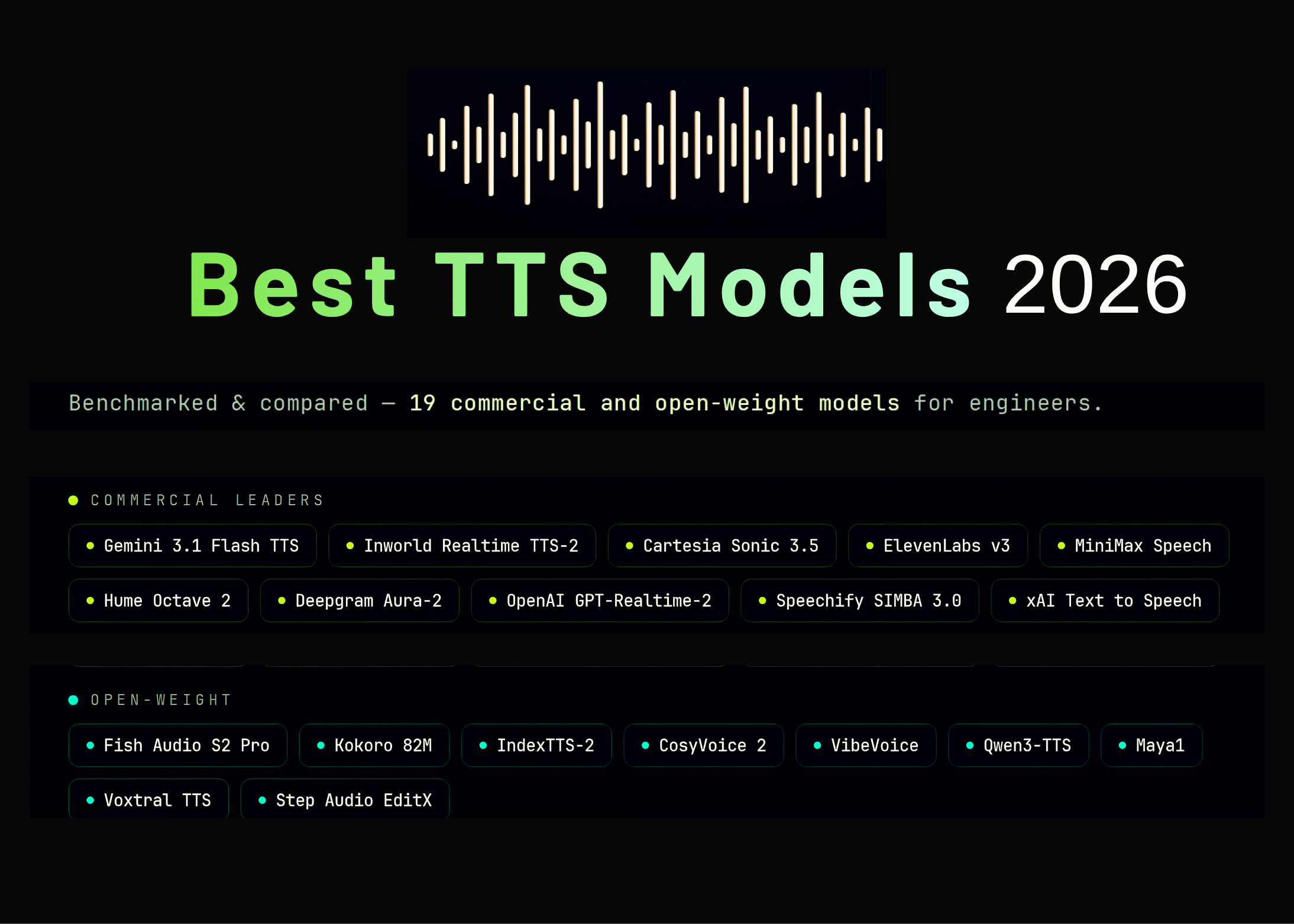
Text-to-speech TTS moved fast over the past year. The line between synthetic and human speech narrowed. Latency dropped below 100 milliseconds for some real-time systems. Emotional control became a standard feature rather than a research demo. This guide reviews the models that really matter in 2026. It is written for AI professionals choosing a model for production.
How to read TTS benchmarks in 2026
Two benchmarks dominate in most community discussions. The first is the Artificial Analysis Speech Arena Leaderboard. It ranks models by blind human preference using an ELO rating. As of 2026 it evaluates dozens of production APIs. The second is the community-run TTS Arena on Hugging Face. It uses the same blind A/B voting method.
These leaderboards measure perceived quality, not accuracy. They also change continuously. As of May 30, 2026, the Artificial Analysis Speech Arena lists Gemini 3.1 Flash TTS, Realtime TTS-2 (Research Preview), Sonic 3.5, Realtime TTS 1.5 Max, and Fun-Realtime-TTS-Preview as its top five by ELO. Those positions shifted within the prior weeks, and they will shift again. Treat any single number as a point-in-time reading, not a fixed truth.
Accuracy needs separate measurement. Trelis Research tested ten models using a round-trip character error rate, or CER. The method transcribes generated audio with an ASR model, then compares it to the input text. Mean opinion score, or MOS, captures perceived naturalness. Both metrics have limits. Round-trip CER depends on the ASR model’s own accuracy. The UTMOS quality estimator was trained on audio up to ten seconds, so longer samples show less score spread.