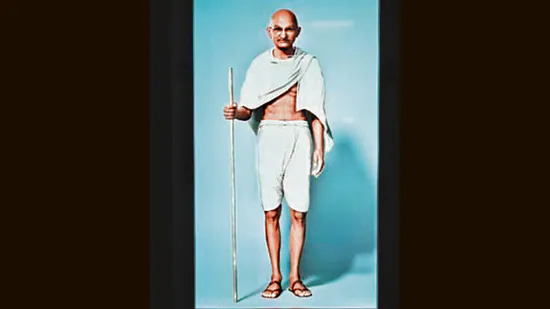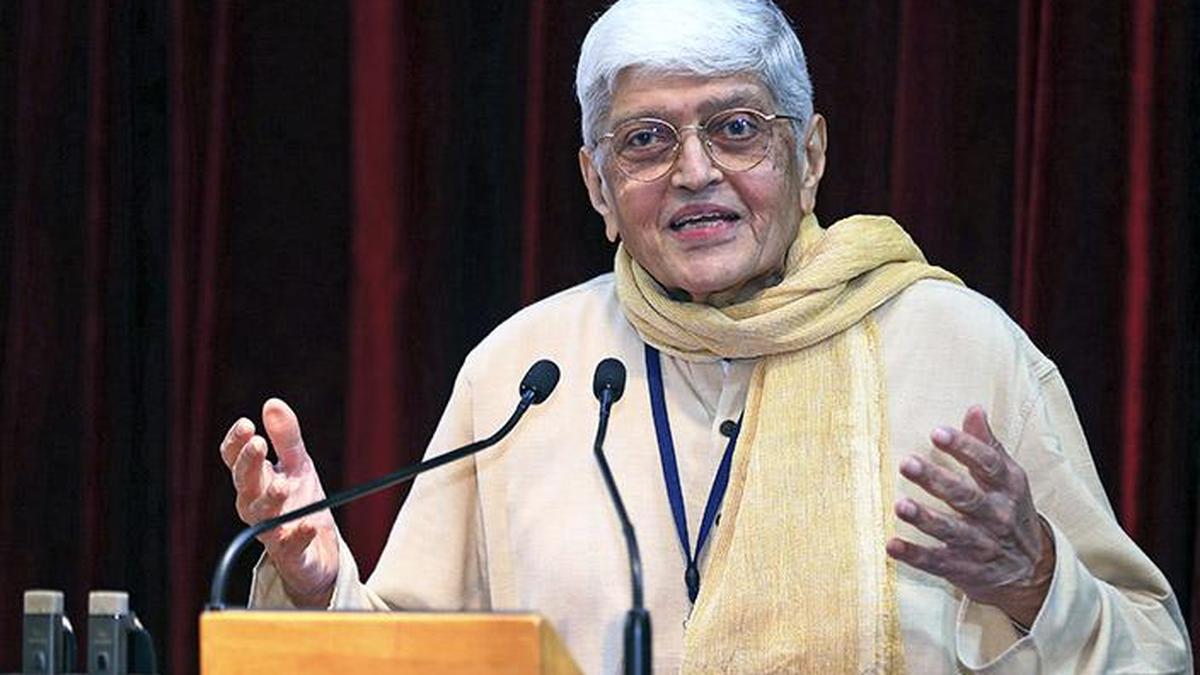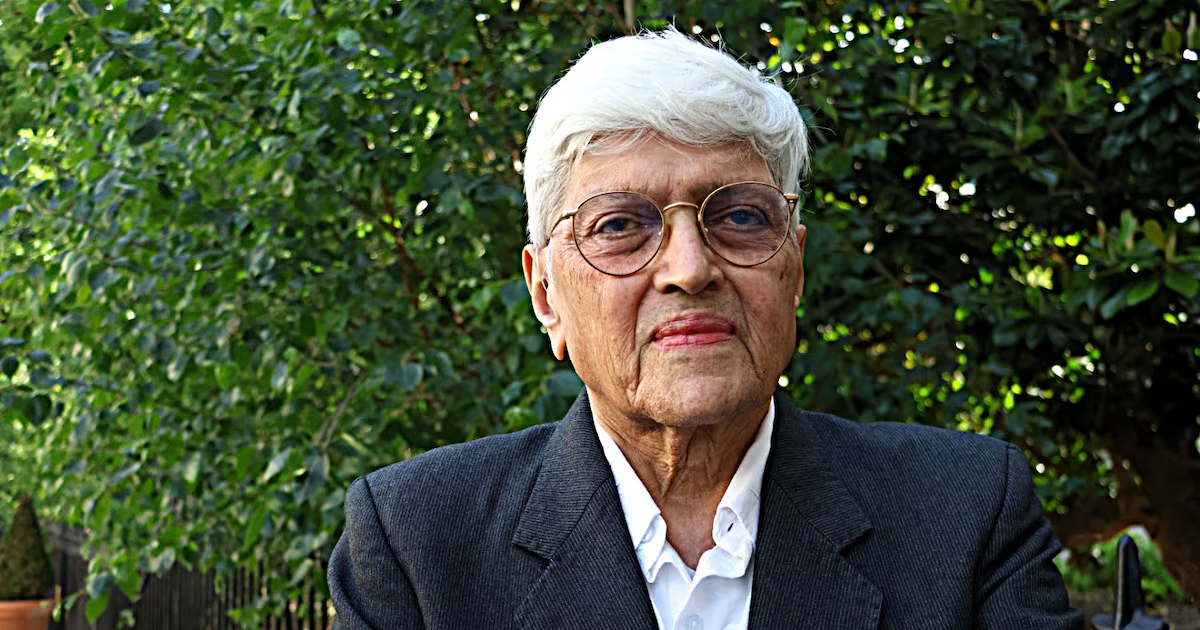
Gopalkrishna Gandhi is known as a writer, academic, diplomat and politician. But he is best known as the grandson of Mahatma Gandhi, India’s founding father.In his 81 years, he had never been to Ireland before. But through his interest in literature and history, he knows more about Ireland’s story than many Irish people do. “To tell you the truth, I feel very moved to be here,” he told an event held as part of the Jaipur Literary Festival in Trinity College Dublin. “Ireland is supposed to be a so-called small country, but it means a lot to us in India with our own freedom struggle, the Irish Home Rule movement and all the great names like James Joyce, Yeats, Shaw.“To be in the country where they were born is a deeply moving experience for me as it is for many Indians.”Gopalkrishna Gandhi, seated right at table, addresses the audience at the Jaipur International Festival in Trinity College Gopalkrishna has had a long and varied career, having been a governor of West Bengal province, the Indian ambassador to South Africa, where his grandfather started his activism, a senior civil servant in the Indian Administrative Service and a prolific writer of fiction, non-fiction books and plays. He now teaches history at Ashoka University in India and specialises in the country’s freedom movement and in particular the actions of his grandfather and Jawaharlal Nehru, who was India’s first prime minister.“The Indian constitution has borrowed from many examples including and most especially the Irish example. Éamon de Valera was consulted very widely by the constitutional adviser BN Rau and De Valera’s advice is palpable even today,” Gopalkrishna said. “De Valera advised that India is a constantly developing society and it should remember that certain basic features which are immutable such as fundamental rights. India is moving fast into the modern age and should have the resilience to meet such a situation.“The freedom struggle was not just for the freedom of India, it was also a struggle for the removal of many discriminations in Indian society.“They were striving for an egalitarian society where the divisions were removed and a more humane order would come into being.”Gopalkrishna Gandhi, right, in conversation with academic Roy Foster at Trinity College Gopalkrishna was in Ireland to appear at the Jaipur Literary Festival, which is the largest literary festival in the world and is touring Ireland for the first time. He held a capacity audience spellbound in Trinity College Dublin’s Examination Hall by reciting, off the top of the head, two WB Yeats poems, An Irish Airman Foresees His Death and The Second Coming. These poems were not “relevant” to the modern world, he told the audience, they were “vital”. He was aged two-and-a-half when his grandfather was assassinated by a Hindu nationalist on January 30th, 1948, just six months after Gandhi achieved his life’s goal of an independent India, albeit one that was partitioned against his will. “From what I have heard from those who witnessed and experienced it, it was a most grievous assault on India’s humanity and the human feelings of ordinary people,” Gopalkrishna said about partition, which split the country into India and Pakistan and led to widespread displacement of people and violence.“Gandhi saw himself as an ordinary man who felt compelled to do things for those who had been brutalised by the partition of India, who had lost hope in life actually. He had said he wanted to die with them. “The freedom of India with India being broken up was not what he had worked for. What Gandhi wanted to do was to prevent the debasement of the human spirit and the mutilation of human lives that came with partition. He didn’t want to see it broken up with hatred and suspicion.“He would like the people of the Indian subcontinent and further afield to Afghanistan and Palestine to recognise that they are inheritors of several faith traditions and ethnicities and they have a common destiny because they are a big chunk of the Earth where the destinies of the people are inextricably linked.” Traditional Indian dancers at the launch of the launch of the Jaipur Literary Festival at Trinity College The festival, having already been in Belfast, Armagh and Dundalk, is concluding this weekend in Dublin. The event in the capital was opened by the Minister for Public Expenditure Jack Chambers, who referenced the colonial links between the two countries.“There are so many aspects of that I could talk to, but for the weekend that is in it, let me just mention: the common experience of empire and partition,” he said. “There is also the visceral experience that so many Irish and Indian people have had of displacement and emigration over the centuries; of leaving our homes behind and going out into the wider world.”Gopalkrishna was in conversation with the academic and historian Roy Foster about the respective literary careers of Yeats and the Indian writer Rabindranath Tagore, both Nobel Prize winners for literature who had created their art under British rule. Gopalkrishna was also to speak on Saturday afternoon with the publisher Manasi Subramaniam about his book The Undying Light, which charts India’s rise as a country in his lifetime.
‘Ireland means a lot to us in India with our own freedom struggle,’ Gandhi’s grandson says
Academic and writer Gopalkrishna Gandhi is participating in Jaipur Literary Festival in Dublin
867 words~4 min read