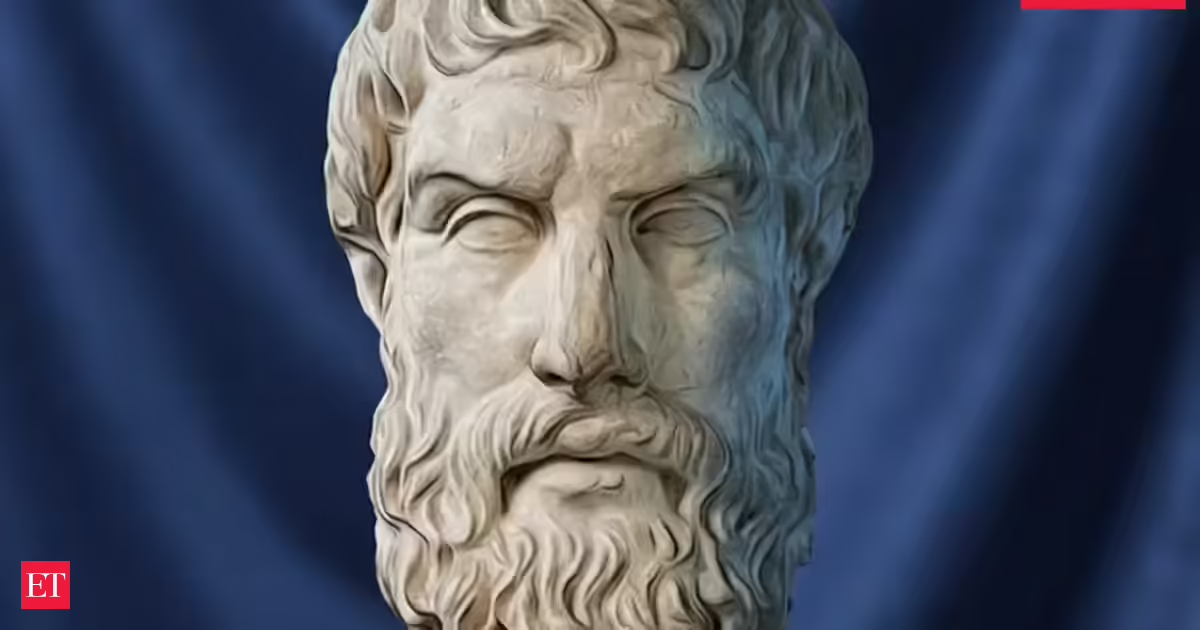
Ancient philosophy often challenges the way modern society thinks about relationships, happiness and personal choices. Long before contemporary debates on marriage and lifestyle, Greek philosophers were already questioning whether lifelong commitments truly lead to peace or simply add complexity to human life. One of the most discussed ideas attributed to Epicurus touches on marriage and whether it supports or disturbs a life of calm, self-sufficiency and inner balance. His views continue to spark debate even today, especially when interpreted through the lens of happiness and simplicity.One of the most commonly attributed and debated teachings linked to Epicurus suggests that marriage is often seen as offering little benefit and that, at best, it should be considered harmless. The idea further states that a wise person may choose not to marry. This interpretation appears in Diogenes Laertius’ work The Lives and Opinions of Eminent Philosophers, Book X, where the translation by C.D. Yonge, published in 1853, presents this view as part of Epicurus’ philosophical discussions.Various interpretations of the quoteThe meaning behind this interpretation is often linked to Epicurus’ broader philosophy of reducing unnecessary desires and avoiding disturbances that could disrupt peace of mind. From this perspective, marriage is not dismissed as inherently negative, but rather examined through the question of whether it contributes to tranquillity or creates emotional, financial and social obligations that might disturb a simple and content life.As per a discussion on the blog newepicurean.com, another translation from the Loeb Classical Library edition by R.D. Hicks, published in 1931, presents a slightly different reading. It notes that Epicurus is said to have suggested that the wise person may avoid marriage and raising children, referencing his writings in Problems and De Natura. However, it also acknowledges that marriage could occur under special circumstances depending on individual life situations.You Might Also Like:This variation in interpretation highlights how ancient philosophical texts are often open to different readings depending on translation and context. While one version presents a more restrictive view of marriage, another allows for flexibility based on personal circumstances, suggesting that Epicurus did not necessarily enforce a universal rule.Modern scholars' interpretationModern scholars also present a contrasting interpretation. According to some contemporary academic perspectives, Epicurus may not have strictly opposed marriage. Instead, they suggest that he believed a wise person could choose to marry and have children if life circumstances made it suitable. This interpretation places emphasis on practicality rather than absolute avoidance, framing Epicurean philosophy as adaptable rather than rigid.About Epicurus and his teachingsUnderstanding these differing views requires a closer look at Epicurus’ broader teachings. Epicurus, who lived between 341 and 270 BC, founded the philosophical school of Epicureanism. His philosophy focused on achieving a peaceful life through the careful management of desires, the removal of unnecessary fears, strong friendships and simple living. For Epicurus, the highest form of happiness was not luxury or status, but a calm and undisturbed state of mind.He encouraged people to live self-sufficient lives surrounded by close friends and to avoid excessive dependence on external validation or material excess. His teachings also included naturalistic explanations of the universe, suggesting that all events arise from atoms moving in empty space. He even introduced the concept of atomic deviation to explain free will within a deterministic system.You Might Also Like:Epicurus is also known for his belief that while gods may exist, they do not interfere in human life. This idea helped shape his argument that fear of divine punishment should not influence human decisions, including those related to relationships and personal choices such as marriage.Much of what is known about Epicurus comes from later sources because most of his original writings have been lost. Only fragments, letters and collections such as Principal Doctrines survive today. Much of his philosophy has been preserved through writers like Lucretius and Diogenes of Oenoanda, who helped pass on his ideas across generations.Over time, Epicurus’ reputation shifted significantly. During the Roman Republic, his ideas were widely discussed and appreciated, but in later centuries, especially during the Middle Ages, he was misinterpreted and often unfairly associated with indulgence and excess. It was only during the Renaissance and Enlightenment periods that his philosophy was revisited more accurately and gained renewed intellectual respect.In that sense, the debate around his teaching is less about marriage itself and more about how individuals define a meaningful and peaceful life for themselves.
Quote of the day by Epicurus: ‘Marriage, they say, is never any good to a man, and we must be quite content if it does no harm; and the wise man will never marry’; what the Greek philosopher’s teachings say about marriage and love
Ancient Greek philosopher Epicurus' views on marriage are debated, with some interpretations suggesting he saw it as offering little benefit and that wise individuals might avoid it. However, other readings and modern scholarship indicate a more flexible approach, where marriage could be suitable depending on individual circumstances and the pursuit of a tranquil life.
721 words~3 min read