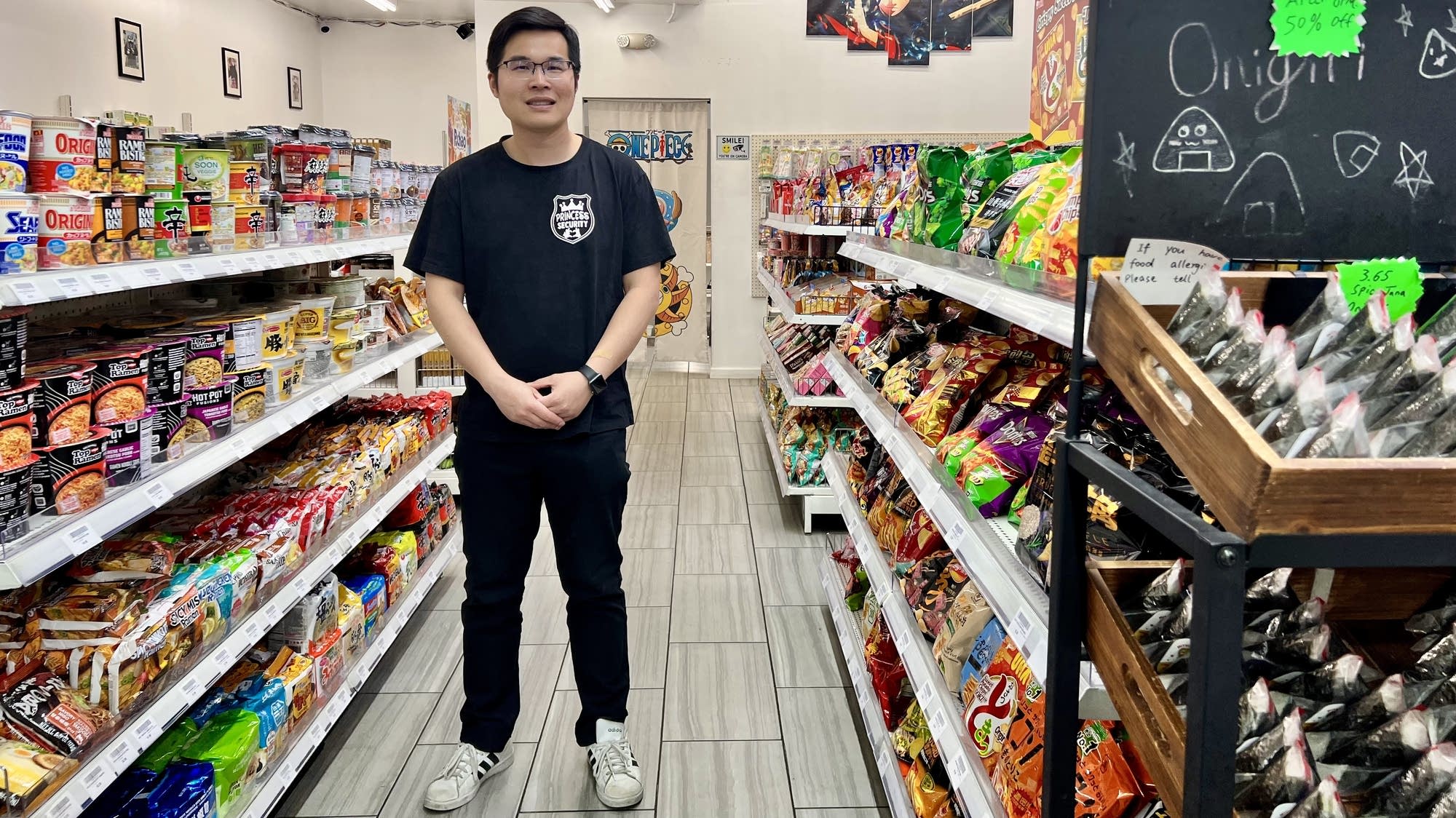
Mitsuki Japanese Market sits on a busy commercial strip in Brooklyn, with a shiny Hello Kitty statue greeting customers at the door. It’s a small shop, just a few aisles wide, stocked with colorful crinkly packages of seaweed flavored chips and matcha Kit Kats.“Just so you know, I only have five minutes,” said Austin Johnson, a customer who is hunched over a high top near the front of the store. “I’m stuffing my face with an onigiri before work.”Onigiri, a rice ball often filled with meat or fish, is a Japanese convenience store staple. The one Johnson’s eating has eel and a savory soy sauce, priced at $3.99.“It’s a staple,” he said. “It’s very cheap and it’s filling and I have a long shift ahead of me so it’s good energy.”From 7-Eleven to Wawa to Royal Farms, convenience stores have regional, devoted followings. And they’re capturing a growing share of retail. According to the National Association of Convenience Stores, convenience stores account for more than a third of in-person retail stores in the U.S.“I love convenience stores,” said Johnson. “Me and my partner are kind of like aficionados when it comes to trying weird snacks and stuff or a new Reese’s flavor or a new soda that’s strange or something.”Most of Mitsuki Japanese Market's sales come from prepare foods.Kristin Schwab/MarketplaceIncreasingly, convenience stores are becoming destinations instead of pitstops on the way to somewhere else. At Casey’s, a Midwest chain with nearly 3,000 stores, the majority of customers don’t even buy gas.“Two-thirds of our profitability comes from inside of the store,” said Chief Merchandising Officer Tom Brennan. “That allows us to actually be very competitive when it comes to how we price retail fuel.”Most convenience stores only make a few cents a gallon on gas — sometimes even less when prices are high.“Which again is why we’re so focused on other areas of the business and that inside the store offer and that food offer because we know there’s much more stability inside of that,” said Brennan. Casey’s is the fifth-largest pizza chain in the country. What even qualifies as a convenience store these days? The definition depends on where you are and who you ask.“Are these grocery stores that have gas or are they gas stations that have food?” said Constance Bailey, co-editor of “Get It While It’s Hot: Gas Station, Roadside, and Convenience Cuisine in the U.S. South.” “In some parts of the South, you know, people think of these more as restaurants,” said Bailey. Convenience stores have become community gathering spots, especially in rural towns. For the book, Bailey’s team surveyed southerners about where they’re most likely to eat a hot meal.“Behind churches, like an actual church meal or a church function, gas station was the second most popular answer,” she said. Convenience stores are also hubs for international cuisine. Nearly half of are owned by immigrants, according to the nonprofit Immigration Research Initiative. There’s a lot of variety: Indian curry, Mexican street tacos and southern staples like fried chicken. “I definitely got to gratuitously engage in a lot of fried food, right?” laughed Bailey. And it’s not just about the food. Convenience stores have become so ironically cool that early aughts band The All-American Rejects recently performed a popup concert at a Sheetz store in Pittsburgh. The internet has even coined the aesthetic “gas station-core,” fashion featuring trucker hats and visor-like sunglasses in chrome colors.A hot item at Mitsuki Japanese Market is blind boxes, each with a mystery toy that’s revealed after opening the box.“When we first opened the store [people] said, ‘What’s that store?’” said Cao. “They’re looking for new products. People love to do that because life needs something new.”
Convenience stores have moved beyond convenience — they're considered cool
Gas stations are now destinations for food and merchandise.
TL;DRAI
Convenience stores now account for over a third of U.S. in-person retail stores; Casey's, the fifth-largest pizza chain in the country, generates two-thirds of its profitability from inside sales — not fuel. The structural shift from pit stop to destination reframes physical retail economics: experience and food service drive margin more than commodity throughput, a signal for any B2B supplier or retailer rethinking channel investment.
615 words~3 min read