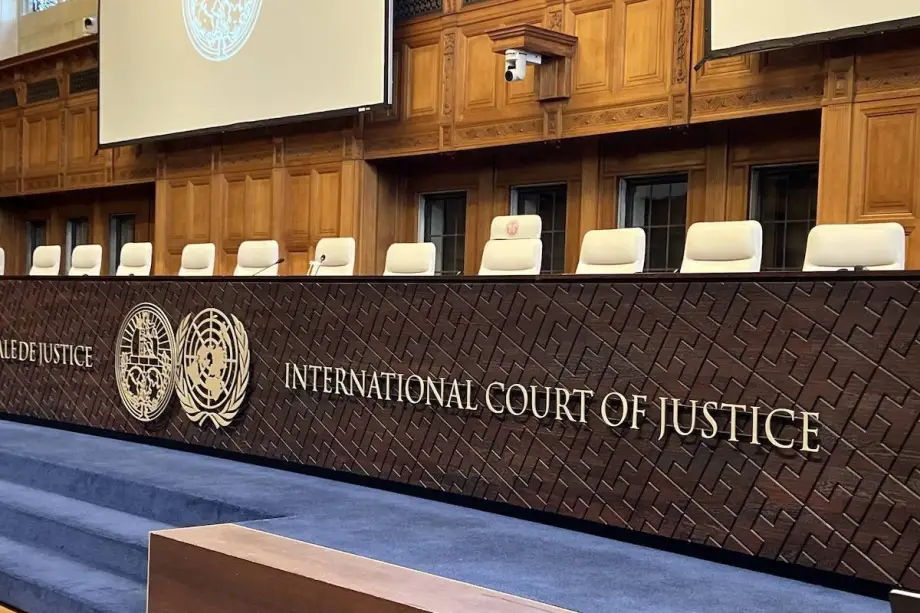
Voltaire’s famous quip about the Holy Roman Empire — that it was neither holy, nor Roman, nor an empire — has often come to mind when I think about the contemporary state of public international law. For all its lofty aspirations, it is frequently neither truly public, nor reliably international, nor consistently law. It is public only in the sense that it concerns states rather than private actors; international only insofar as sovereigns consent to be bound; and law only to the extent that it can be enforced — an increasingly fragile proposition in a world where power, not principle, is again determining outcomes.The erosion of an edifice of normsOver the last century and a half, humanity painstakingly constructed an edifice of norms, treaties and institutions meant to restrain the worst impulses of states. From the Hague Conventions to the Geneva Conventions, from the UN Convention on the Law of the Sea (UNCLOS), from human rights covenants to arms-control regimes, the international community sought to replace the anarchy of the past with a rules-based order. Yet, in recent years, that order has been fraying at an alarming pace. Across continents and conflicts, states have violated foundational principles with impunity, eroding the credibility of the very system meant to protect global peace and stability.The most fundamental of these principles is the UN Charter’s prohibition on the use of force and its guarantee of the sovereignty and territorial integrity of states. Russia’s invasion of Ukraine in 2022 and the the U.S.-Israeli war on Iran in 2026 stand as the starkest breaches of this norm in decades: an unprovoked assault on a sovereign state, justified through dubious claims and enforced through overwhelming military might. Both invasions confirmed that the Charter’s core promise could be shredded when a powerful state chose to do so.The U.S. and Russian records are equally deplorable in disregarding the prohibition on force. The 2003 Iraq invasion, undertaken without Security Council authorisation and justified on grounds later proven baseless, remains one of the most consequential breaches of the Charter that set a precedent for Russia’s conduct. More recently, the targeted killing of Iranian Supreme Leader Ali Khamenei and the U.S.-Israeli strikes on Iran have raised serious questions about the erosion of the norm against unilateral force. Israel’s repeated military operations in Gaza and Lebanon, including large-scale bombardments causing extensive civilian casualties, have also drawn widespread allegations of disproportionate force and violations of international humanitarian law.The pattern is not confined to major powers. Türkiye’s incursions into northern Syria, Azerbaijan’s use of force in Nagorno-Karabakh, and Ethiopia’s conduct in the Tigray conflict, including cross-border strikes into Sudan, have all arguably breached international norms.Beyond the use of force, states have violated UNCLOS, one of the most widely ratified treaties in the world. The South China Sea has become a theatre of systematic disregard for maritime law. China’s expansive “nine-dash line” claim, rejected by the Permanent Court of Arbitration in 2016, continues to be enforced through militarised artificial islands, harassment of foreign vessels, and coercive coast-guard tactics. The Philippines, Vietnam, Malaysia, and Indonesia have all faced incursions into their exclusive economic zones.The Strait of Hormuz has witnessed repeated blockades and interdictions. Iran and the U.S. have seized foreign tankers, closed the Strait, and imposed maritime blockades in the region, without clear legal justification under UNCLOS. These actions undermine the principle of freedom of navigation, a cornerstone of global trade and maritime stability.Brazen actions across the worldInternational humanitarian law has also suffered grievous violations. In Syria, the Assad regime’s use of chemical weapons, indiscriminate bombing of civilian areas, and siege tactics have been extensively documented. Non-state actors such as the Islamic State (ISIS) and various militias have committed atrocities on a massive scale. In Yemen, the Saudi-led coalition and Houthi rebels alike have been accused of targeting civilians, hospitals, and critical infrastructure. In Ethiopia’s Tigray region, reports of mass killings, sexual violence, and starvation as a weapon of war have shocked the conscience of the world.Human rights treaties, too, have been flouted with increasing brazenness. Israel’s indiscriminate killing of civilians in Gaza and China’s treatment of Uyghurs in Xinjiang — including mass detention, forced labour, and cultural erasure — have been described by several governments and scholars as crimes against humanity. Myanmar’s military junta has carried out systematic abuses against the Rohingya and other ethnic minorities, prompting genocide allegations. In Iran, the violent suppression of protests following the death of Mahsa Amini revealed a pattern of extrajudicial killings and torture. Even democratic states have not been immune: the U.S.’s use of torture during the “war on terror”, Australia’s offshore detention of asylum seekers, and Europe’s pushbacks of migrants in the Mediterranean have all raised serious legal and moral concerns.Arms-control regimes have also weakened. The collapse of the Intermediate-Range Nuclear Forces (INF) Treaty, the erosion of the Open Skies Treaty, and the uncertain future of the New START agreement have revived fears of a new arms race. North Korea continues to defy UN resolutions with missile tests and nuclear development.Iran’s nuclear programme, once constrained by the Joint Comprehensive Plan of Action (JCPOA), has allegedly accelerated following the agreement’s unravelling. These developments threaten to undo decades of painstaking progress in nuclear restraint.Environmental law, too, has suffered. States have failed to meet their commitments under the Paris Agreement, with emissions rising and climate targets slipping out of reach. Illegal deforestation in the Amazon, often abetted by state actors, violates international norms on biodiversity and environmental protection. Deep-sea mining, pursued without adequate regulation, threatens fragile marine ecosystems.There is a vacuumWhat ties these disparate violations together is not merely their frequency but their impunity. International law depends on consent, reciprocity, and enforcement through collective mechanisms. Yet, the Security Council is paralysed by geopolitical rivalries; the International Criminal Court faces accusations of bias and lacks jurisdiction over major powers; and treaty bodies often rely on voluntary compliance. In this vacuum, states increasingly act as though power, not principle, determines legality. Thucydides’ bleak observation — “the strong do what they can, and the weak suffer what they must” — resonates today with unsettling clarity. When powerful states violate international law without consequence, they signal to others that norms are optional and that might is right. The result is a world sliding back toward the law of the jungle.This is not merely a philosophical concern. The erosion of international law has tangible consequences: conflicts become harder to resolve, civilians bear the brunt of violence, global commons are degraded, and trust between nations evaporates. The rules-based order, imperfect as it is, remains humanity’s best defence against chaos.The challenge in reaffirming the value of international law is that it requires strengthening multilateral institutions, enhancing accountability mechanisms, and cultivating a global political culture that prizes restraint over adventurism. It also requires recognising that international law is not a panacea but a framework — a set of shared expectations that guide behaviour even when perfect compliance is elusive. Without it, the world risks returning to a state where power alone determines outcomes. And in such a world, it is not only the weak who suffer; ultimately, everyone does.Shashi Tharoor is the fourth-term Member of Parliament (Lok Sabha) for Thiruvananthapuram (Congress party), the Chairman of the Parliamentary Standing Committee on External Affairs and the Sahitya Akademi Award-winning author of 29 books, including Pax Indica (2012) and The New World Disorder (2020)
International law, ‘optional’ for powerful states
Across continents and conflicts, states have violated foundational principles with impunity, eroding the credibility of the very system meant to protect global peace and stability
1,223 words~6 min read