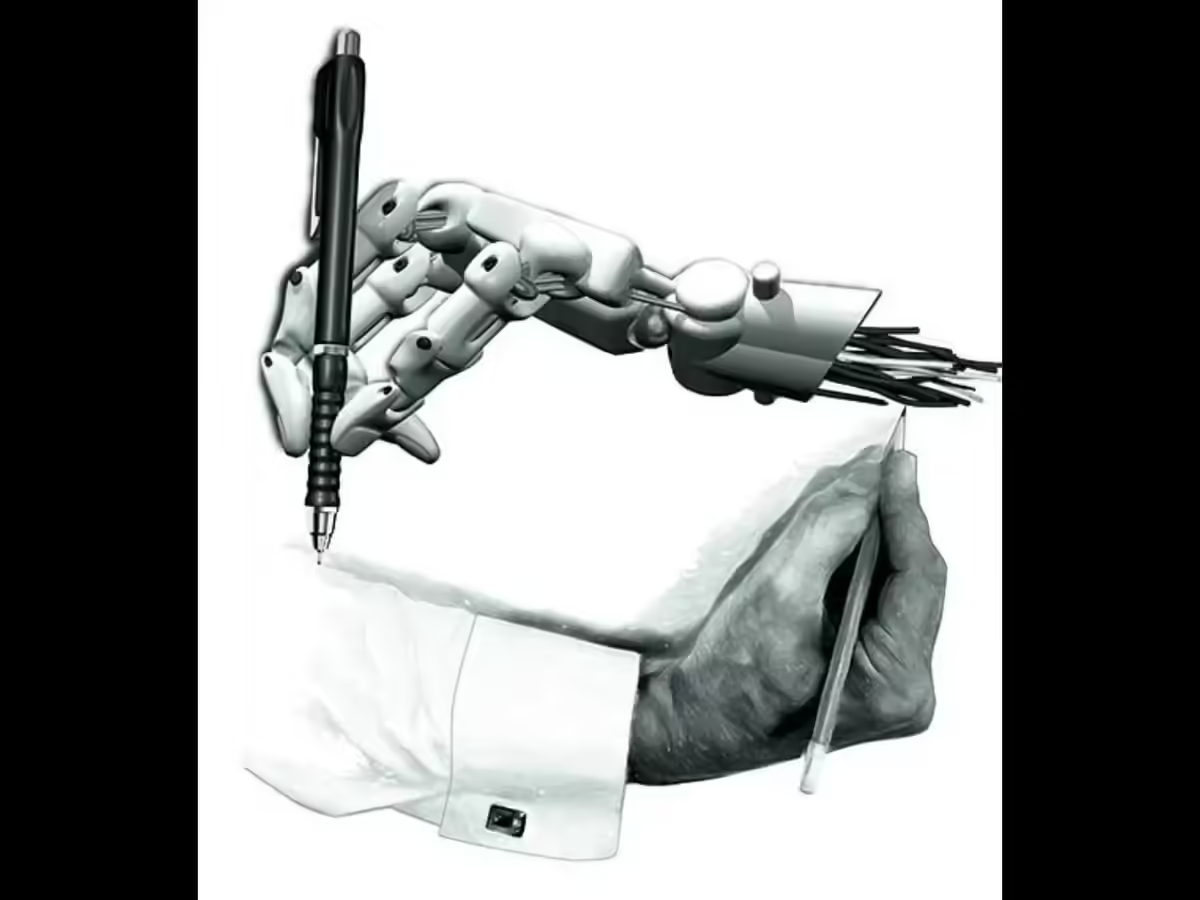
The recent consternation over whether a Commonwealth Short Story Prize winner was written by AI is understandable. It's also beside the point.Assume that AI has been used in producing a book to the maximum extent possible. Then, as a jury member, ask the harder question: what exactly are we judging? Is it originality of idea? Creativity of structure? Power of language? Overall impact on the reader? These are questions that literary award organisations have always needed to answer. AI's advent simply forces them to answer them sharply and honestly.The idea of solitary authorship has always been a romantic one - but a complete myth. Consider the relationship between a writer and an editor. A great editor does not just correct grammar, but also challenges structure, questions characters in the story or narrative, pushes back on endings, and occasionally suggests entirely new directions. Maxwell Perkins shaped Ernest Hemingway and Scott Fitzgerald into the writers we now remember. Nobody questioned whether The Old Man and the Sea was 'truly' Hemingway's when he won the Pulitzer and Nobel for the novella in 1953 and 1954, respectively.And editors are only part of the story. Beta readers - people who read early manuscripts and provide detailed feedback - routinely shape what a book becomes.Then there's ghostwriting, which is more prevalent than the literary world likes to admit. Harry's 2023 memoir, Spare, and Andre Agassi's 2009 Open were both written by the same ghostwriter, J R Moehringer. Few people remember his name. Fewer still argued that either book was 'inauthentic'.Some will argue that even if we accept AI's role in the writing, surely, the originating idea must be the author's own. But this is a false premise. An idea at inception is rarely the idea that ends up in the book. It gets tested, complicated, deepened and sometimes entirely inverted through the act of writing itself. The 'final idea' - core vision of the finished work - is the product of exactly the same iterative, back-and-forth process as the prose. It does not arrive neatly and completely formed, and then get dressed in words. It emerges.Whether that emergence happens through a notebook, feedback from others or sustained engagement with AI, the process is secondary. The result is what we judge.Working with AI is not categorically different from any of this. A serious writer does not blindly accept whatever the tool generates. He or she wrestles with it, rejects, refines and reshapes. The author recognises what is 'alive' in the output and what is fluff. Writers working with AI reorder, rewrite, and toss versions back and forth. That sustained conversation with a demanding interlocutor is where authorship has always thrived.If anything, working with AI raises the bar rather than lowers it. A great editor brings independent judgement and can push back or refuse. AI, with its strong bias towards pleasing us, obliges. The burden of taste, discrimination and vision, therefore, falls more heavily on the author, not less. A weak sensibility working with AI will produce a weak work. A strong one will produce something that reflects that strength - perhaps more efficiently but no less authentically.And, importantly, AI grants everyday writers resources previously available only to those with access to top editorial talent.The award jury, in any case, has the final word. They read what is on the page. They do not read the process. If the work moves them, it moves them. AI-generated mediocrity will still read as mediocrity, and won't make the cut.The AI tool is available to everyone. Authors who use it with intelligence, taste and rigour will produce better work than those who do not. That has always been true of every tool available to writers - spellcheck, thesaurus, beta readers, structural editors, copy editors.... What AI is doing is a combination of all of these, at once and on demand.The right response is not to police the tool - a battle that cannot be won - but to trust the judgement we already have. Simply ask what we have always really been asking: does this book matter?(Disclaimer: The opinions expressed in this column are that of the writer. The facts and opinions expressed here do not reflect the views of www.economictimes.com.)
AI in literature debate: Does the book still matter? - The Economic Times
The debate over AI-written stories is missing the point. Literary awards must now focus on what truly matters in a book. The final work's impact on the reader is the key. AI is just another tool, like editors or beta readers. Authors who use it intelligently will produce better work.
700 words~3 min read