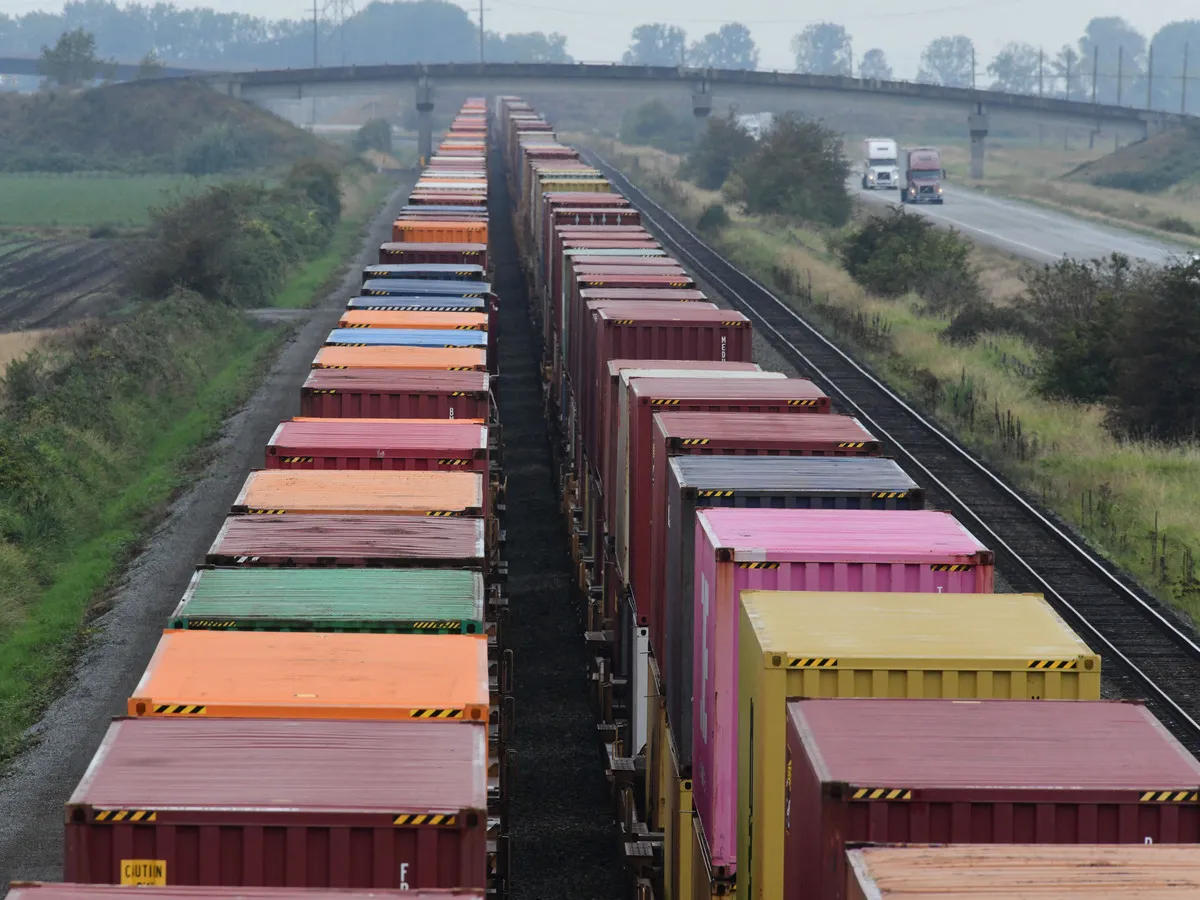
Skip to Content News Archives Economy Energy Oil & Gas Renewables Electric Vehicles Mining Commodities Agriculture Real Estate Mortgages Mortgage Rates Finance Banking Insurance Fintech Cryptocurrency Work Wealth Smart Money Wealth Management Investor Personal Finance Family Finance Retirement Taxes High Net Worth FP Comment Executive Women Puzzmo Newsletters Financial Times Business Essentials More Innovation Information Technology FP500 Podcasts Small Business Lives Told Tails Told Shopping Financial Post Store Obituaries Place a Notice Advertising Advertising With Us Advertising Solutions Postmedia Ad Manager Sponsorship Requests Classifieds Place a Classifieds ad Working Profile Settings My Subscriptions Saved Articles My Offers Newsletters Customer Service FAQ News Economy Energy Mining Real Estate Finance Work Wealth Investor FP Comment Executive Women Puzzmo Newsletters Financial Times Business Essentials HomeFP CommentTransportationOpinion: Capacity, not market power, is grain transport’s big problemLimits on what rail companies can earn from hauling grain may protect shippers but discourage long-term investment in carrying capacityLast updated 4 hours ago You can save this article by registering for free here. Or sign-in if you have an account.Railcars with containers sit idle near the Roberts bank Super Port after a strike by railway workers on August 23, 2024, in Delta, B.C. Photo by DON MACKINNON/AFP via Getty ImagesOne of Canada’s Big Two railways has again exceeded Ottawa’s grain revenue cap, reigniting a dispute that has persisted for decades but is becoming harder to dismiss as routine regulatory friction.Subscribe now to read the latest news in your city and across Canada.Exclusive articles from Barbara Shecter, Joe O'Connor, Gabriel Friedman, and others.Daily content from Financial Times, the world's leading global business publication.Unlimited online access to read articles from Financial Post, National Post and 15 news sites across Canada with one account.National Post ePaper, an electronic replica of the print edition to view on any device, share and comment on.Daily puzzles, including the New York Times Crossword.Subscribe now to read the latest news in your city and across Canada.Exclusive articles from Barbara Shecter, Joe O'Connor, Gabriel Friedman and others.Daily content from Financial Times, the world's leading global business publication.Unlimited online access to read articles from Financial Post, National Post and 15 news sites across Canada with one account.National Post ePaper, an electronic replica of the print edition to view on any device, share and comment on.Daily puzzles, including the New York Times Crossword.Create an account or sign in to continue with your reading experience.Access articles from across Canada with one account.Share your thoughts and join the conversation in the comments.Enjoy additional articles per month.Get email updates from your favourite authors.Create an account or sign in to continue with your reading experience.Access articles from across Canada with one accountShare your thoughts and join the conversation in the commentsEnjoy additional articles per monthGet email updates from your favourite authorsSign In or Create an AccountorThe Canadian Transportation Agency has ruled that Canadian Pacific Kansas City exceeded its “maximum revenue entitlement” (MRE) for the most recent crop year. Introduced in 2000, the MRE limits how much Canada’s two major railways — CPKC and Canadian National Railway — can earn from shipping grain. Excesses trigger a financial penalty. CPKC’s penalty this crop year amounted to $2.8 million, which is within recent ranges. In 2008, CN received the largest penalty at over $47 million.Never subtle in its intent, the MRE was designed to constrain railway market power and provide predictable freight costs for Prairie producers in a system in which competition is limited. Twenty-five years later, that structure remains intact. What has changed is everything around it.Get the latest headlines, breaking news and columns.By signing up you consent to receive the above newsletter from Postmedia Network Inc.A welcome email is on its way. If you don't see it, please check your junk folder.The next issue of Top Stories will soon be in your inbox.We encountered an issue signing you up. Please try againFarm groups argue the MRE remains one of the only meaningful constraints on two dominant railways controlling access to export corridors. They point to Canada’s Grain Monitor — the country’s grain industry watchdog — having found that rail freight from Saskatoon to Vancouver can cost more than twice what it costs to move grain across the Pacific to Yokohama, including port fees. That’s the kind of differential that, in any other sector, would raise serious questions about pricing power.Growers also argue efficiency gains have not been passed through. The number of grain elevator sites has fallen roughly 60 per cent since the MRE was introduced. Unit trains and loop-track loading systems have made rail operations faster and more efficient than the system’s architects could have anticipated. Yet those gains have not shown up in lower freight costs.The railways have pushed back hard — and have a case worth hearing. They say they should be allowed to price grain movement like any other commodity and warn that revenue caps distort investment in a capital-intensive industry. Locomotives, hopper cars and terminals are long-term assets. A tight cap changes how capital gets allocated.They also point to geography, which in Canada is no minor constraint. Moving grain 1,200 kilometres from Saskatoon to Vancouver — through sleet, snow and the Rockies — is not comparable to shorter export routes in countries like Brazil or Australia. Canadian grain rates, they add, already come in below U.S. benchmarks.But the issue is not price alone. It is whether the system is straining under pressure.The Grain Monitor shows freight rates rise during harvest, when demand peaks, then fall later in the year. Railways describe this as normal seasonality. Fair enough. But that logic sits uncomfortably with the reality that Canada’s grain system constantly runs near its limits.At Vancouver’s port, grain ships can sit at anchor in English Bay for weeks waiting to load — sometimes months. RBC estimates Canada’s share of global agricultural markets has slipped from fifth to seventh since 2000, with further declines possible if structural constraints persist. These are signs of a system absorbing more pressure than it was designed to handle.Which brings us back to the MRE, a policy that quietly channels penalty payments into the Western Grains Research Foundation, a farmer-run body that funds agricultural research. Putting found money into research may have made sense when the central challenge was boosting farm productivity. But now the binding constraints are increasingly physical: ports, terminals, weather disruptions and peak-season rail capacity.Some stakeholders argue what should be obvious but is rarely said out loud: we may be misallocating attention and money. What most needs attention is fixing the chokepoints that slow the system down. That includes Vancouver’s aging infrastructure, rain-related loading delays and equipment constraints — all evidence the system’s problem is not pricing design but physical capacity.Canada’s grain transport system is operating under assumptions that no longer hold. We are still regulating it as if the main risk was railway overreach, not lost efficiency at critical chokepoints. What needs to be debated is whether a policy designed 25 years ago to manage railway market power can still carry the weight of today’s logistical and economic realities.Ottawa has so far preferred incremental adjustments over structural reform, wary of reopening a politically sensitive file that sits at the intersection of farm income, rail investment and export competitiveness. But pressure is building from all sides at once.For now, the MRE remains in place. But the tension between regulation, infrastructure and market forces is becoming harder to contain. The question is how long the system can absorb this tension before requiring fundamental reform.Mary-Jane Bennett is a transportation consultant living in Vancouver. Join the Conversation This website uses cookies to personalize your content (including ads), and allows us to analyze our traffic. Read more about cookies here. By continuing to use our site, you agree to our Terms of Use and Privacy Policy.
Opinion: Capacity, not market power, is grain transport’s big problem
Mary-Jane Bennett: Limits on what rail companies can earn from hauling grain discourage long-term investment in carrying capacity. Read on.
1,289 words~6 min read