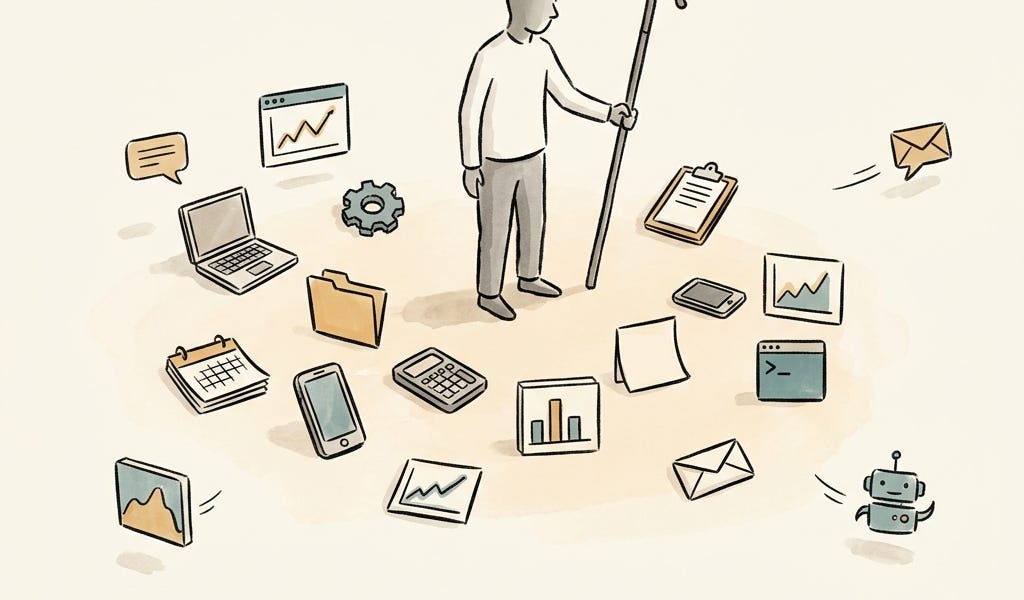
Product management has always been a rationing job. Most ideas would not get built. Engineering time was scarce. Coordination was slow. A roadmap was partly a strategy document and partly a rationing system, and product managers helped decide which customer problems, executive priorities, technical constraints, and market bets deserved the company’s limited ability to make software.That role is changing, because the cost of a first version has collapsed. The thing entering the product conversation is no longer a request. It is a working artifact. A dashboard. A lightweight app. An agent that already touches a system of record.The scale this reaches is already documented. Inside Microsoft, employees have built more than 1 million Power Platform citizen-development assets: 18,000-plus environments, 170,000 apps, 50,000 automated flows, 1,200 chatbots. Most companies are nowhere near that, but the shape of the problem is arriving everywhere, and the product function is the part of the org that has to absorb it.The old model asked, “Should we build this?” The new model starts one step later: somebody already built something. Now the company has to decide whether it should matter. The PM is no longer mainly a coordination role around scarce engineering. It becomes the discipline that classifies software abundance into market value, internal reliance, or deletion. That is a more strategic job, and a more technical one. Get it wrong and the failure is not loud. You do not get an outage on launch day. You get a pile of half-real tools nobody owns, spreading into systems of record before anyone decided they were allowed to.Here’s what’s inside:Why the old roadmap filter broke. When a first version costs almost nothing, rationing engineering time stops being the job. You get a clear read on what replaces it, and why the shift is more strategic than the prototyping conversation suggests.A four-state ladder for classifying what your team builds. Personal tool, team beta, supported internal product, customer-facing product, with the specific user-count and risk thresholds that move a tool from one rung to the next.The demotion triggers almost everyone skips. The exact signals that tell you a tool you still support has stopped earning it, so you stop paying to keep dead software alive.Two prompts you can run this week. One classifies any employee-built tool into its real production class and names what promotion would take. The other audits a tool you already support and tests whether it should be demoted.The cost of making software fell. The cost of being wrong about what you depend on did not. Below, here is how the product job changes when production stops being the scarce input, and the two prompts that turn it into something you can run on Monday.
Your team built 1 million internal tools before anyone classified them. Here's the four-rung ladder that fixes it
Watch now | PMs used to ration engineering. Now they have to classify abundance.
449 words~2 min read