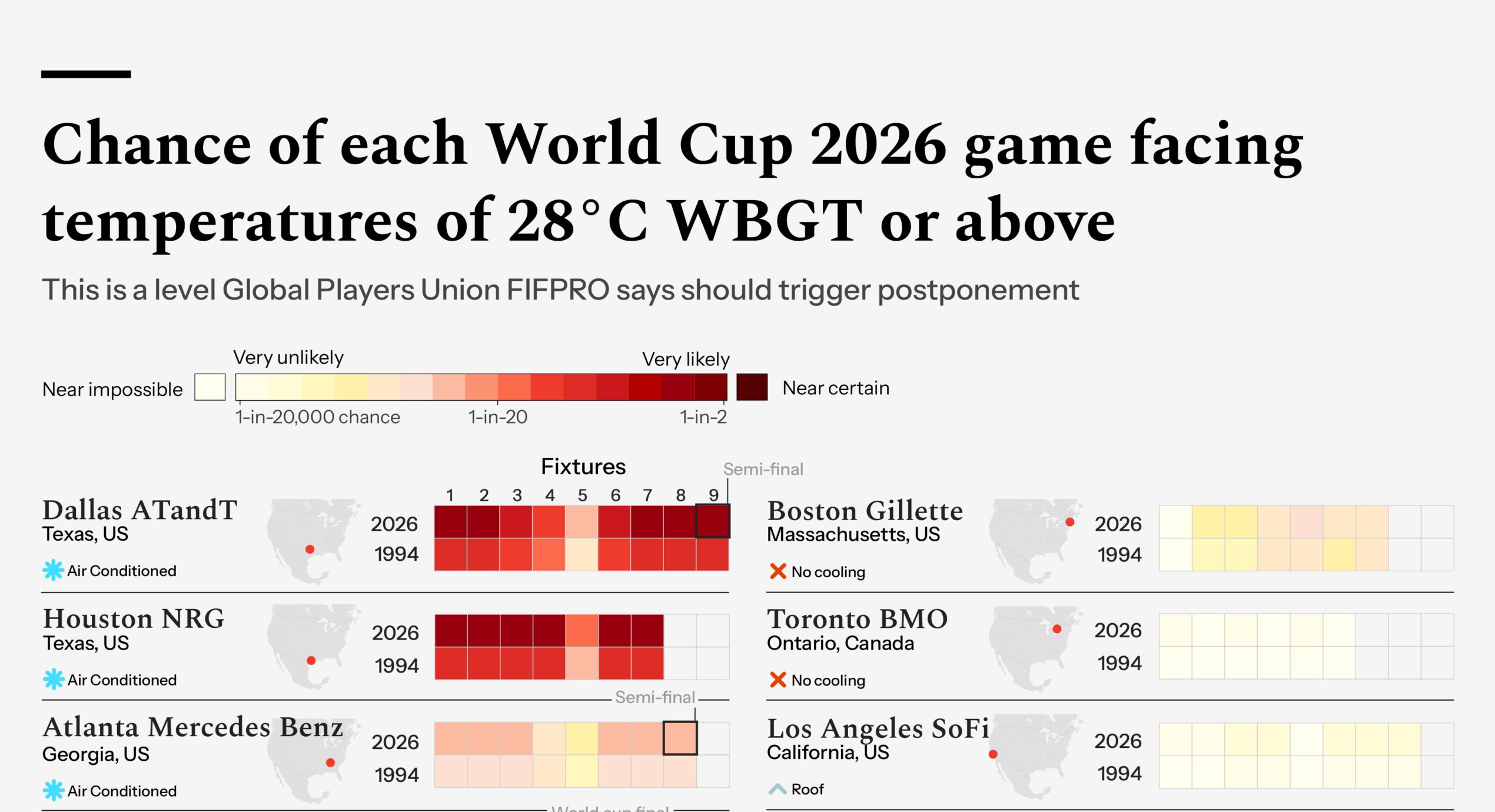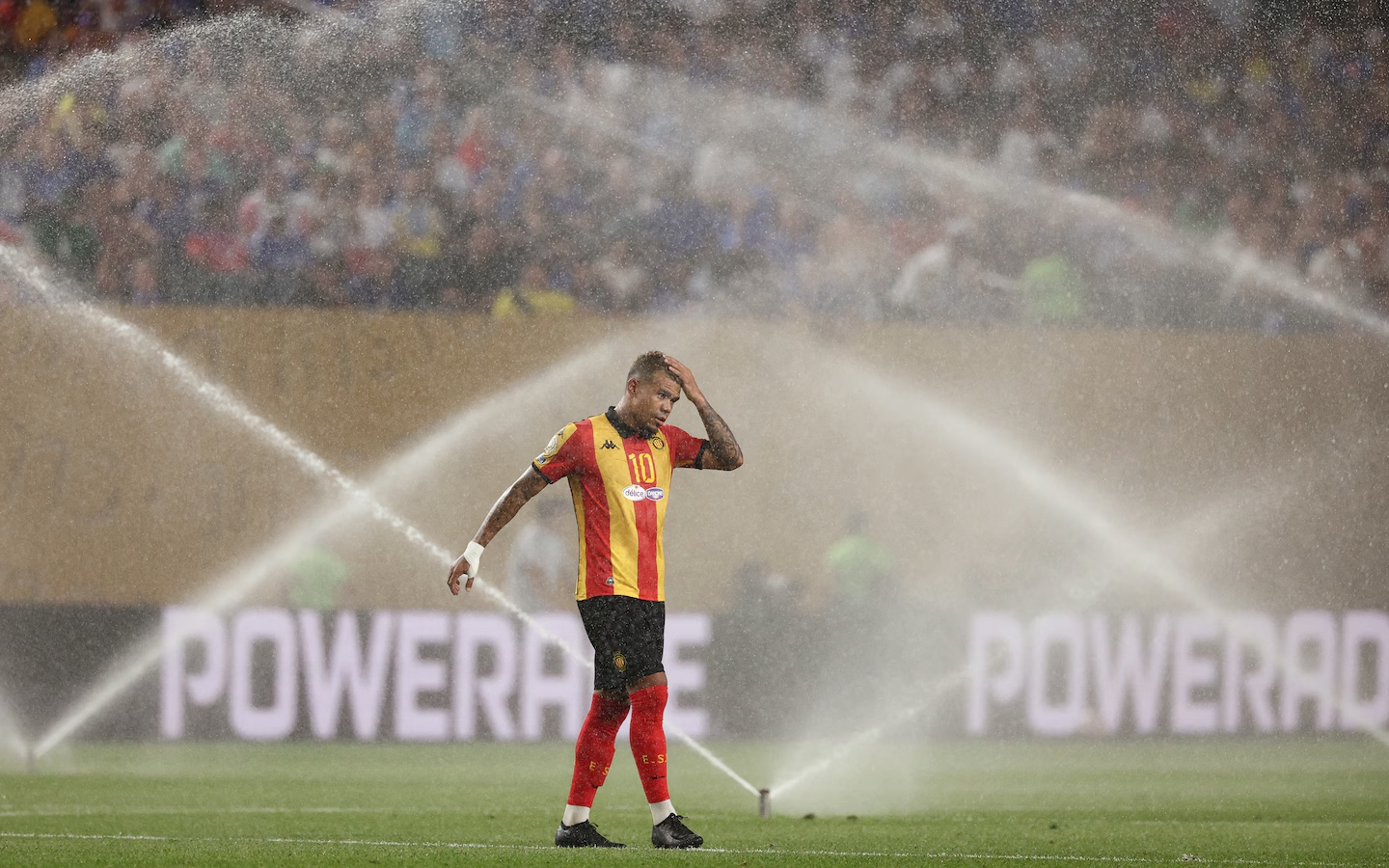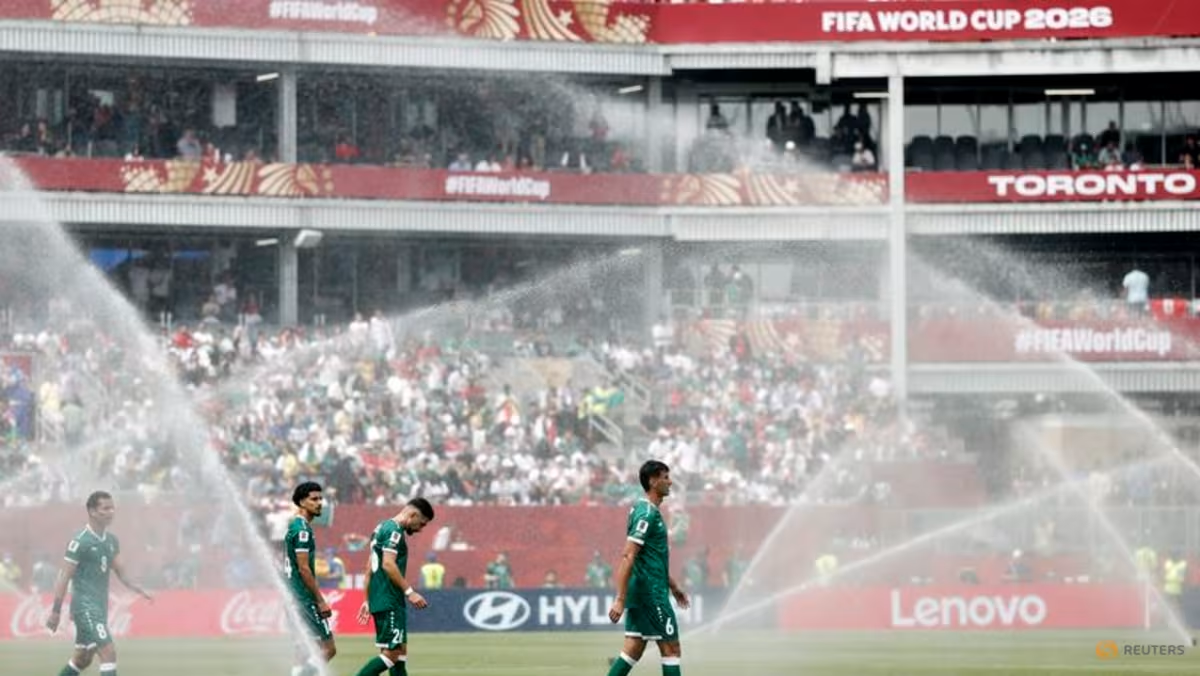
Players and supporters face significant risks of extreme heat at this summer’s World Cup, a Queen’s University Belfast researcher has stated. Fifa has taken some measures to mitigate the risks of heat-related incidents during the tournament in the United States, which is co-hosting it along with Mexico and Canada. There will be three-minute water breaks in each half. Four of the 16 host venues, Los Angeles, Dallas, Houston and Atlanta, have retractable roofs that will keep temperatures down. The 1994 World Cup was noteworthy for games played in fierce heat. Irish fans will recall events in Orlando when Ireland played Mexico in 37 degrees and Jack Charlton got into a row with Fifa officials after he threw water bottles on to the pitch. There was much criticism of Fifa at that World Cup for scheduling games in the middle of the day for European audiences. Many of the games in this World Cup are being scheduled for the evening time when the heat will be less of an issue. QUB researcher and climate scientist Dr Donal Mullan said many of the other venues, most notably Miami and Monterrey, but also Philadelphia, Kansas City, Boston and New York, will host games where the Wet Bulb Globe Temperature (WBGT) index will be above 28 degrees even with evening kick-offs. This is the threshold at which the international players’ union, Fifpro, recommends that mitigation measures should be taken, ranging from extended breaks to postponement. Fifa has set the threshold at 32 degrees. [ New York and New Jersey subpoena Fifa over ‘manipulated’ World Cup ticketingOpens in new window ]Mullen estimates that 92 of the 104 matches could be played in a high-environmental-stress situation which would significantly impact players’ performance. “Since March, we have seen record-breaking temperatures across parts of the US. Global warming is a real challenge. As a society, we now feel the impact of this in so many areas of our lives. For sport, it’s fast becoming a public health issue,” he said. Roy Keane and Steve Staunton after Mexico's win over the Republic of Ireland in Orlando, Florida during the 1994 World Cup. Photograph: Billy Stickland/Inpho Mullan said moving games to evenings is not enough to tackle perilous heat conditions. Exposure can lead to severe health issues including nausea, dehydration, headaches and heatstroke and can be life-threatening in certain cases.“There is a very real risk that both players and fans will be exposed to extreme heat during the Fifa World Cup 2026 ... I would urge football fans to prepare in advance for perilous conditions to protect their safety. Staying well hydrated is vital.”[ Warning shot for 2026: Fifa Club World Cup’s brutal heat exposes a World Cup riskOpens in new window ] He said that while the three-minute cooling breaks will help, Fifa’s “heat policy for further action such as delaying or postponing matches has been widely criticised by various bodies, including global players union, Fifpro”.“Climate change is having a big impact on the world around us, including elite sport. The first priority has to be the health and welfare of athletes and spectators.”
World Cup: Extreme heat ‘a very real risk’ for fans and players, says Irish researcher
Queen’s University Belfast climate scientist says high temperatures to be big issue despite mitigation measures
515 words~2 min read