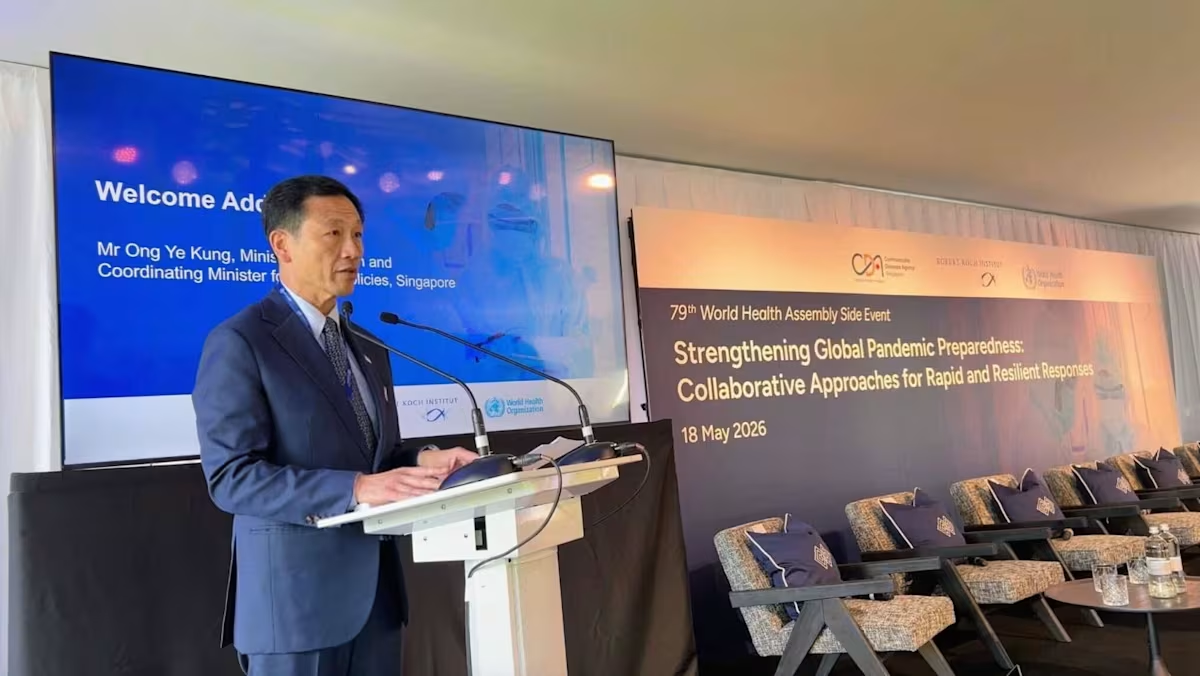
Singapore's Ministry of Health will invest SG$2.5 billion ($1.9 billion) over the next five years in boosting translational and clinical research, including AI for preventive care and precision medicine. This was announced by Minister for Health Ong Ye Kung at the recent National Medical Research Council Awards Ceremony and Research Symposium. WHAT'S IT ABOUTThe investment, part of the country's nearly $30 billion Research, Innovation and Enterprise 2030 (RIE 2030) Plan, will usher in the next phase of government-backed translational and clinical research.It covers Phase III of the National Precision Medicine (NPM) Programme, which now focuses on sequencing the genomes of up to 450,000 people or about a tenth of the local population. Another key priority is harnessing AI as part of the national preventive care initiative, Healthier SG. According to Minister Ong, digital tools and AI models will be developed, trained on local clinical data and clinical practice guidelines, initially targeting cardiometabolic and ophthalmic diseases. He said these AI models, which could help flag at-risk patients and suggest care pathways, will be designed to integrate into regular clinical workflows. Minister Ong also emphasised the work to validate these models' outputs and ensure explainability, "so that patients and healthcare professionals have confidence in the models and their benefits for patient and clinical outcomes."The minister said there is "real opportunity" through Healthier SG to integrate AI models into outpatient and primary care services. The government has also committed SG$350 million ($274 million) under RIE 2030 for a challenge for private-public partnerships to propose "promising innovations in both preventive and acute care." Minister Ong said brain health will be a key priority, alongside physical function and socio-environmental innovations that support healthy longevity. THE LARGER TRENDDr Tan Ee Shien, chief innovation officer of PRECISE, which leads the NPM programme, previously told this publication that Phase III is expected to deliver the foundational evidence base for the "systematic integration of precision medicine into routine clinical practice."PRECISE is exploring other conditions to include in the national genetic testing programme following the launch of the first test for familial hypercholesterolemia in June. Meanwhile, Singapore previously announced a $150 million investment over five years from 2024 to scale AI implementation across the public health system. In March, the National Cancer Centre Singapore announced a $4.7 million collaboration to develop an AI-powered cancer test based on advanced genomic sequencing.
Singapore commits $2B for preventive, precision medicine
It also covers AI for Healthier SG and a $270 million challenge for public-private collaboratives proposing solutions for preventive care, ageing, and longevity.
391 words~2 min read