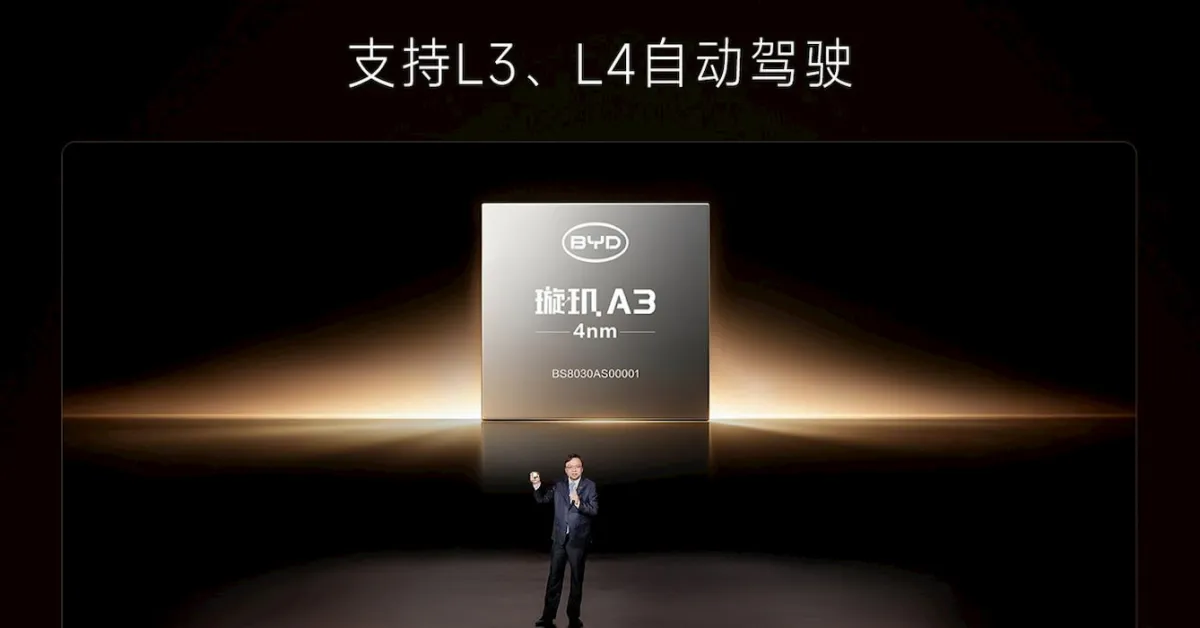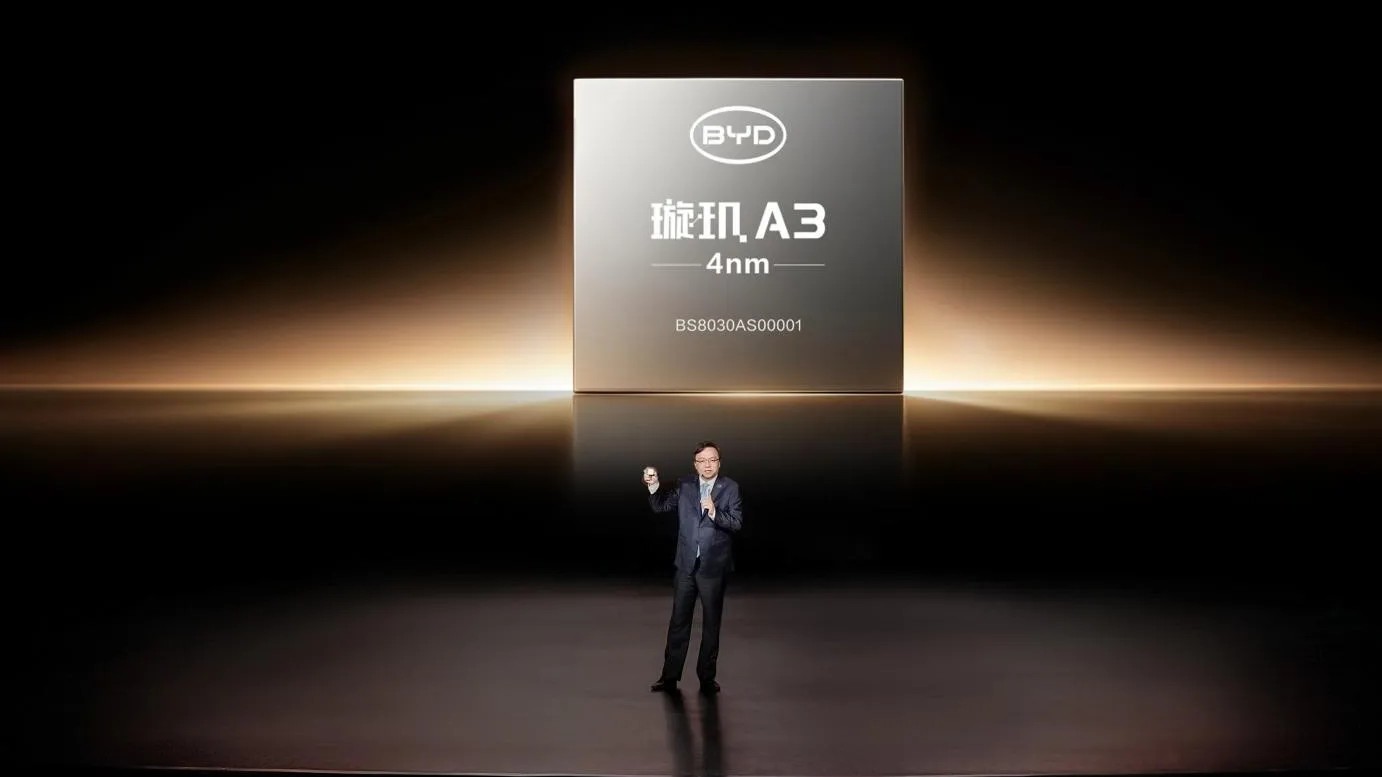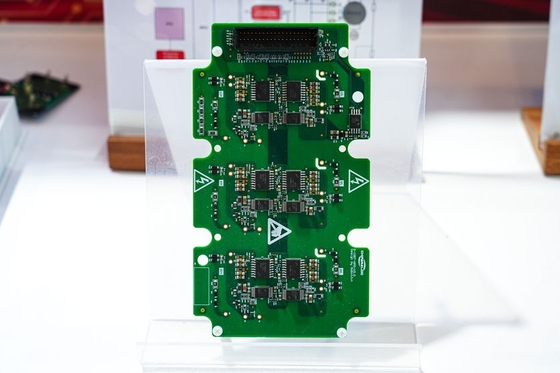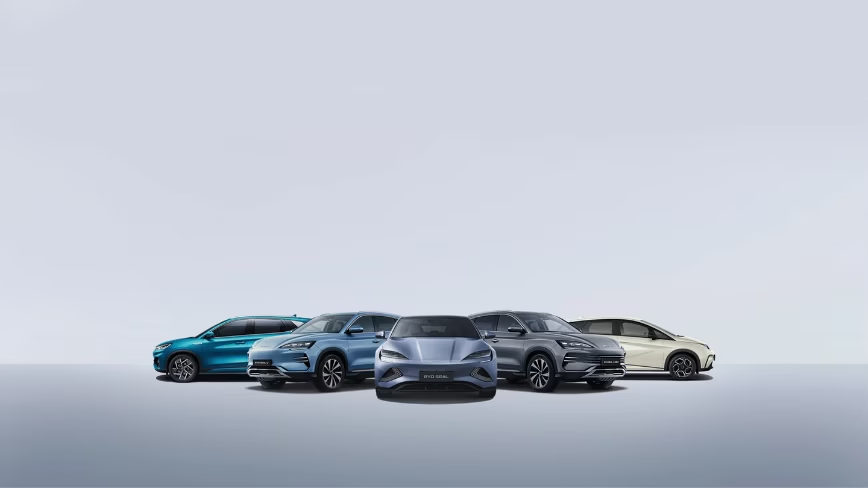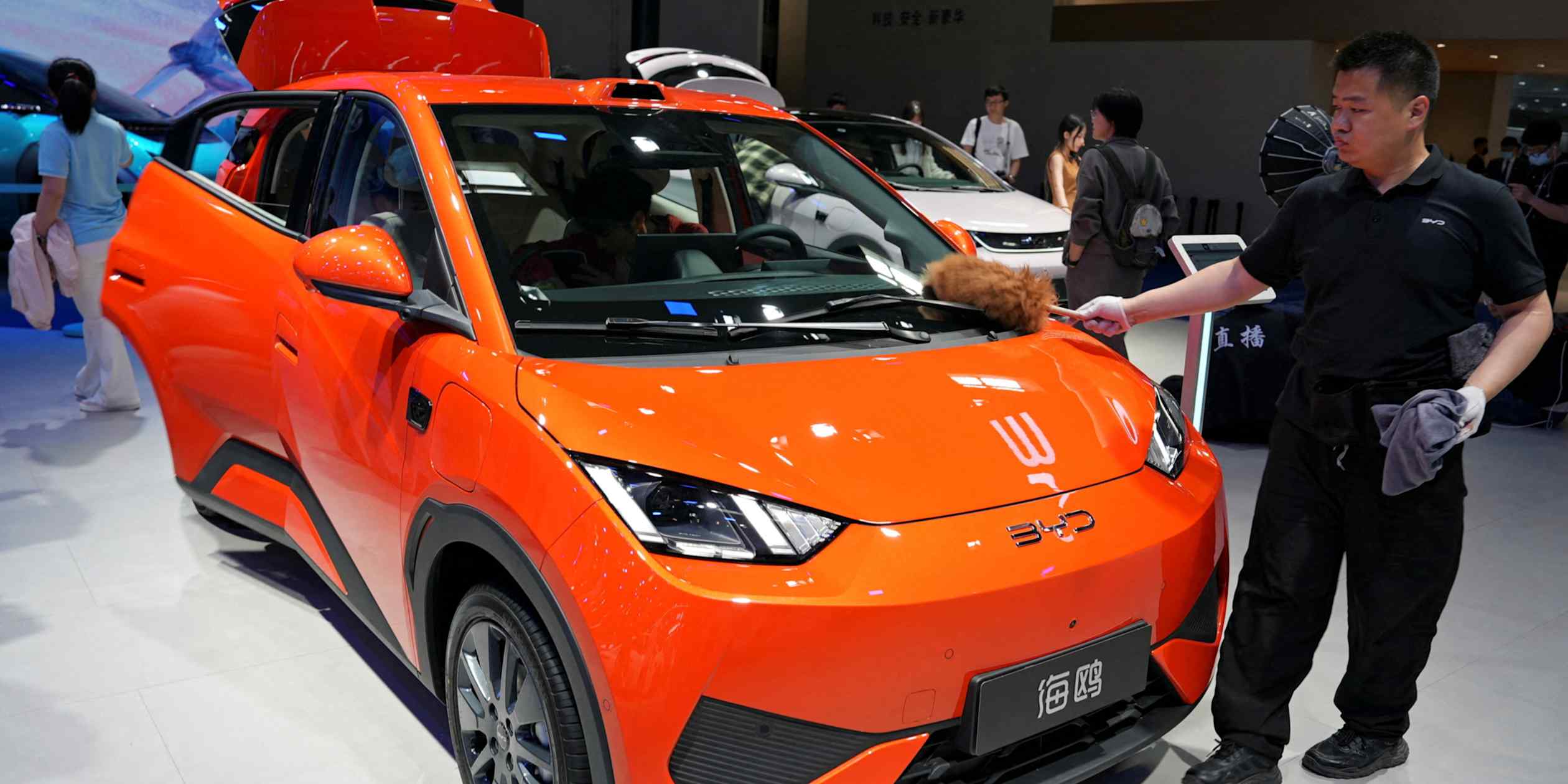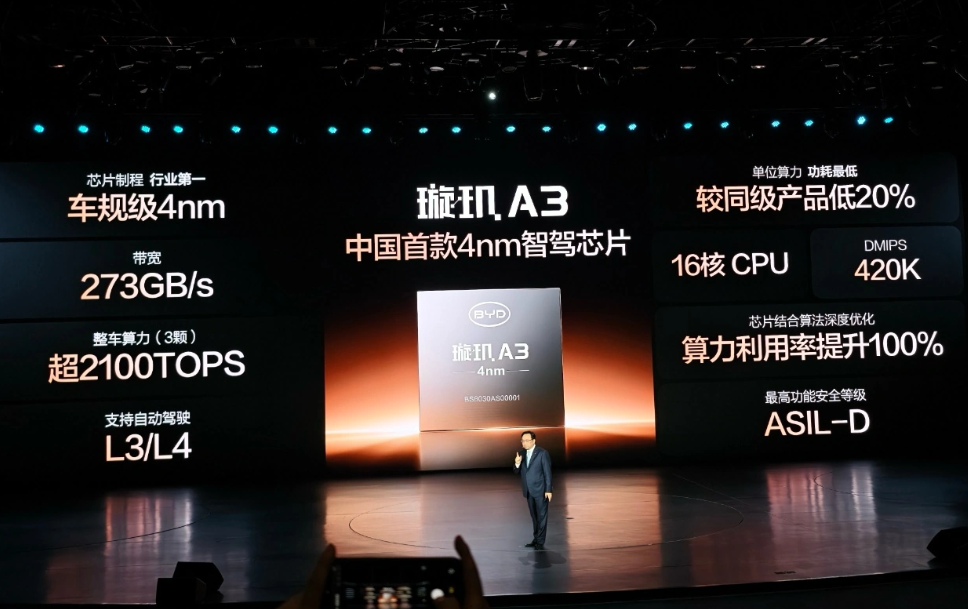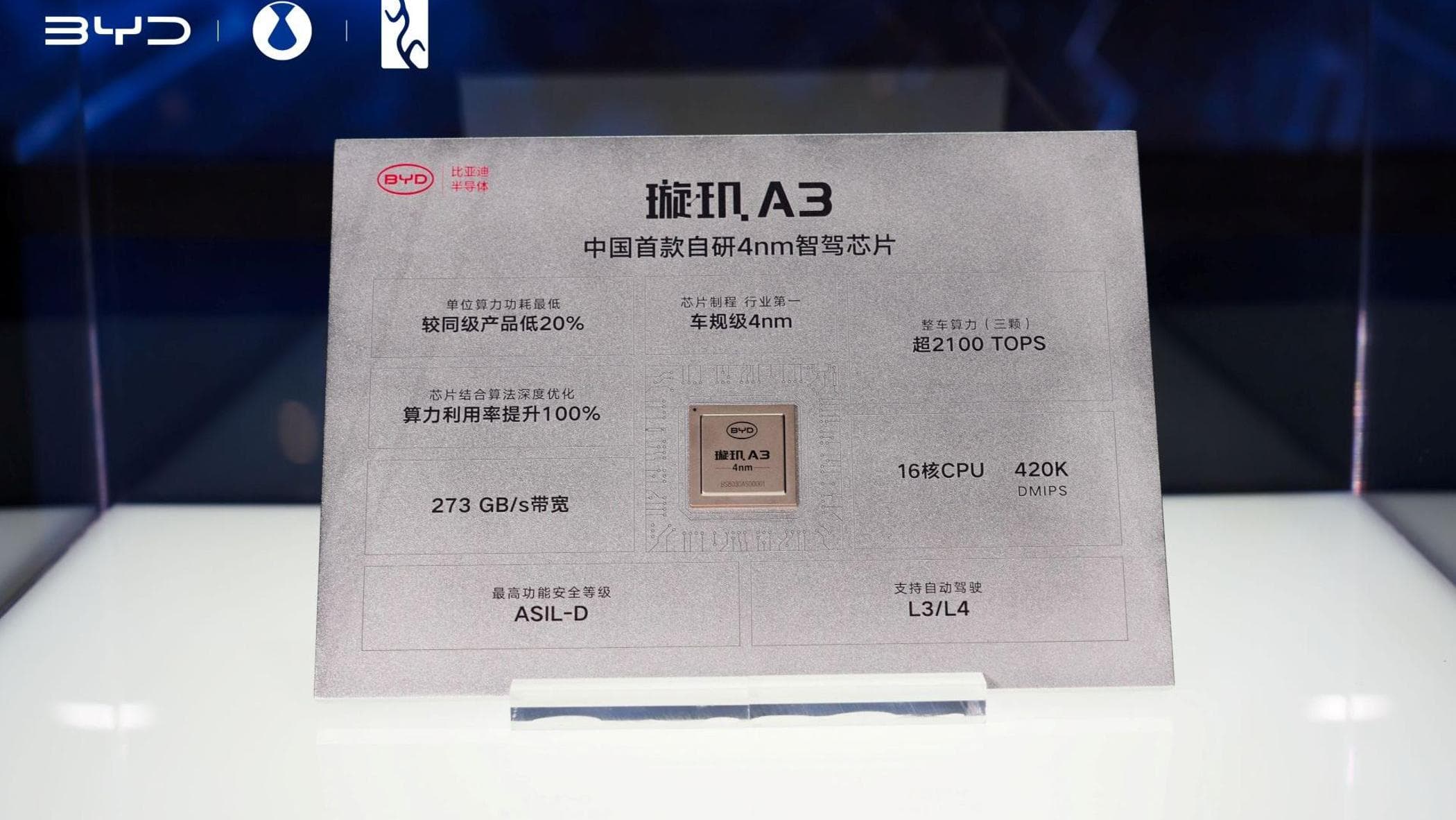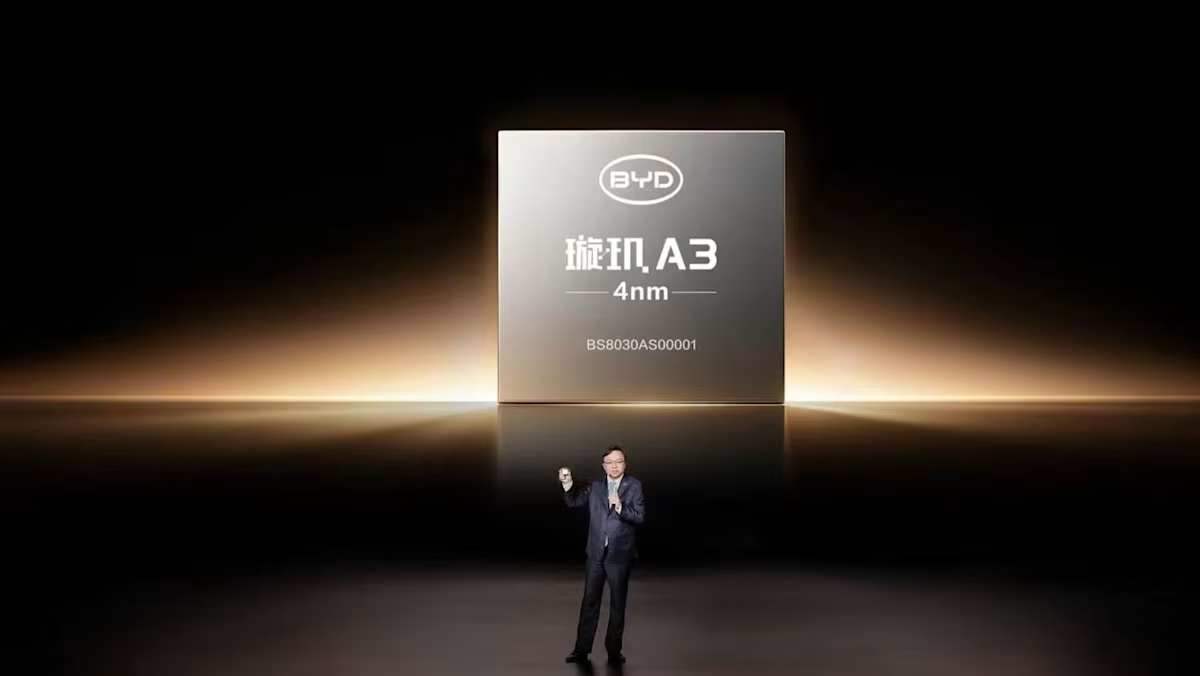
BEIJING - BYD, the world’s largest electric vehicle maker, unveiled a series of technology advances including what it calls China’s most powerful chip for self-driving cars. The semiconductor breakthrough steps up the rivalry with Chinese tech giant Huawei Technologies and is designed to allow BYD’s computer-assisted driving to stand out from a crowded Chinese EV market that includes rivals such as Xpeng and Xiaomi.Facing eight months in a row of falling sales and intense competition for more advanced charging and intelligent driving technologies, BYD is looking to spark more demand for its vehicles.BYD shares rose as much as 3 per cent in early Hong Kong trading on May 29, before easing back slightly. Its chief executive officer Wang Chuanfu announced the Xuanji A3 chip at an event on May 28 at its Shenzhen headquarters, saying it has the best energy efficiency in the industry and uses 20 per cent less power than similar semiconductors.The Xuanji A3 is the centrepiece of BYD’s new laptop-sized central computing platform. The company said the unified software suite speeds up three previously separate domains within an EV: its smart cockpit of dashboard controls, an advanced driver-assistance feature and the core electric propulsion. BYD is waiting for China to formalise legislation allowing more consumer-facing deployment of self-driving vehicles, which the company expects to happen as soon as 2027. The carmaker is prepared to roll out products at that level of autonomy when the time comes, according to Yang Dongsheng, a senior vice president.While it doesn’t offer that fully driverless technology yet, BYD plans to expand its partially automated driver-assist system across all models in China. It will deploy that feature with laser-mapping sensors known as LiDAR to mass-market EVs such as its compact hatchback Seagull, which starts at 69,800 yuan (S$13,000). The technology, which automakers usually reserve for premium vehicles, will be available at a standard price of 12,000 yuan. Offering the upgraded driver assistance as a paid-for add-on gives the company a new revenue stream amid a fierce price war in China that has crunched earnings.“Even the affordable Seagull or Dolphin models can be equipped with the smart driving experience that usually goes with luxury cars,” Mr Wang said. “Our add-on package is the most sincere in the industry, priced only at cost.”‘God’s eye’ insuranceMr Wang said his company is providing one year of insurance that fully covers any damages that might result from accidents when a BYD car has engaged the latest version of its assisted-driving technology, which it markets under the name God’s Eye. BYD made God’s Eye a standard feature in 2025 on most of its vehicles. However, that initial phase relied on a tiered structure with more affordable models receiving only basic highway cruise control, while advanced urban navigation was limited to more pricey vehicles. The system has also attracted a litany of complaints that it doesn’t work as promised.To accelerate software development, BYD is capitalizing on its massive market share to build a real-world data collection loop. The company says it has more than 3.15 million vehicles equipped with advanced driver-assistance hardware on the roads, generating roughly 200 million kilometres of driving data every day.Some industry analysts caution that deployment scale does not automatically equate to system maturity, noting that BYD’s automation performance has historically trailed pioneers like Tesla. However, the Chinese automaker expressed confidence in the software’s trajectory.Tesla is pursuing a competing technological path, relying on a vision-only approach that uses standard cameras and neural networks instead of radar or LiDAR. The US carmaker is currently working to clear regulatory hurdles to launch its so-called advanced Full Self-Driving (FSD) system in China, which still requires active human intervention and will be marketed under a different name due to tight scrutiny by Chinese transportation authorities. BLOOMBERG
BYD debuts smart-driving chip it calls China’s most powerful
The semiconductor breakthrough steps up the rivalry with Chinese tech giant Huawei. Read more at straitstimes.com. Read more at straitstimes.com.
TL;DRAI
BYD unveiled the Xuanji A3, China's most powerful self-driving chip, consuming 20% less power than rivals, and is expanding LiDAR-equipped driver-assist to mass-market EVs like the Seagull at 12,000 yuan add-on. With 3.15M ADAS-equipped vehicles generating 200M km of daily driving data, BYD is building a data flywheel that could close the gap with Tesla before China's autonomy legislation formalizes around 2027.
626 words~3 min read