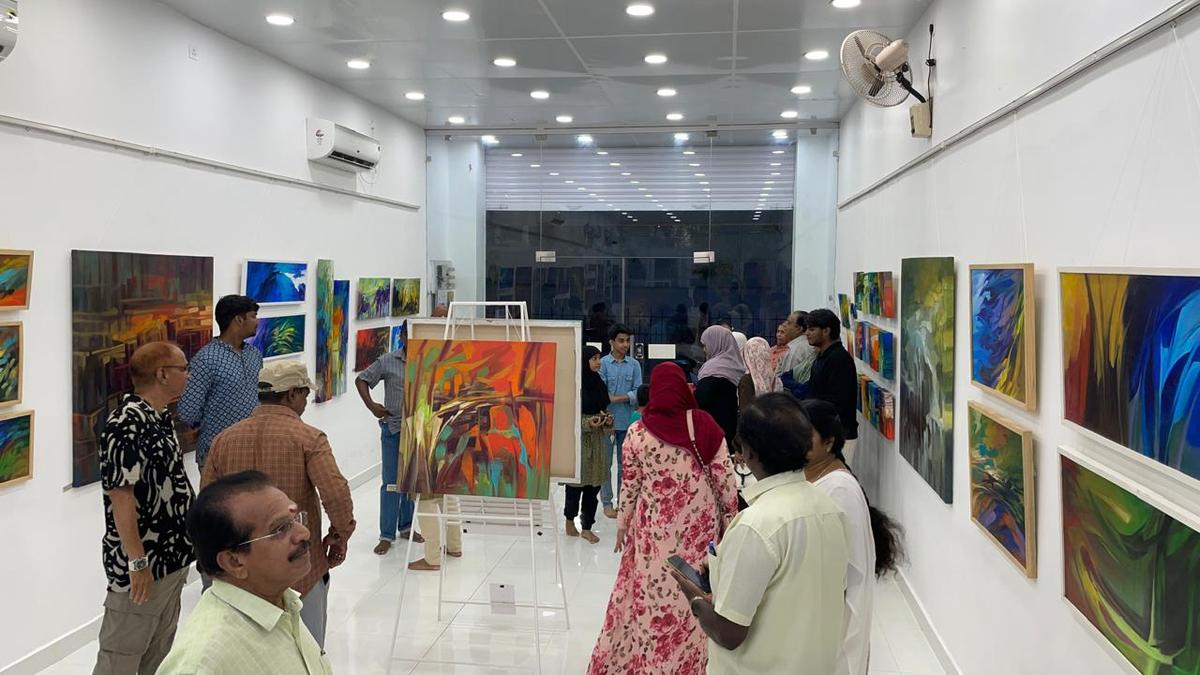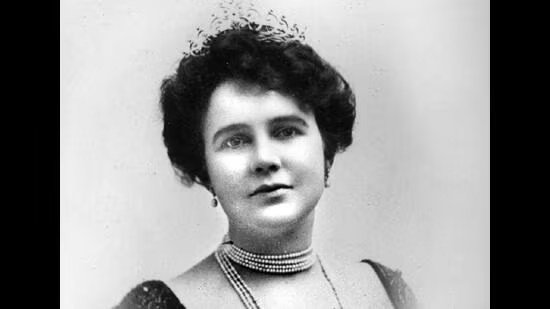
MUMBAI: At the Subcontinent Art Gallery in Fort, a blushing gulmohar tree, reimagined in oil, its flaming red blooms bunched together like floral bouquets, overlooks a large window. Gallery co-founder Dhwani Gudka points to its twin outside, glowing under the early evening sun. It might seem a sheer coincidence that this mirroring dense foliage forms the backdrop for the gallery’s new botanical show, Bombay Blooms—curated by Ruta Waghmare Baptista—showcasing six oil paintings by 20th century British painter, Lady Winifred Strangman. But it’s not, Gudka insists. “We first realised that these paintings could have been made in old Bombay because they brought to life flowering trees that we were used to seeing all around us,” she says.Unpacking nutrition science behind the sub-2 marathonGudka and her gallerist husband Keshav Mahendru discovered Lady Strangman accidentally over two years ago, in London. “During a visit to the Kew Gardens, we chanced upon Marianne North’s artworks, which is on permanent display there,” he says. The 800-odd paintings were the result of an assiduous documentation work undertaken by North, a 19th century artist who defied convention and travelled the world solo to record these tropical and exotic plants.“All these paintings were relatively small-scale works—some oil on canvas, some gouaches. But the fact that she was in India for a couple of years in the 1870s, indicated that there were probably other female artists also working in the subcontinent that we had no idea about,” shares Mahendru. It led the gallerist couple down the rabbit hole.As they delved deeper into the art market, they were pointed towards six botanical paintings, attributed to one Lady Winifred Strangman of whom they knew nothing, except that she was married to Sir Thomas J Strangman—the first barrister in India to successfully prosecute Mahatma Gandhi—and that these paintings had been with the family for over 60 years. “We acquired them not just because they were really well-preserved beautiful paintings, but also because these trees were a part of the Indian landscape,” says Gudka.Curious to know more about these paintings, Gudka roped in long-time friend and collaborator Ruta Waghmare Baptista whose research revealed that Lady Strangman had indeed spent close to 30 years in India, much of it in Bombay.An exemplary talent re-discoveredThe six paintings, which will be on display at the art gallery from tomorrow, bring alive the city’s flora and fauna in all its glory. The canvases also reflect Lady Strangman’s sensitivity towards the natural world and her eye for vivid detail. Apart from painting the yellow allamanda—its golden blooms, a spectacle throughout the year—the fiery red gulmohar, semal, hibiscus and poinsettia, and lavender-hued Bengal clock vine, she also captures the fauna (large swallowtail, small grass butterfly, lemon pansy, common mormon) that inhabit them, and the rich plant-life (golden mosaic, red leaf philodendron, blue plumbago) surrounding these trees.With this exhibition, the first ever dedicated to a female British artist working in pre-independent Bombay, Baptista and the gallerists have also attempted to stitch a portrait of the artist and the context in which she made her art. “While researching, we found out that the auctioneers Bonhams had auctioned some of her collections, which included textiles, some antiquities, and porcelain works,” recalls Gudka.Her aspirations as a prized collector became even clearer when Baptista, who is a museum consultant, found the first independent mention of her at the Chhatrapati Shivaji Maharaj Vastu Sangrahalaya (CSMVS) archive, which stated that Lady Strangman had donated six Himriyatic tablets to the museum in 1924.Each discovery unpeeled new layers about her life. Winifred Strangman (1874-1955) was born in South Africa as Winifred Warneford to William Warneford, a captain in the British Army. Having demonstrated quite early an artistic talent, Strangman was awarded a scholarship to the prestigious Slade School of Art in mid-1890s where she received formal training. Her subsequent marriage to barrister Sir Thomas J Strangman, brought the couple to Bombay. She left India and returned to England in the late 1930s. But her philanthropy—she raised over 80,000 rupees through proceeds from stalls and raffles for the Children’s Welfare Exhibition—and art, which stands at an intersection of scientific and artistic pursuits of botanical studies in colonial India, remain an indelible part of her legacy.The fact that Baptista had to take such a circuitous route to flesh out the life of painter Lady Strangman also sheds light on what it meant to be a female artist in early 20th century Bombay. “It meant you were not written about,” Baptista says, plainly. “Despite being so accomplished, there was so little known about her. A male artist is an artist. But a female artist was considered a hobbyist,” adds Gudka.Looking beyond the artBeyond the paintings, Baptista also highlights the contributions of some of the artist’s accomplished predecessors—Lady Charlotte Canning, Lena Lowis and North—in the “archival section” of the show. She also charts out the history of the building of gardens in Bombay—the first one was set up in the mid-16th century by the Portuguese physician and naturalist Garcia da Orta—and how they became sites of “recreation, experimentation and knowledge”. The gallerists have also loaned a rare edition of Lena Lowis’s ‘Familiar Indian Flowers’ (1878), from the Sarmaya Archives, which will be on display. The book, say Gudka and Mahendru, is an important archive of botanical drawings and observations made by Lowis during her time in India (she was born here), and consists of 30 chromolithographs made after her original artworks.By exploring these artists and their drawings Mahendru says you also get a sense of how Lady Strangman’s botanical paintings were different. “The works of Lena Lowis, or any other artist of that time, followed a certain scientific format.” In their works the flower, the leaf, the branch become the focus. “Lady Strangman moved away from this format, as her intention was different,” he says. Though her paintings of plants, flowers and insects were just as meticulous, she offered a fuller picture of the environment in which they thrived. “In doing so, she makes her work alive, and makes you feel present in that moment,” he says.(Bombay Blooms will be on exhibit at the Subcontinent Art Gallery, Fort, from May 30 to July 10.)
Unpacking nutrition science behind the sub-2 marathon
It might seem a sheer coincidence that this mirroring dense foliage forms the backdrop for the gallery’s new botanical show, Bombay Blooms—curated by Ruta Waghmare Baptista—showcasing six oil paintings by 20th century British painter, Lady Winifred Strangman | Mumbai news
Mumbai's Subcontinent Art Gallery opens six botanical oil paintings by Lady Winifred Strangman—first exhibition dedicated to a female British artist working in pre-independence Bombay, rediscovered after 60+ years in the Strangman family's possession. Reconstructed from dispersed archives and auction records, her near-erasure from art history shows how institutional record gaps systematically suppress contributors—a signal for teams managing knowledge attribution and documentation systems.