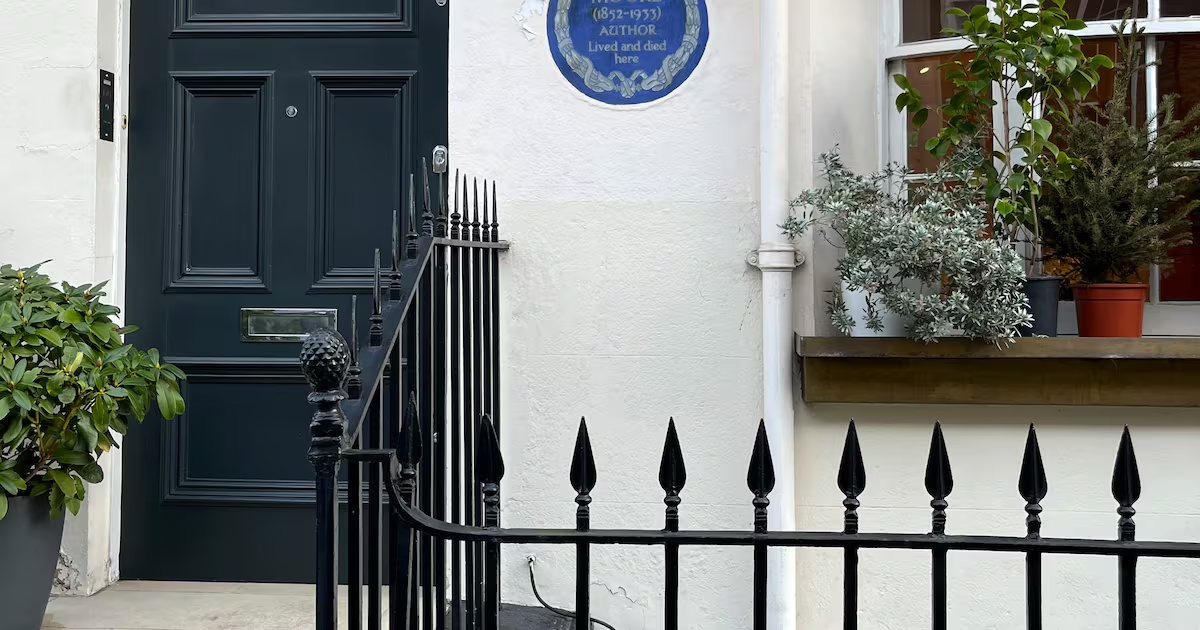
Londoners and visitors to London are sometimes seen to stop and stare outside houses that carry heritage plaques honouring the famed Irish writers who spent significant time living in them.A bronze plaque on Woburn Buildings, off Euston Road, shows where William Butler Yeats lived for 23 years from 1896 to 1919. A four-minute walk could take him from there to London Euston railway station for his frequent trips home to Ireland via train and mailboat. In less than half an hour he could walk from his lodgings to the Strand, where homesickness inspired him to write The Lake Isle of Innisfree.Yeats’s London home was on a narrow pedestrian laneway, now renamed Woburn Walk, near Tavistock Square in northern Bloomsbury. An early visitor, Augusta Gregory, scoffed at his cheap furnishings from nearby Tottenham Court Road stores. As his future collaborator and perennial Galway hostess, she provided him with a leather armchair, a Harvey Nichols curtain and, at least once, a £20 note left on the mantelpiece.Overnight guests included the adulterous Olivia Shakespear and the idolised Maud Gonne. The residence “was also discreet, and allowed a poor man to walk to most locations in central London”, noted John Kelly, co-editor of The Collected Letters of WB Yeats.Yeats left Woburn Buildings after marrying Georgie Hyde-Lees in London in 1917 and moving briefly to Oxford before returning to Ireland. He rented a house in Merrion Square, Dublin, and purchased an abandoned Norman castle at Thoor Ballylee in south Galway, where he and his family spent summers until 1929. It was the only home he ever owned. Another sometime Yeats collaborator, Mayo-born writer George Moore, is remembered by a blue plaque on the front of the London house where he lived for 23 years until his death in 1933. The two men were introduced by a mutual friend in the Cheshire Cheese pub on Fleet Street. Moore was 13 years older than Yeats and they had a hot-and-cold relationship in London and Dublin for many years. Moore was educated in England and lived in Paris for five years. He lived at various addresses in London between 1880 and 1901 before moving to Dublin for a decade. Returning to London in 1911 he moved into 121 Ebury Street, near Victoria Station, the railway terminus for the Dover-Calais ferry and onward connection for return visits to Paris. The London County Council plaque on No.121 matches another at No.180 on the same street where Wolfgang Amadeus Mozart was living when he wrote his Symphony No 1 in 1764.Leading booksellers and distributors WH Smith and major circulating libraries banned some of Moore’s early novels over alleged risqué content until he showed them how much money they were losing by failing to stock his bestsellers.An English Heritage blue plaque is affixed to the house where James Joyce and his partner Nora Barnacle lived for several months in 1931. Exiles throughout their adult lives, they moved to London following legal advice that they should marry there for “testamentary reasons” after they had lived together as husband and wife for nearly 27 years in Austria, Italy, Switzerland and France.[ Plaques broad and narrow – Frank McNally on Dublin street honours big, small and missingOpens in new window ]Before and after their civil wedding in the Kensington Register Office on July 4th, 1931, they lived at No.28 Campden Grove, an exclusive enclave off Kensington Church Street. The three-storey-over-basement house is a short walk from Kensington High Street, where they dined every day, passing en route the Edward Pugin-designed Carmelite Catholic church that gives the long street its name.Newspapermen, alerted to the wedding, laid siege to the house, forcing Joyce to threaten legal action. His British Who’s Who biography said that “he was married in 1904 to Miss Nora Barnacle, of Galway”, but the Kensington wedding register described Nora as a “spinster”. “All day the bell went and the telephone. Even at midnight when we came back from supper there was a reporter posted on the steps,” Joyce told his son Giorgio in a letter after the wedding. Aged 49 at the time, he said that anyone who thought that the ceremony was a publicity stunt “must be an imbecile”. Joyce told son Giorgio that the civil marriage was necessary “for testamentary reasons” because he would have to make a new will. “Try to look as natural as possible, so that people meeting you may not perceive that you have been turned into an honest citizen all of a sudden,” he wrote.
London calling: Ray Burke on the many plaques in the British capital honouring Irish writers
Plaques mark the home where WB Yeats lived for 23 years, and where James Joyce and Nora Barnacle spent a few months
748 words~3 min read