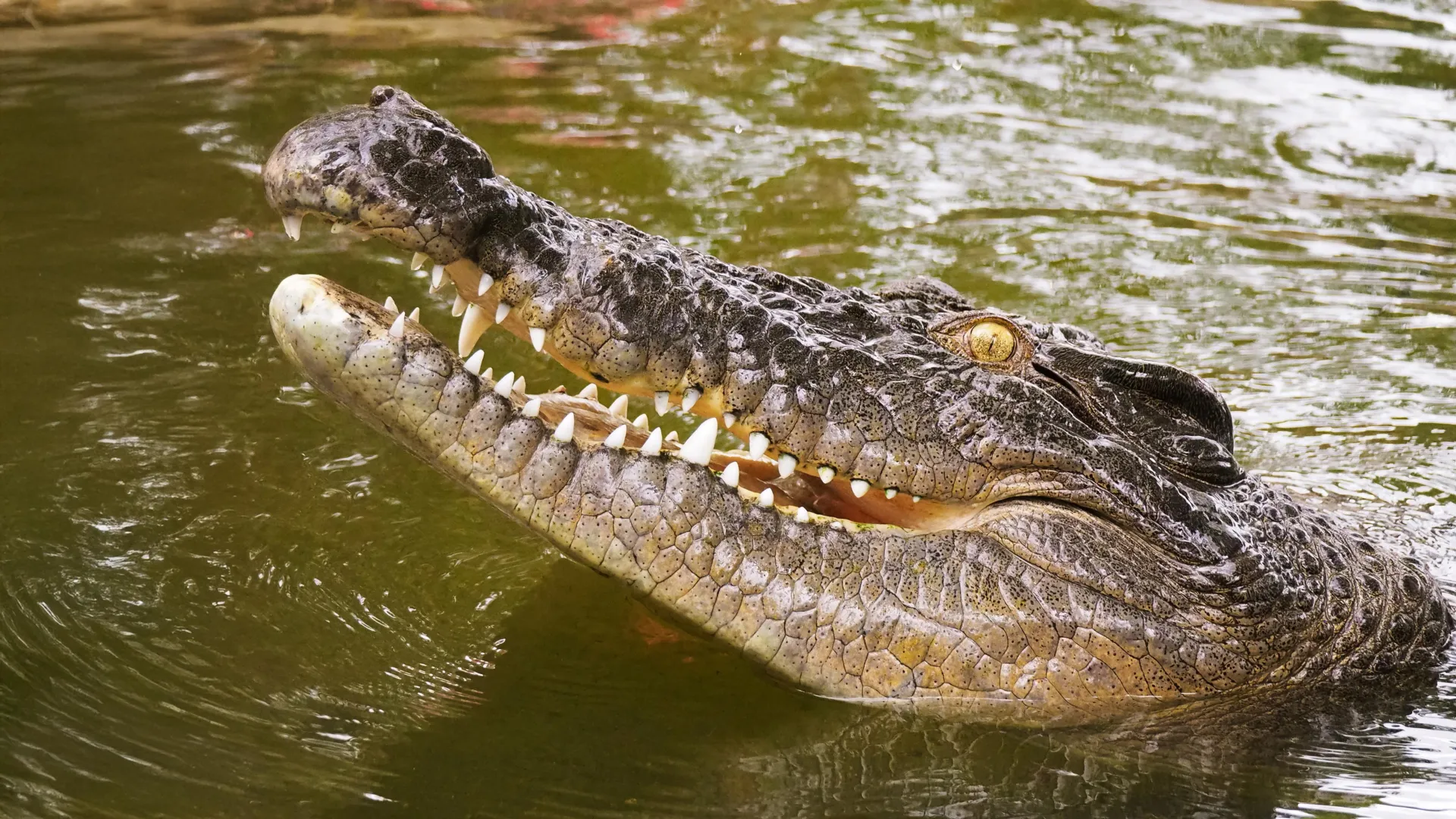
The crocodile’s death roll may seem savage, but scientists say it’s actually an elegant evolutionary solution to a major biological problem.gettyEven people who know little about reptiles understand, instinctively, that crocodile territory is governed by very old rules. They wait almost perfectly still. The water barely moves. Then, in a matter of seconds, something enormous vanishes beneath the surface.The fact that they kill isn’t what makes them so unsettling. Lions kill. Sharks kill. Wolves kill. Rather, it’s that crocodiles are capable of dragging animals twice their size underwater and tearing them apart through a maneuver so violent that it has its own name: the death roll. And yet, from a biological perspective, crocodiles aren’t chaotic killers. Their success doesn’t depend on speed in the conventional sense, nor is it brute force alone. They combine stealth, explosive acceleration, extraordinary bite mechanics and the physics of water itself into one of the most effective predatory systems on Earth.How Crocodiles Overpower Prey That Should Be Able To EscapeMost crocodiles are surprisingly unremarkable movers on land. A healthy antelope, zebra, or wildebeest would easily outrun one over any meaningful distance. Even humans, despite our many physical shortcomings, are considerably more agile. But this is precisely why crocodiles rarely hunt in open, on-land pursuit.Instead, they exploit one of the oldest, most universal vulnerabilities in the animal kingdom: the need to drink water. Rivers, lakes and muddy shorelines are predictable: anyone who wishes to drink from them must, for at least a short while, lower their guard in some capacity. So, crocodiles position themselves almost invisibly beneath the surface, exposing little more than just their eyes and nostrils. Then they wait. And wait.MORE FOR YOUAs crocodiles are masters of short-range acceleration, the strike itself is astonishingly fast. Their powerful tail launches the body forward, while the jaws snap shut with terrifying force before the prey has time to react meaningfully. But it’s what happens after this that makes crocodiles biomechanical outliers.In a 2012 study published in PLOS One, researchers measured the bite force and tooth pressure across all 23 living crocodilian species (i.e., crocodiles, alligators, caimans and gharials). They found that crocodiles have the strongest bite forces ever reliably recorded in a living animal. Large saltwater crocodiles (Crocodylus porosus) generated bite forces exceeding 16,000 newtons — the equivalent of shoving a double-decker bus.The researchers also examined tooth pressure: the amount of force concentrated through the relatively small surface area of a crocodile’s teeth. Because crocodilian teeth are conical and narrow, they concentrate immense pressure onto tiny points. Unlike mammalian predators, who slice prey’s flesh with sharpened teeth, crocodiles evolved instead for grip. Once those jaws close, escaping is incredibly difficult.Water only compounds this advantage further. Most mammals’ strength lies in their footing and leverage. Once they’re dragged into deep water, however, those advantages disappear immediately. Their legs lose traction, their balance collapses, and they panic. The crocodile, meanwhile, is perfectly at home.Why Crocodiles Perform The ‘Death Roll’Crocodiles cannot chew food in the same way mammals do. Their jaws are extraordinarily good at closing with force, but they’re terrible at processing large carcasses into manageable pieces. As such, crocodiles had to come up with another solution: using the entire body as a rotational weapon. Thus, the death roll evolved.A seminal 2007 study published in the Journal of Experimental Biology examined the mechanics of what researchers call “twist feeding.” With high-speed video analysis, the researchers demonstrated just how powerful crocodilians’ rotational movements were around their long body axis.To say the result is devastating would be an understatement. As the crocodile spins, the prey experiences immense torsional and shear forces. Their limbs twist beyond their normal range of motion. Their flesh tears. Their joints destabilize. Large chunks of their tissue is ripped out entirely. The sheer bite force already makes it hard enough to escape the crocodile’s jaws. But with the addition of the death roll, their prey is disoriented so severely that it becomes virtually impossible.Ironically, the death roll is actually a compensation for the crocodile’s many anatomical limitations. Since they cannot slice meat cleanly or chew effectively, rotational feeding is the most efficient way to break prey into crocodile-bite-sized portions. Only instead of slicing, they use momentum and torque.The death roll proves especially useful in situations where the prey is too large to consume whole. Crocodiles clamp onto a limb or section of flesh and rotate violently until tissue separates. The researchers noted that the rolling behavior amplifies mechanical force dramatically. In turn, this lowers the amount of energy needed in comparison to a prolonged struggle or pursuit.The energy efficiency of the maneuver is likely its greatest advantage. Crocodiles are ectotherms, meaning that they rely largely on external heat sources to regulate body temperature. Unlike mammals, this means that they can’t afford chronically expensive bursts of energy expenditure. As such, their predatory behavior favors patience and short bursts of efficiency over endurance. The death roll is brutal, but it’s also biologically economical.And since the death roll often results in drowning, it makes even more sense evolutionarily. The prey isn’t just being held underwater; it’s being held underwater and continuously destabilized simultaneously. Mammals depend on coordinated body orientation to generate force and maintain respiration. Violent rotational motion disrupts both of those processes. Even large animals rapidly exhaust themselves under these conditions, especially while deprived of oxygen.Why Evolution Favored Crocodiles’ Violent StrategyTo us, crocodiles’ hunting strategy looks grotesque to the point of excess. But evolution has no interest in appearances, nor in mercy. It rewards efficiency — and crocodiles are very efficient.Ambush hunting enables energy conservation while minimizing the risks associated with pursuit; remaining motionless in water for hours also costs comparatively little. So, when prey eventually does approach, the crocodile only has to deploy a quick burst of explosive power, without the need to sustain a lengthy chase. The death roll follows the same logic. Crocodiles don’t have specialized chewing teeth or the ability to manipulate food with dexterous limbs, so they needed to find another way to process large prey. Twist feeding solved that problem elegantly. By transforming their whole body into a source of rotational force, crocodiles could dismember prey using the power of physics, rather than their precious metabolic energy.In evolutionary terms, this strategy was remarkably successful. Crocodilian ancestors have persisted through mass extinctions, dramatic climate shifts and ecological upheavals that have eradicated countless other lineages. Their body plan stayed the same over thousands of years because it worked extraordinarily well to begin with.Most prey animals evolved to fight, flee or maneuver effectively on land. Crocodiles win by rewriting the rules of battle and forcing prey into an environment where those adaptations fail catastrophically. Once in the water, where crocodiles have the home-ground advantage, large mammals become clumsy, oxygen-limited and vulnerable to rotational forces they are poorly equipped to resist.So, while crocodiles’ infamous violence may look like savagery to us, in the animal kingdom, it’s a result of sophisticated engineering — which may be precisely why crocodiles are so unsettling. Putting the spectacle of the death roll aside, what’s left is objectively scary: a predator whose strategy was perfected long before humans even existed at all.Think you know crocodiles and other cold-blooded creatures? Test your herpetology knowledge with my fun Reptile & Amphibian IQ Test, and see how you compare to others.
How Do Crocodiles Drown Animals Twice Their Size? A Herpetologist Explains
The crocodile’s death roll may seem savage, but scientists say it’s actually an elegant evolutionary solution to a major biological problem.
1,217 words~6 min read