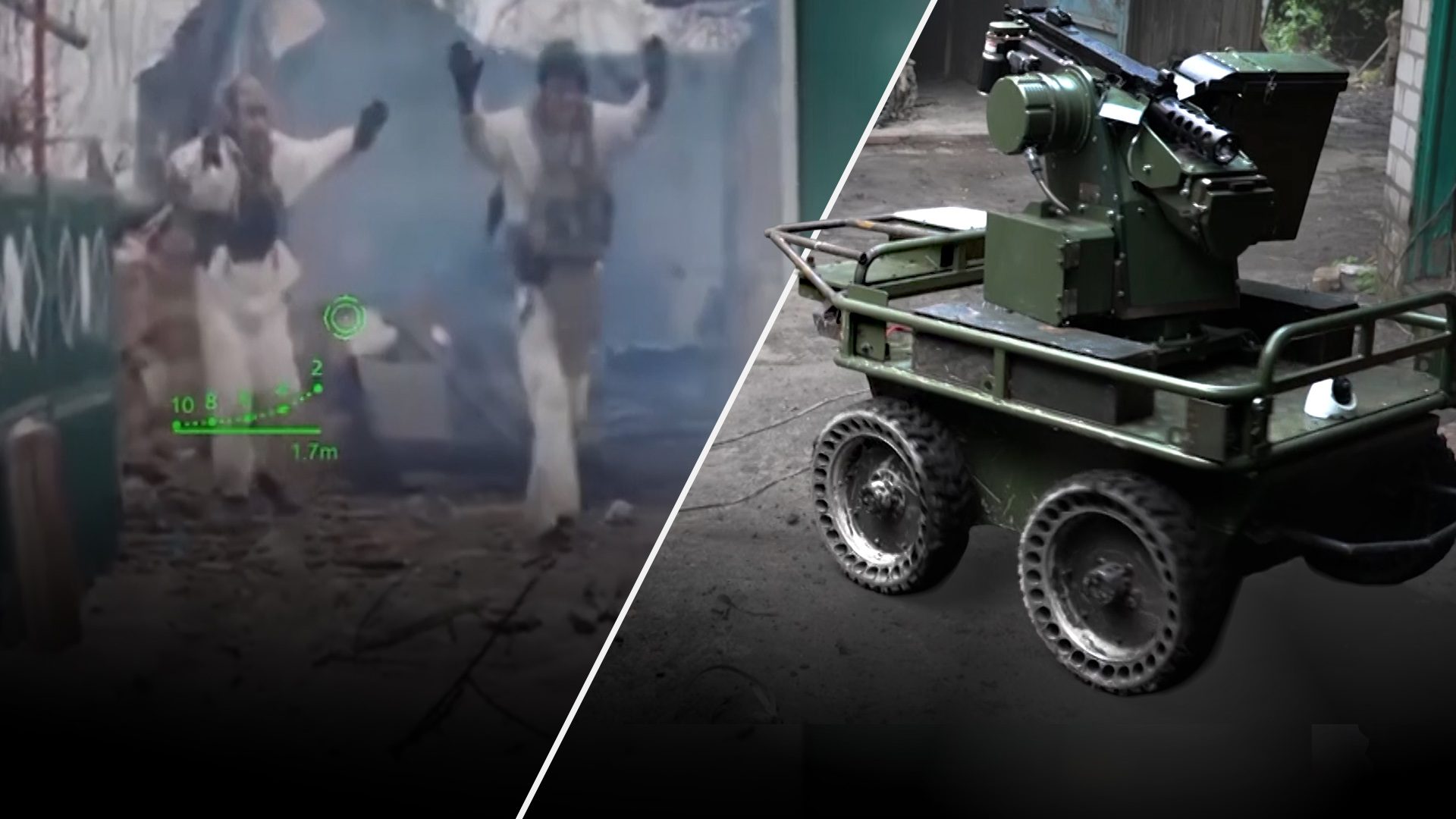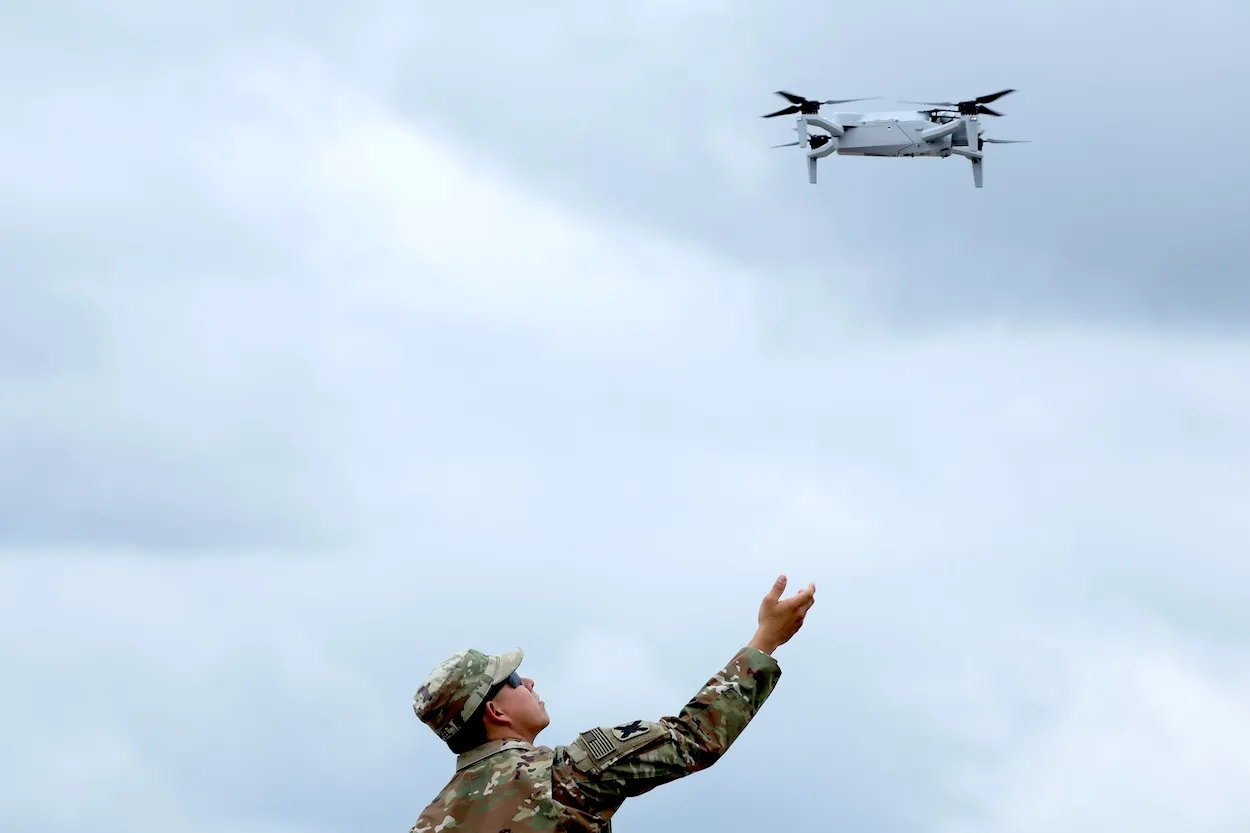
May 28th 2026 It has never been a great time to be an infantryman. But today’s conditions are especially pitiable. In the “kill zone” imposed by both sides’ drones in eastern Ukraine, the risk of finding yourself inside a lethal video game is omnipresent. In February Ukrainian troops trying to join the small number of their comrades still inside Myrnohrad, a town in Donetsk, knew that Russian drones operated by well-hidden pilots would make it impossible to do so in vehicles. They had to infiltrate gingerly through the forests. It could take weeks. They might not get out for months. The after-effects might last years. Soldiers returned from the front keep their windows covered and lights dimmed even when hundreds of kilometres outside the zone. Trapped in what psychologists speak of as hypervigilance and hyperarousal, the sound of a drone can trigger fear and a feeling of helplessness. They glance up as they walk. As the battle for Myrnohrad was grinding on, American and Israeli jets taking part in the other great-power war of the moment were bombarding Iran at will. Their pilots had everything they needed to pound, assess and pound again, all the sensors the world’s most advanced military forces could bring to bear—on-board infrared and radar, back-up from drones nearby and radar farther off, satellite oversight and more besides. Israel hacked traffic cameras in Tehran to track Ayatollah Ali Khamenei, the country’s supreme leader, as it closed in to kill him. Such different wars in their prosecution. But in other ways oddly similar. Both the war in Ukraine and the war over Iran are shaped by technology which has introduced a new transparency to the places and situations in which armies fight. This transparency is not complete. It is always partial, always sporadic, always subject to challenge. But over the eight years since your correspondent left the world of think-tanks to become The Economist’s defence editor, a post he is now leaving for pastures new, it has been warfare’s defining technological trend. There are other similarities between Ukraine and Iran. Both are wars instigated by the leaders of great powers in the apparent belief of easy victory. Both have developed in ways those leaders did not anticipate into something like a stalemate—stalemates in which, for Russia and America alike, a lack of victory looks increasingly like defeat. Are technological changes making the role of the defender easier? Or systematically encouraging big powers to start wars they cannot win? Or is this merely a case of business as usual—great powers blundering into ill-advised wars that reflect the prevailing technologies of the day? The question matters because war is a somewhat booming industry. The Uppsala Conflict Data Programme recorded 65 active state-based conflicts—wars where at least one belligerent is a state and which result in at least 25 battle-related deaths in a year—in 2025, the highest level since its records began in 1946. They included eight wars categorised as state-on-state, two with annual battle-death rates over 1,000. The Peace Research Institute Oslo identifies a similarly bleak trend. “Despite a sharp decrease in battle-related deaths from 2022 to 2023,” it observed, “the past four years have been the most violent period since the end of the cold war.” armed conflicts involving states, 2010-25 Tactical transparency boils down to three things: more and better sensors; precision firepower; and networks that convey actionable data from the first to the targeting systems of the second. To reduce all this to drones is an oversimplification. There are all sorts of robust sensors that can be scattered across battlefields or mounted on the soldiers and vehicles traversing them. There are other sorts of smart projectiles, not to mention dumb projectiles that can be smartly used. And none of this matters without the networks, technical and human, which join all these sensors to the various shooters, providing analysis and decisions as they do so. The drone, which can combine sensor and shooter under the control of a single operator, invites the imagination to collapse all that complexity into a simple package. To attribute to weapons the advantages that accrue to the systems which use them best has misled military minds in the past. It could do so again. That said, the drone is an undeniably powerful avatar of change. It hovers like a sentry in the sky; it pursues with hideous intimacy. It captures how this new warfare can at the same time seem delocalised and hyperlocal; how it can be everywhere and also in each specific somewhere. How it can be controlled from afar—but right in your face, right now. At the same time as it is strange and new, it is curiously everyday. Its manufacture uses supply chains much more similar to those which produce consumer electronics than to those which produce tanks or high-end missiles—or, for that matter, artillery shells. This allows rapid evolution through endless innovation and counter-innovation. “You update code every few days,” says Air Vice-Marshall Simon Strasdin, who leads Britain’s Integrated Warfare Centre. “In six weeks, you typically need to do some sort of larger upgrade to your software. And in six months, you’re probably looking at doing a hardware change as well.” New generations of technology can rise and fall without the lines moving more than a few metres. America began using drones—Predators, then Reapers—to kill its enemies within weeks of 9/11. But the drone that changed things for the non-superpower world was the Bayraktar TB2, developed and built in Turkey. The TB2’s first major outing was countering the Libyan National Army’s advance on Tripoli in 2019. In 2020 it showed its prowess against armour—first in Syria, then in Armenia—and armies around the world began to take note. Then, in February 2022, Ukrainian TB2s played a role in stopping Russian tanks from reaching Kyiv. Their success was partial—artillery mattered more—and short-lived; but it was amplified by the propaganda value of the videos it produced. The TB2s, though, were only the first of the drones with which the two sides would bring the war to its current grisly standstill. Smaller, smarter and sneakier drones appeared in 2022; by 2024 many varieties were in mass production. Along with artillery, fortifications, satellite communications and a huge amount of pilot training these created a lethal “attrition belt” that was once 5km deep and is now often closer to 30km. Today, drones originally designed to act as bombers deliver food and water on both sides—an innovation that appreciably lessens the hardship of soldiering. The wounded are taken away by uncrewed ground vehicles, which Ukrainian forces used for more than 24,000 missions in just the first three months of 2026. And between the meals and the medical evacuations come the attacks.Drones originally designed to act as bombers deliver food and water on both sides Every day each side produces thousands of “first-person view” (FPV) drones used to hunt and kill one-on-one. Their use accounts for a significant fraction of the 1.1m-1.4m Russian soldiers whom The Economist estimates to have been killed or wounded in the war: one in 25 of the country’s men under 50. Ukraine’s losses are lower, in part because it is costlier to attack than to defend, in part because Ukraine has gone further in substituting robots for humans. Ukraine’s losses equate to one in 16 of its pre-war 18- to 49-year-olds. Some say this is now the future of wars in which states seek to capture territory: two sides endlessly pinned down by small, cheap and all-seeing killers. General Valery Zaluzhny, Ukraine’s ambassador to London and formerly its commander-in-chief, says that large-scale manoeuvre warfare—armies moving with speed and shock, in contrast to frontal, attritional battles—is now “unattainable”. It will become possible again only when wars evolve into robot-on-robot fighting at machine speed. Others treat this as fanciful. Stephen Biddle, a professor at Columbia University, argues that the scale of the sensor revolution is “easy to exaggerate”. As new counter-drone systems—lasers are especially promising—appear, and as jammers and dazzlers blind satellites, the balance may tilt again, bringing some relief to ground forces. Jamming was one of the reasons the TB2’s early success in Ukraine did not last; Russia’s electronic-warfare specialists got their measure. The same fate befell American Excalibur GPS-guided shells, whose hit rate fell from 70% to 6% in just a few months. In the battle over Kursk province, Russia pioneered the control of drones through fibre-optic cable—a modern twist on second-world-war technology which both sides now use. William Owen, the editor of Military Strategy Magazine and an adviser to the British army, says that better trained and equipped armies would not be tied down in the first place. If first-rate Israeli kit and training were used against an opponent of the standard of Russia or Ukraine, he argues, $3,000 FPVs would be “mostly, if not completely, irrelevant”. In a speech to Chinese military cadets last year, Admiral Sir Tony Radakin, Britain’s then chief of defence staff, said Britain’s way of war would be fundamentally different from that seen in Ukraine anyway: its model would be “Israel’s strikes on Iran [in 2024], which wiped out the entirety of the country’s air defences in a single sortie, on a single night, using long-range, stand-off weaponry, exquisite targeting and fifth-generation technology”. But armies rarely get the wars they want. Sir Tony is almost certainly correct that in a war between, say, NATO and Russia, the alliance would establish something like air superiority (providing, that is, that America committed itself to the fight). What then? Air superiority has not just become harder to establish and maintain, says Franz-Stefan Gady, an Austrian military expert; it also buys you less than it used to. Below 4,000 metres (13,000 feet) the battlefield is increasingly “decoupled” from what happens above that ceiling. It is dominated by mass-produced drones of various sorts and defences which, though not able to deal with the profusion of drones, can still trouble larger, high-value aircraft. Some have started calling it the “air littoral”. Just as big navies are increasingly challenged when bringing their advantages to bear against mines, shore batteries and small craft in the confined shallows at the edges of the oceans, so big air forces must worry about the shallows at the bottom of the atmosphere.Air forces must worry about the shallows at the bottom of the atmosphere. This means air power might offer little escape from messy and lethal close fighting at short range. Mr Gady points to the Israel Defence Forces’ experience over their past two years of operations in Lebanon as evidence of this. “The IDF had air dominance and superior ISR [intelligence, surveillance and reconnaissance]. It still had to clear villages on foot, take casualties, and accept that strikes alone neither dislodged Hizbullah nor delivered a political result.” In recent weeks Hizbullah has adopted drones controlled by fibre-optic cables, as in Ukraine, to inflict casualties on Israeli troops. To Mr Owen’s point, this does not mean that there is a deadlock in Lebanon; indeed, the IDF has responded by pushing its offensive deeper. But it does mean air superiority isn’t everything. Armies which are paying attention increasingly see superiority as something to be created at specific times and places: “pockets of superiority”, as Rob Lee, an expert on the Ukraine war, puts it. For example, Ukraine might disrupt Russian drone operations at a specific place and time, blinding their operators, shelling their positions, attacking them with drones of its own. Given how well hidden, and numerous, such positions can be, such a coup might take weeks of preparations, diversions and intelligence gathering. If the pocket is properly opened up, Ukrainian armour would hope to rush forward and exploit it, getting five or ten kilometres past the front line and precipitating a rout. At that point, it is hoped, Russian drone teams would flee and their lines “collapse”. Mr Lee says he expects to see successful armoured advances based on these principles this year. When Mr Lee says Ukraine is in a “world-war-one moment”, it is tempting simply to understand him in terms of immobility and attrition. But he is also thinking about the new tactics of 1918 which, by combining surprise, right-first-time “predicted” artillery fires and small, well-drilled assault teams, made decisive breakthroughs possible again and brought the trench warfare to an end. “Defensive capabilities have taken the advantage,” he says. “Now we’re going to see the demands for technology and tactics that will help re-establish manoeuvre.” The irony of that particular innovation in combined-arms warfare—the sort which requires contributions from a variety of forces and units—was that the defeated Germans learned more from it than the British and French, taking it forward in ways the victors did not. The Wehrmacht’s victory in the Battle of France two decades later reflected not bigger or better tanks, but doctrine which better combined the strengths of armour, infantry, artillery and air power. Training is one way to try to develop such tactics before the real shooting starts. But though vital, it is also never enough. Mr Biddle says a well-equipped brigade he recently observed at Fort Irwin in California’s Mojave Desert—the US Army’s National Training Centre—was still “systematically deficient”. It was so concentrated on mechanised warfare skills (which are felt to have atrophied) that it had “little mental bandwidth” to deal with novelties like counter-drone warfare. Command posts, logistical sites and air-defence systems were all dangerously exposed. The best way to learn is from the people who are doing. Observers in Ukraine are a boon to European armies; so are Ukrainian veterans. Last year Exercise Hedgehog saw Ukrainian drone operators helping to test NATO’s plans for defending Estonia. Sweden’s Aurora exercise did much the same this year. The results did not show Nato forces off to advantage. “We failed and failed dramatically,” says a Swedish official familiar with that exercise. But that, he adds, was the point: realistic drills where you lose teach far more than heavily scripted ones you do better at. America has found learning this way harder, in part because it has placed very few soldiers inside Ukraine. Just as new ways of war are always more complicated than the success of a single type of weapon, the decline of old ways is more than the irrelevance of yesterday’s champion. Again, the tank is a case in point. Drone people will tell you that the tank is dead. “Why deploy a tank,” asks Ilya Sekirin, a drone operator who has advised Ukraine’s high command, “when, for the same price and little risk to operators, you can now send a few dozen tracked land robots…supported by swarms of attack…drones?” But the old threats remain and can adapt. Mr Lee notes that last year Ukraine’s 20th mechanised brigade needed more than 60 FPV drones to halt the advance of just two “turtle tanks”, armoured vehicles heavily modified to cope with drones. Even then, one of the turtles would have got through and made bloody hay behind Ukrainian lines had its gearbox not malfunctioned. And what should Ukraine push through its pockets of superiority if not tanks? The long tail of traditional weapons is also evident in other recent wars. In last year’s skirmish between India and Pakistan, the most serious conflict between the two countries in 26 years, the extensive use of drones on both sides was much commented on. But the most serious strikes were carried out by piloted jets firing long-range, high-end missiles. Even in Ukraine the expensive kit needed for deep strikes has its role—as long as the missiles’ big, vulnerable launchers, whether tracked, wheeled or winged, are kept mostly out of sight and a long way from the kill zone. This leads have-it-all generals and admirals to talk about a “high-low mix” in which cheap and numerous weapons supplement a smaller number of expensive high-end ones. Thus they seek to embrace the different and disruptive as well as the newest, swankiest versions of old-time favourites, such as fighter jets and destroyers and, yes, tanks. They promise “hybrid” armies and fleets in which uncrewed and robotic systems work with traditional tanks, planes or ships. But that is not the way ministries have been spending money. “I think we’re going down the pipeline of investing in yesterday’s technology,” laments Matt Van Wagenen, a two-star American general who recently retired as the deputy chief of staff for operations at nato’s main military command. The alliance’s defence planning process, which tells it what to buy, is “based on decades-old stuff”, he says. “A 77-ton combat vehicle that’s burning 500 gallons of gas every 12 hours on a battlefield that is going to be largely transparent” is unwise, he argues. “The formations of the future are going to be wildly unmanned.”“The formations of the future are going to be wildly unmanned.” — Matt Van Wagenen. That may be going too far. But at the moment armies which have not actively engaged in the new ways of war seem much more likely to be underinvesting in them—in the relevant tactics and training, as well as the relevant procurement—than overinvesting. The expressions of sheer power in which the most advanced armed forces have been investing can be seen nowhere better than in the war against Iran. And yet to the extent that they were ever defined, President Donald Trump’s objectives in that war have not been met. More military action of the same sort as before seems unlikely to change that much. America’s Operation Epic Fury has hit 13,000 targets, with Israel adding thousands more. And yet Iran’s ability to strike back persists. It has used its missiles and drones to hit the aggressors’ early-warning radars, planes, drones, runways, barracks, fuel depots and headquarters. These counter-attacks, though more impressive than many expected, have not had a huge military effect. The fact that they have been possible, though, is still important—as is the shadow Iran’s surviving arsenal casts over the Strait of Hormuz. Iran is still capable of producing long-distance drones. And American intelligence indicates that it still has 75% of its pre-war missile launchers and 70% of its cruise and ballistic missiles. Having removed 30% of the missiles is, by historical standards, impressive. In 1991 America and its allies assiduously hunted Saddam Hussein’s Scud missiles, dispatching special forces to scour the desert for their launchers and conducting more than 1,500 air sorties against them. There is no evidence that a single one was destroyed. But in war there are no points for beating your own lacklustre record. The failure in Iran shows that canny defenders, particularly those lucky enough to live in a large country with plenty of craggy nooks, can hide large and powerful weapons for months even when pursued by two of the most advanced air forces on the planet. One response is to push technology harder—to create situational awareness so all-seeing that launchers are spotted the instant they leave their hiding places, and “kill chains” down which data can flow so unimpeded as to allow them to be instantly attacked. As Sir Lawrence Freedman, a historian, points out, some military minds have a long-standing attachment to the idea of the “knock-out blow”, one which administered hard enough brings victory in and of itself. Proponents of air power littered the 20th century with such notions. Evidence of success was more sparse. There is certainly room for improvement. In Britain, for example, targeting operations make use of more than 270 different applications running on 20 different computer systems. Connecting them poses all sorts of problems. Sometimes one system produces data far too quickly for the network to handle: in her recent book about Maven, an American targeting system, Katrina Manson, a journalist, reports that at the outset of the Ukraine war users had to send out to satellite companies for “encryptors” with enough capacity to deal with the new spate of information. Sometimes two systems will be simply incompatible in the absence of human mediation—often in the form of a “swivel chair” whose occupant rolls between the desks on which different terminals sit. The technology is becoming more efficient. Britain’s chief of general staff says “sensor-to-shooter” time has fallen by 33%. And AI enthusiasts in charge of America’s targeting apparatus are already planning to move beyond the state of the art seen in Epic Fury, with its 400 targets a day. Earlier this year Brigadier General Steve Carpenter, the commander of America’s 56th Multidomain Command Europe, said that he wanted his unit to “develop” at least 1,500 targets every 24 hours; a colleague acknowledged this to be “beyond…human scope”. Ms Manson reports that when Maven is integrated with large-language models such as Anthropic’s Claude or France’s Mistral it is thought to be able to produce 5,000 targets a day. There are cases where better, faster targeting could be crucial. One of the reasons Russia has never enjoyed air superiority in Ukraine is that the Ukrainians, tipped off by intelligence, moved a lot of their air-defence assets just before hostilities began. The first strikes with which Russia had hoped to blind its victim hit the empty places where they had been. If Russia had been able to update its targeting quicker, it might have promptly destroyed the relocated weapons. That could have changed the course of the war. But if Epic Fury had 4,000 targets a day rather than 400, would it have been commensurately more effective? There is a tendency for targeting—and, in particular, quantitative measures of targeting—to become a substitute for strategy. In Vietnam, American forces rewarded units with leave and medals for racking up higher reported body counts. “Once more—with more targets” turns the myth of the knock-out blow into the trap of the perpetual pummel. Look at the history of Afghanistan, a country that can be seen as air-power’s graveyard from the days of the Stinger-armed mujahideen on. In 2003 President George W. Bush said the Taliban had been pounded so hard they were “effectively out of business”. In 2017, when Mr Trump ramped up bombing in Afghanistan, General John Nicholson, commander of NATO forces in the country, asserted that the “Taliban cannot win on the battlefield.” (Reader, they won.) Mr Gady sees in all this what he calls the Belloc syndrome; the belief that a one-sided application of brute force in its most modern and efficient form will always prove decisive. The reference is to the most famous couplet in “The Modern Traveller”, a satire on imperialism written by Hillaire Belloc in 1898. When faced with a native mutiny, William Blood, one of the grasping British colonialists, reassures himself under his breath: Whatever happens, we have got. The Maxim gun, and they have not. It is true that automatic weapons like the Maxim gun were crucial in the “scramble for Africa”, allowing Europeans bloody victories against much larger forces. It is not the case that, in themselves, they could end all resistance—as Blood, when abandoned by those his gunnery protected, discovers to his cost. If in some ways the hypermodern war over Iran seems the continuation of pre-existing trends, both in extraordinary technology and poor statecraft, other aspects of modern war are evolving quickly. It has long been claimed that, for those who see modern warfare only through screens, the effect is sanitised. In today’s social-media world that is changing radically. Pentagon and White House social-media accounts have revelled in recorded real-world destruction, intercutting battle-damage-assessment footage with quips and exhortations from Hollywood movies, using exploding enemy ships as money shots. Entrepreneurs weave FPV-derived video depicting the terrified or resigned faces of cornered Russian and Ukrainian soldiers into snuff movies set to heavy metal. Combat increasingly resembles bespoke remote-controlled execution. In one FPV video highlighted by the US Army’s Training and Doctrine Command, a Russian soldier approached by a Ukrainian drone gestures towards his nearby comrade lying in a ditch: kill him instead. The drone pauses imperiously. It drops a grenade on the second soldier, decapitating him. Then it returns to the first soldier and does the same to him. The engagement is horrifying. It is not necessarily illegal. Neither soldier was clearly hors de combat. Officials say the public believes the rules of war to be much less permissive than they are. If Hamas has built a tunnel under a building, it may be lawful to topple it. If Iran uses a bridge to move missiles, it is not necessarily illegal to blow it up, even if civilians also use it. Public misapprehensions aside, though, General Van Wagenen says he is “shocked” at the “complete erosion” of the laws of war in recent years. “My peers out there, they’re in shock at it, too.” Janina Dill, the co-director of the Oxford Institute for Ethics, Law and Armed Conflict, points to two important developments. One is the revival of punitive language—threats of reprisal which shade into collective punishment. The other is threats against entire classes of targets, such as bridges and power plants. Both are commonplace in the rhetoric of Mr Trump and his secretary of war, Pete Hegseth, always ready to give voice to his debased version of the warrior ideal. Where talk of killing is lionised, can killing for the sake of talk be far behind? In 2011 Steven Pinker, a professor at Harvard, devoted a book—“The Better Angels of Our Nature”—to the provocative thesis that humans were getting less violent. Among the evidence he pointed to was a decline in both wars and war deaths. John Mueller, a political scientist, has made a similar case. In 2020 he argued that the previous 30 years had only seen four big inter-state wars, defined as conflicts with at least 1,000 battle-related deaths each year: America’s wars in Afghanistan and Iraq; the Azerbaijan-Armenia war, that harbinger of transparency; and the Ethiopia-Eritrea war of 1998-2000. Mr Mueller’s timing was unfortunate. Vladimir Putin started the largest land war in Europe since 1945 shortly afterwards. And there are other holes in the argument. Subsequent analysis has shown that the post-1945 spell of great-power peace would need to last another century, at least, to become a statistically significant trend. In that sense, the decline of war is noise. Mr Pinker’s invocation of declining casualties is also misleading. Yes, battle deaths had fallen. But battlefield medicine, armour and evacuation have all improved. Many soldiers who would previously have died now ended up wounded—progress, but not exactly a sign of global pacification. And then there are the nukes. Many would argue that the fact of nuclear arsenals played a central role in the lack of all-out great-power conflicts since 1945. That said, such a role depends on the possibility of their eventual use. And if a large nuclear exchange and its climatic consequences were to kill hundreds of millions, data on long-term trends in violent death would need a spectacular amount of updating, should anyone be in a position to care. The past eight years have not seen a definitive lurch towards nuclear war. But nor have the auguries been good. The age of nuclear-arms-control agreements has come to an end. The contrasting fates of Kim Jong Un and of Saddam Hussein and Khamenei seem to have made the two possible courses of action for states with nuclear aspirations clear: either abjure the very idea or commit, and be quick not coy about it. Worries about the use of tactical nuclear weapons in Ukraine—which peaked during a scare in October 2022, when American spies reckoned that there was a 50-50 chance Russia would use them if a breakthrough threatened Crimea—have receded. But this does not mean there are no red lines. It just means that people are not sure where they lie. Hardly reassuring.Spies reckoned that there was a 50-50 chance Russia would use them if a breakthrough threatened. These uncertainties would be thrown into sharp relief if China were to attempt to annex Taiwan by force. Nuclear powers have gone to war before, and the care with which India and Pakistan have signalled their intentions to each other shows that escalation risks inherent in such conflicts can be managed with some success, as long as those conflicts follow well understood courses. But were America to come to Taiwan’s aid, the world would see two nuclear powers engaging each other’s forces in a whole new way, and with a third, deeply unpredictable nuclear power sitting on the sidelines in the shape of North Korea. It would be a confrontation of a new sort because the world has not seen what blue-water navies can do to each other when pushed for almost a century. What will the transparency revolution look like when tested on, over and under the surface of a vast, hard-to-monitor ocean? What new tactics will create pockets, or moments, of superiority? What old tactics will fail? Partly because these are not settled questions, America believes its role in such a war would be to attack the Chinese war machine’s connective tissue, rather than its individual ships and planes, thus paralysing its decision-making. But as Mr Gady warns, this would involve lightning-fast attacks on many of the systems that China also relies on to control its nuclear forces. The risks of miscalculation are huge. Given what it is seeing in Ukraine, the People’s Liberation Army can hardly be relishing the thought of attempting to occupy a country as technologically adept as Taiwan—especially as its supply lines would be vulnerable to attack by submarines, the platforms which have so far succumbed least to transparency. Yet political leaders seem to be perennial optimists when it comes to the utility of war as an instrument of statecraft and their ability to fine-tune its course. Despite the evidence around them, they seem still in thrall to the dangerous delusion that technology will provide them with the knock-out blow. ■ Illustrations: Patrick Leger This article appeared in the Essay section of the print edition under
The dangerous delusion of modern warfare
Our defence editor assesses how conflict has changed in recent years
4,974 words~23 min read