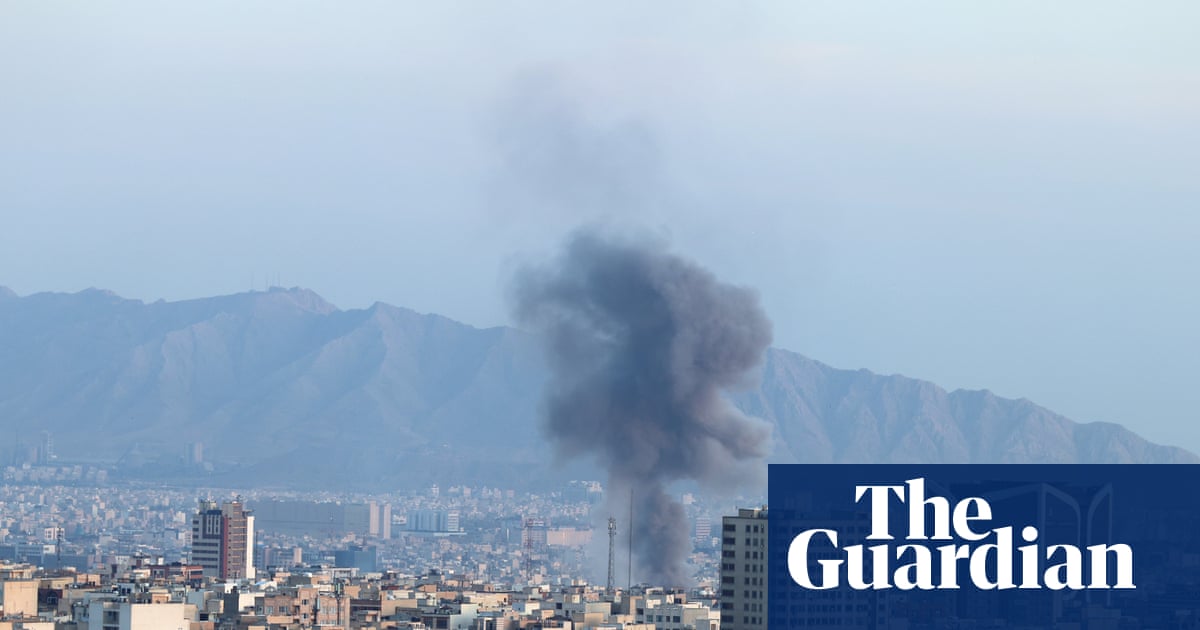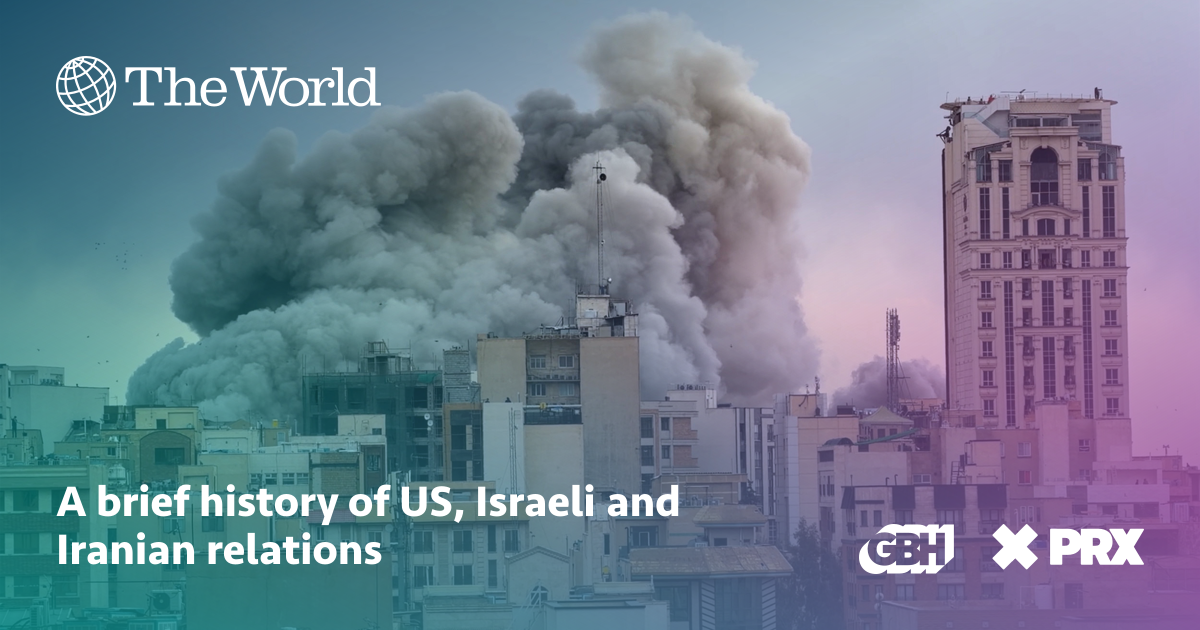
Public radio’s longest-running daily global news program.AboutContactDonateMeet the TeamPrivacyTerms of use©2026 The World from PRXPRX is a 501(c)(3) organization recognized by the IRS: #263347402.A brief history of US, Israeli and Iranian relationsThe current war in the Middle East is just about a week old, but the history of US intervention in Iran dates back to the 1950s. We take a step back to look at the history of relations between Iran, the United States and Israel with Naghmeh Sohrabi, a professor of Middle East history at Brandeis University. She joins Host Carolyn Beeler to explain. US-Israel-Iran WarMarch 11, 2026Updated: March 11, 202612:46A plume of smoke rises after a strike in Tehran, Iran, March 2, 2026.The US-Israeli strikes on Iran came suddenly in late February, 2026, but violence and tension between the three countries is not new. They’ve shared a complex relationship for much of the past century. Naghmeh Sohrabi joined The World’s Host Carolyn Beeler to discuss the history that set the stage for the current conflict. She is a professor of Middle East history at Brandeis University near Boston.Naghmeh Sohrabi: The story goes back to 1951, when the Iranian Prime Minister Mohammad Mosaddegh nationalized the British oil company. At the time, the way it was was that the Brits had built the infrastructure and they were extracting oil and they got a far larger share of the profits than the Iranians were. And by nationalizing it, Mohammad Mosaddegh made a claim that the oil belonged to Iranians. It was an act of independence. So, after that was when the British appealed to the Americans to help them regain control of oil profits in Iran. And through a whole series of events, the CIA got involved and conducted this coup. And when it was over, what happened was that the Brits and the Americans then each got a 40% share of the new oil company that took the place of the British oil company. In this Sept. 27, 1951 file photo, Prime Minister Mohammad Mosaddegh rides on the shoulders of cheering crowds in Tehran’s Majlis Square, outside the parliament building, after reiterating his oil nationalization views to his supporters.AP/File photoYeah, I would say it was very, very good between the three countries, although it’s really important to remember that the main relationship here is between Iran and the United States. Because out of the 1953 coup, the Shah felt that what he needed more than anything else to survive was to build up a military that was loyal to him.And what that meant was that US-Iran relationships happened primarily through large credits that the Iranians got, that the Shah got, in order to buy military equipment. And the other relationship that happens between the three is through the security forces. So in 1957, Iran creates its security intelligence force, which is called SAVAK in Persian. And it does that with the help, eventually, of both the United States and Israel.US President Jimmy Carter, the Shah of Iran (left), Empress Farah and Mrs. Roslynn Carter on the balcony at the White House in Washington, Nov. 15, 1977.AP/File photoThe revolution took a while to come, and in the sense that it was connected to the United States, one of the most important parts of it happens actually in 1964 when the United States and Iran come to a status of forces agreement. And the reason that’s important is that what Iran gives to the United States in return for more military credit was the fact that no American on Iranian soil would be prosecuted by Iranian judiciary. So, it was kind of immunity of everybody, any American in Iran.And the reason that is important is that that is the moment in which Ayatollah [Ruhollah] Khomeini, rises as the leader of eventually what becomes the revolution. In other words, in some ways, Khomeini’s fame is tied up to the fact that he was against the capitulation rights. And he gave his famous speech and eventually is exiled, and is in exile for 15 years. I think it’s really important for us to remember that the 1960s and ‘70s in the United States, in Europe and all over the world, especially young people, are basically rising up and mobilizing against this idea of — they’re anti-imperialist, anti-colonial. The question of social justice is a very important global idea among the youth in particular. For the Iranians, this anti-imperialism meant something very specific, right?It was anti-American because of the 1953 coup. It was anti-Israel because of the way in which Israel and the United States were deeply connected. And the ways in which the Palestinian cause was a global cause for a lot of, again, young groups that were mobilizing. At the same time, you have Khomeini in exile. By fall of 1978, he really emerges as the leader of this umbrella group, these umbrella revolutionaries. Many of them leftist, many of them secular, many of them Islamic. They’re a whole hodgepodge of groups, but they all come together under his leadership.Ayatollah Khomeini is pictured in Tehran after 14 years in exile, Feb. 1, 1979. In an address he declared the government of Iran illegal because it was appointed by the Shah.AP Photo/File photoUS-Iran relations actually does not break up with the revolution. What breaks up US-Iran relations is actually when a number of politically active students in November of 1979 climb up the walls of the US embassy and they take over it in what we know as the 444 days of the US hostage crisis. When they climb up the walls and take over the US embassy, that is when they kind of turn to the government, to both the transitional government and Ayatollah Khomeini as in, “OK, we did this, what do we do now?”And the most common narrative is that Khomeini then kind of gave a green light to what they were doing. But the transitional government actually was against that and it resigns in protest. And you can think about it as a moment in which the Iranian revolution in the Islamic Republic could have taken multiple paths. And the path that it then takes is towards more radicalization. And that’s when diplomatic relations between the two countries absolutely breaks up.In this Nov. 27, 1979 file photo, demonstrators, including oil tank drivers with their vehicles, protest in front of the U.S. Embassy in Tehran, Iran. The 444-day hostage crisis soured relations between the US and the Islamic Republic for decades to come.Mohammad Sayad/AP/File photoIf you take, for a second, the US motivations for the current war out of the equation, the line then would be that by getting rid of the deal and never putting another deal in place, you basically eliminated one method by which to actually have some kind of control over Iran’s nuclear capacities. With that gone, you were left basically with three options. Renew a deal, continue with sanctions on the country or go to war. And the Islamic Republic of Iran is a system in which its own survival is its number one priority.And so, it ratchets everything up. In many ways, by not having a deal and getting rid of the deal, we were barreling our way toward a war or toward status quo, and clearly status quo was no longer an option. The reason I say it’s a bit more complicated or it’s not so simple is that we still do not know, President Trump’s administration has given multiple reasons for why this attack and why now and what the end goal is. And because we don’t have clarity as to what decision makers in Washington are thinking about what constitutes a victory in this war, drawing a link between 2018 and this moment in terms of what is the end goal becomes very difficult.In this Sept. 10, 2015 file photo, US President Barack Obama, accompanied by Secretary of State John Kerry, meets with veterans and Gold Star Mothers to discuss the Iran Nuclear deal, in the Roosevelt Room at the White House in Washington.Andrew Harnik/AP/File photoI grew up in Iran in the 1980s when the eight-year bloody war with Iraq, which was the bloodiest conventional war in the 20th century between two countries, had happened. And I remembered as a teenager, wondering if we were ever going to be released from this feeling and what it meant to constantly be thinking about death all the time. And those of us who lived through the Iran-Iraq War, and particularly the missiles and bombings of the cities, carry that trauma with us in different ways. We have dealt with it in different ways, but we have [actually] dealt with it in different ways.And I think back to that and I think that, at the end of the day, people’s need to survive and need to live is a very, very strong instinct. And more and more people are going to die. Infrastructure is being just absolutely pummeled to smithereens. And I would say that today I was in touch with an Iranian journalist, and she wrote to me, “May we see each other in a free Iran.” And I have to believe that that is one of the many possibilities in front of us.Parts of this interview have been lightly edited for length and clarity.
A brief history of US, Israeli and Iranian relations - The World from PRX
The current war in the Middle East is just about a week old, but the history of US intervention in Iran dates back to the 1950s. We take a step back to look at the history of relations between Iran, the United States and Israel with Naghmeh Sohrabi, a professor of Middle East history at Brandeis University. She joins Host Carolyn Beeler to explain.
1,551 words~7 min read