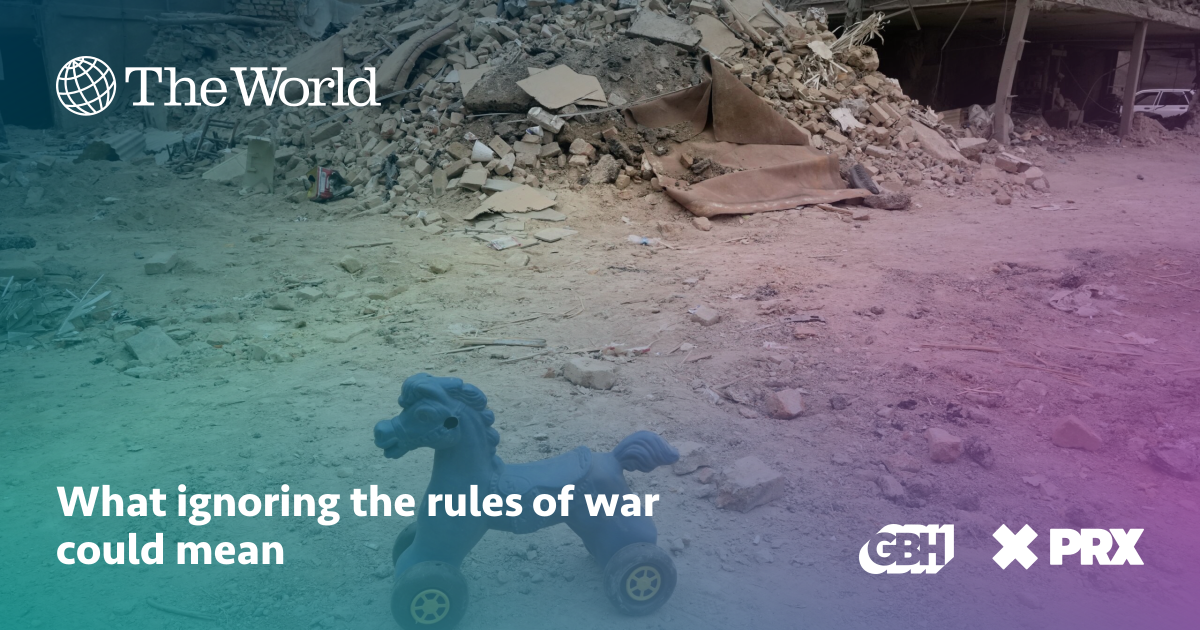
Public radio’s longest-running daily global news program.AboutContactDonateMeet the TeamPrivacyTerms of use©2026 The World from PRXPRX is a 501(c)(3) organization recognized by the IRS: #263347402.What ignoring the rules of war could meanThe war in Iran suggests many of the doctrines, rules and assumptions that shaped US military strategy for decades may no longer apply. Margaret MacMillan, an emeritus professor of history at the University of Oxford talks with The World’s Host Marco Werman about the consequences of dispensing with the international rules‑based order that attempted to govern global conflict and constrain the use of force under law.13:16A toy remains on the ground next to a residential building damaged when a nearby police station was hit Friday in a U.S.-Israeli strike in Tehran, Iran, Sunday, March 15, 2026. There is more chaos and escalation this week in the US-Israeli war on Iran. Israel is expanding its ground operations in Lebanon in an attempt to root out the Iran-backed militant group Hezbollah, and US President Donald Trump is calling on allies and China to send warships to Iran to help reopen the Strait of Hormuz. So far, the response to Trump’s request has been tepid at best, prompting the president to accuse reluctant countries of disloyalty to the United States.It’s just the latest in a series of reminders since the war began that we are living in a new era. Many of the doctrines, rules and norms that shaped American military strategy for decades are being tossed out the window. US Secretary of Defense Pete Hegseth, at a Pentagon press briefing earlier this month, boasted that the US military is unleashing the most precise and lethal air power campaign in history.“All on our terms with maximum authorities,” Hegseth said. “No stupid rules of engagement, no nation building quagmire, no democracy building exercise, no politically correct wars.” Margaret McMillan, an emeritus professor of history at the University of Oxford and a leading scholar of 20th-century peacekeeping agreements, joined Host Marco Werman to discuss the consequences of ignoring international rules of engagement.In this file photo released by US Marines, a US Marine looks back at the body of a dead Japanese soldier while his platoon passes a small village on Okinawa, in April 1945. US Marines via AP/FileWell, what was happening was the Industrial Revolution and the rise of nationalism, the rise of competition among powers in the 19th century. And there was, I think, a growing fear that the weapons of destruction were getting so strong that they would threaten the whole of human civilization. There was a tremendous attempt in the 19th century to [address] that. And of course, that was further fueled by the First World War, out of which we got the Americans and others coming together to try to make a League of Nations that would act collectively against aggressors. Because there was, I think, a real prospect, as we know today, that we now have such means of destruction, and that’s how they certainly felt by the end of the 19th century and the beginning of the 20th century. We have such a means of destruction that we can destroy human civilization itself. And so, we have to think of ways to avoid that.The first meeting of the council of the league of Nationas, September 10, 1924 at Geneva, prior to the big Assembly. AP photoWell, it has been severely damaged because it is being ignored, and it was ignored, of course, by Russia when it attacked Ukraine and took Crimea, and when it attacked Ukraine again and seized large chunks of Ukrainian territory. I mean, one of the laws of war is that seizing territory by force will not be recognized by the international community, and that’s pretty much been in effect since 1945. And that, of course, now seems to be going by the by. We’ve also, I think, seen treatment of prisoners that has not matched, they have not lived up to the rules of war. The sad thing is that the laws of war actually benefit both sides. You know, sooner or later Americans, for example, will be taken prisoner, and it would be in the interest of the United States and those prisoners that they be treated according to the Geneva Conventions. This image from video provided by US Defense Department shows explosion on an Iranian ship in the Indian Ocean during the Iran war.US Central Command via APThat has often happened, and it has helped to undermine faith in international law. You could argue that the invasion and occupation of Iraq, which the coalition carried out, really tended to make international law look rather useless. But I think the fact that we have it is a way of holding up nations and their leaders to criticism; holding them up, perhaps, eventually to punishment. I mean, we have seen cases where those who have broken the laws of war have, in fact, been tried. [Former Presidents] Slobodan Milosevic of Yugoslavia and Radovan Karadzic of Bosnia have been tried at The Hague, and they have been blamed for what they did. So, I think it remains an aspiration. It’s not always going to work, but I think we’re better off with some form of international law, and hope that international law can work than not having it at all, because then we just go back to power makes right, and the powerful will do whatever they want. Well, the Geneva Conventions of 1949 simply expanded and made more explicit a lot of what had been understood before. And again, I think we have sometimes managed — not always — to hold nations to account. And we have sometimes managed to prevent worse things happening. I mean, Slobodan Milosevic was planning to expel all the Albanians from Kosovo, and he had already started to do it. Collectively, we managed to stop that. And a number of the Albanians were able to come back to what was their homeland. I think we have to keep trying. The alternatives, I think, are too terrifying. And, of course, we have much stronger weapons now than we’ve ever had before. I mean, our capacity to destroy civilization globally is now huge. Kosovo Albanian children place Albanian flags on the graves at memorial complex during the 20th anniversary of the NATO bombing in the village of Glogjan, Kosovo on Sunday, March 24, 2019. Kosovo on Sunday celebrated the 20th anniversary of the NATO bombing as the start of their freedom and independence victory. Many killings from then-Serb leader Slobodan Milosevic were a major factor in NATO’s decision to launch an air campaign against Serbia to end Kosovo’s 1998-99 war. Visar Kryeziu/APWell, the rules were not followed. It was an unprovoked attack by an American Army patrol on a village from which there had been, I believe, shots fired at American forces, but it was a village with ordinary people in it. No evidence that there were Viet Minh there. And there was simply a massacre. It was a classic example of the military running out of control. They’re trained to kill, but they’re trained to do it in a disciplined way. And, unfortunately, the discipline broke. There wasn’t full punishment for everyone involved, but it was made public. It did lead to a great deal of soul-searching in the United States, a great deal of discussion about what is happening to our children, what is happening to us. And the mother of one of the soldiers involved said, “I sent you my son. He was a good boy, and you sent me back a murderer.” I think that really mattered. And I think one person was held accountable, but a number of names came out, and I think those who were involved had to live with the shame of it. I think it was an important moment and a very good example of what can happen when military discipline breaks down.A man points out to Sen. Tran Van Don, left, the place where he said he found 30 bodies after U.S. troops left My Lai in South Vietnam in March 1968, on Dec. 3, 1969. The man said he was hiding outside the hamlet at the time and declared he did not see Americans kill civilians, but heard women crying and gunfire after they entered the hamlet. The man at the right is unidentified. Hugh Van Es/APWell, we do have to worry about that, and it seems to me that the statements of Secretary of Defense Hegseth are not what you would expect from a Secretary of Defense, and none of his predecessors, I think, would have talked like that. Power is not the only thing that matters in war, and just because you can do something doesn’t mean you should. You know, we can get into the moral arguments, but I think there’s also a very practical argument here, and that is, if you break those rules, you’re asking for trouble for your own soldiers. I think that’s important, and I think it’s important that civilians are protected; that civilians don’t ask to be caught up in a war, they sometimes find themselves in the middle of a battlefield or at the receiving end of an attack. It is important that the civilians be protected, because one day it’s going to be your civilians that are going to need to be protected. Even if you are the great power, one day your civilians are going to be in that position, and I think you want to do what you can to protect them.We tend to get back to the relevance after a catastrophe … and that’s part of the trouble. It sometimes takes something awful to happen, and I don’t think we want the world to get any more trouble than it is at the moment. But sometimes events make us realize that, in fact, we need to think of other ways of settling disputes and going to war. And again, just to go back to something I said earlier, I mean, the weapons at the disposal now of the powers and not-so-great powers, including North Korea, are absolutely terrifying. I mean the bomb dropped on Hiroshima — which destroyed a whole city — was tiny by comparison with what’s in the arsenals of some of the nuclear powers today. And so we can’t risk a major war. We need even more than before, perhaps, to find ways of avoiding war. And that’s what the League of Nations, at the end of the First World War, which was very much pushed by the United States and President Woodrow Wilson, and that’s what the United Nations, again, very much pushed by the United States, and this time the United States joined, which it didn’t for various reasons with the League Of Nations. President Franklin Delano Roosevelt really thought that it was important because he understood what war would cost. He’d lived through the First World War. He’d seen the devastation of the Second World War, and there was a lot of support for this around the world; that we have to find another way of settling disputes and going to war. The idea was that these new institutions would provide collective security, so that if an aggressor nation attacked one of their members, collectively they would deal with it. Now, that hasn’t always worked very well, as we know. But I think the idea is a good one. And just because something doesn’t work doesn’t mean the idea’s not good. And as I say, I don’t think we have much choice now but to try and avoid war, and avoid a war that will spread into a major confrontation between nuclear-armed powers.President Franklin Delano Roosevelt, left standing at the podium, calls for the production of 125,000 aircraft Jan.6,1942, as he delivers his war message to Congress. AP photoWell, I for sure hope it doesn’t mean that, because I think, even worse, it is catastrophic. I mean, you know, we had a global war, particularly in the Second World War, and the damage done by weapons then was absolutely enormous. I mean, the damage that could be done today, I think, is absolutely horrific. And, of course, we’re not just destroying people, we’re destroying infrastructure. We’re destroying the environment. Already, what’s happening in Iran, with the enormous fires that are going on, is polluting the air and may have long-term consequences. I think we’re really in a very dangerous situation. I only hope that the powers of the world will sort of step back and say, “Look, we don’t want to go into a major war.” The trouble is when you start a conflict, you never know where it’s going to end; when great powers get involved, then it gets more dangerous. I mean, we may look back in 20 years and say, “Thank goodness! We dodged something there,” and people may have forgotten that it happened, and students may say, “What? Was there a war in the Middle East?” But we may look back and say, “We should have known better.”Parts of the conversation have been edited for length and clarity.
What ignoring the rules of war could mean - The World from PRX
The war in Iran suggests many of the doctrines, rules and assumptions that shaped US military strategy for decades may no longer apply. Margaret MacMillan, an emeritus professor of history at the University of Oxford talks with The World’s Host Marco Werman about the consequences of dispensing with the international rules‑based order that attempted to govern global conflict and constrain the use of force under law.
2,190 words~10 min read