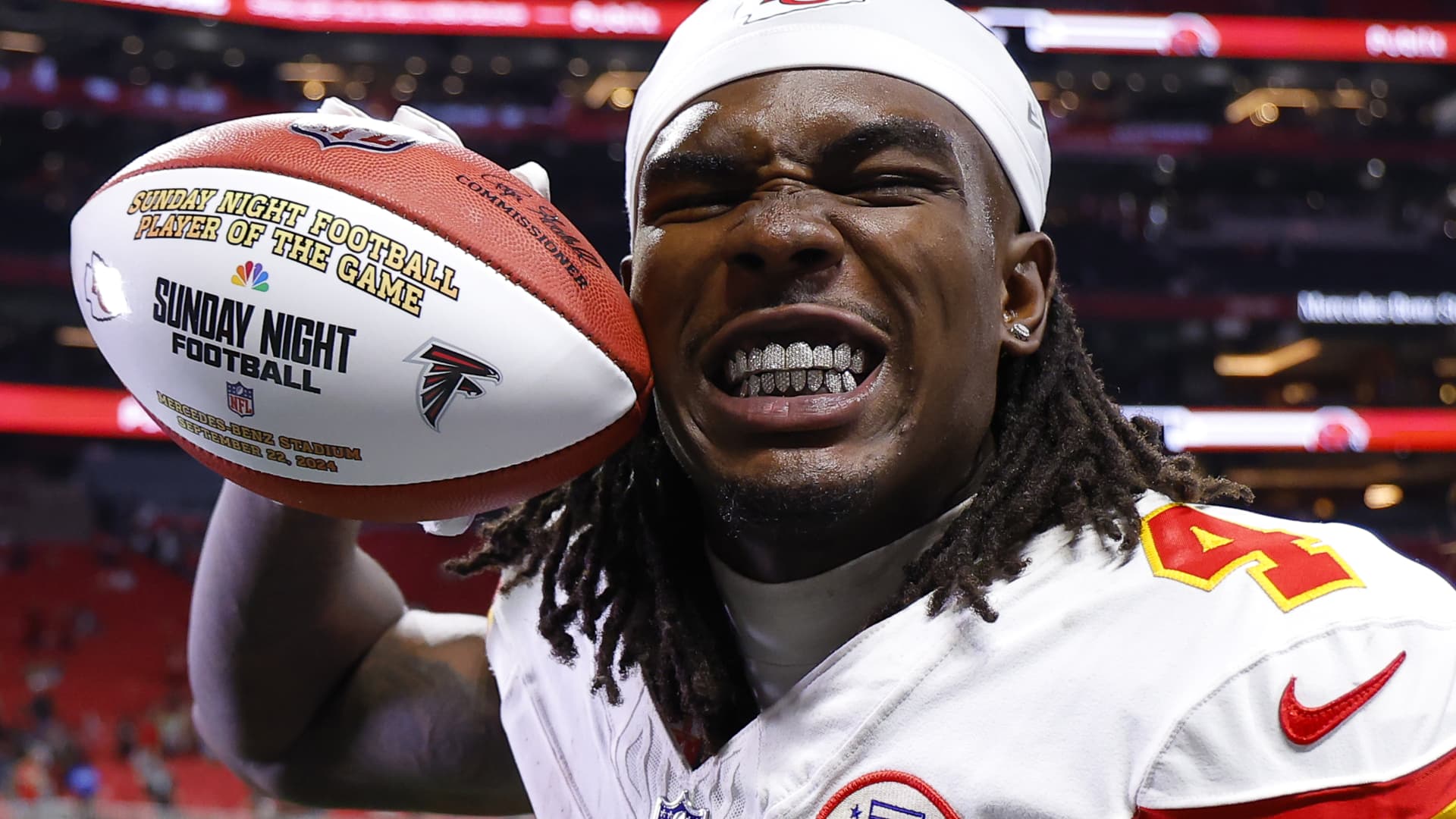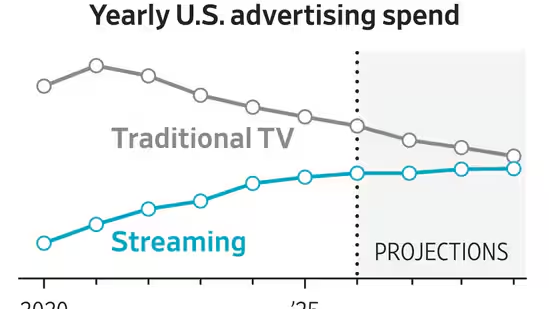
As the monoculture goes about its business of finding a quiet corner to curl up and die in, live sports continues to gobble up much of the TV advertising dollars that once targeted big-reach entertainment programming. Little wonder, then, that in-game spend across the converged TV market is on pace to zoom past the $20 billion mark just one year from now.According to a new report from eMarketer, sports’ share of converged ad spend—a catchall that includes investments across traditional and connected TV—will reach a smidge (+$30 million) over $20 billion in 2027, up 3% versus the $19.53 billion projected for this year. As such, sports will account for nearly a quarter (23%) of what’s expected to be an $87 billion U.S. TV market.As the broadcast and cable networks pull back on their original scripted development and entertainment impressions vanish like so many D.B. Coopers, sports will secure its position as TV’s last great reach vehicle. By 2030, sports TV spend is expected to reach $24.83 billion, up 27% from this year’s projected haul. (That works out to a little more than four times the 6.6% growth rate eMarketer has gamed out for the overall converged TV ad market between 2026 and 2030.)Leading the charge at the league level is the NFL, which in 2025 commanded 47% of all U.S. sports TV dollars. Toss the college game into the mix and football accounted for almost three-fifths (56.8%) of last year’s sports TV investment. Advertisers’ seeming inability to get enough of the gridiron is a function of football’s outsized popularity; per Nielsen, 90 NFL and college games ranked among last year’s top 100 most-watched broadcasts. Given football’s stranglehold on the American psyche, and the fact that U.S. consumers spend approximately $300 billion more during football season than they do throughout the rest of the year, marketers tend to heavy up on ad spending in the fourth quarter. Per eMarketer, 45.7% of all stateside sports TV spend in 2025 landed in the period spanning Oct. 1-Dec. 31. At 37.5%, first-quarter spend wasn’t all that far behind, but Q2 (20.2%) and Q3 (23.2%) were relatively sleepy.Naturally, the first quarter of 2026 will be a bit of an outlier, as NBC generated $1.92 billion in ad revenue by way of its coverage of Super Bowl LX and the Milan Cortina Winter Olympics. Per eMarketer estimates, the Big Game generated approximately $920 million in ad sales, and Disney could cross the $1 billion mark with February’s outing in Inglewood. (The Mouse House is softening on its initial unit-cost ask, as upfront pricing has been closer to $9 million per 30-second spot than the sticker shock-inducing $10 million demand with which it opened its negotiations.) Advertisers’ enthusiasm for in-game buys is amplified by a combination of relative scarcity and scale. Scripted TV no longer puts millions of fannies in the seats; per Nielsen, adults in the 18-49 demo made up just 12% of the Big Four networks’ primetime deliveries during the 2025-26 broadcast season. By way of comparison, 33% of NBC’s Sunday Night Football audience last season were members of the under-50 set. The NFL’s dominance really pops when you plug in the average demo deliveries, as SNF drew 6.85 million viewers per game in the dollar demo, whereas the entertainment average for the season that ended last week was shy of 400,000.Give it a few years and sports will be just about the only thing left to buy on TV. Disregarding the handful of streaming-native shows that were used to fill in a few gaps in the primetime schedule, the networks this past season aired a record-low 51 scripted series. That marks a 45% drop compared to the pre-pandemic 2018-19 slate, when 92 scripted shows were featured on ABC/CBS/NBC/Fox.While the primetime eyeballs are following scripted programming’s ongoing exodus to the streaming platforms, traditional TV isn’t losing much ground to connected TV on the sports front. Per eMarketer, CTV this year will account for 42.5% of total converged TV spending, but just 18.3% of the overall U.S. sports TV spend.That dynamic will persist through at least 2030, which is as far as eMarketer’s projections extend. Four years from now, CTV will account for 29% of U.S. sports spend, versus 71% for the legacy TV networks.Some of the disconnect can be chalked up to taxonomy, as many streaming sports feeds are merely simulcasts of live linear telecasts. For example, the commercial loads in the CBS Sunday afternoon NFL games are identical to the loads that pop up during the games streaming on Paramount+. As these “pass-through” commercials originate on trad TV (and are brokered by TV sales execs), they are categorized as linear spots.In the near term, the next monolithic sporting event on the calendar is the 2026 FIFA World Cup, which kicks off on June 11. The 39-day juggernaut concludes with the July 19 final, whereupon Fox and Telemundo are expected to amble off into the sunset with a combined $850 million in ad sales revenue. If the projections hold, that’ll work out to a 121% increase compared to the most recent summer World Cup in 2018, when the rights holders booked $384.3 million.
NFL-Fueled Sports TV Ad Market to Approach $25 Billion by 2027
The NFL last year accounted for 47% of all sports TV advertising spend, with the NBA coming in a distant second at 10.8%.
858 words~4 min read