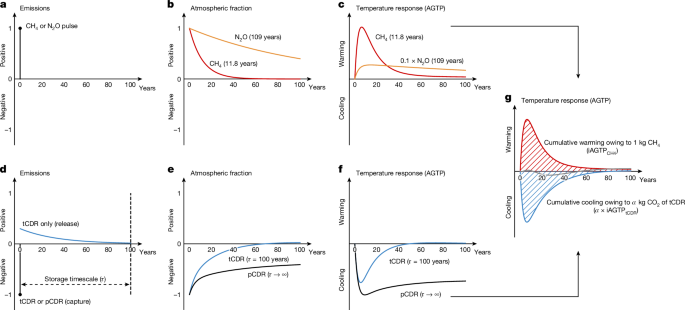
MainCDR is essential for achieving the long-term temperature objectives of the Paris Agreement and national net-zero emission targets, receiving increasing attention from scientists, policymakers and industry1,2,3,4,5. The durability of these CDR methods varies widely, ranging from decades to theoretically permanent sequestration6. However, true permanence remains challenging to achieve in practice, owing to economic and technical barriers, as well as reversal risks from land management changes and natural disturbances8,9,10. Consequently, most CDR methods in use today are inherently temporary7,11,12,13. Yet, although permanent CDR would straightforwardly integrate into climate policies as negative CO2 emissions, temporary CDR presents far greater complexity owing to its transient nature6. This creates an urgent need for robust frameworks to accurately assess and integrate temporary CDR into climate policies.Previous scientific attempts have sought to establish direct equivalency factors between temporary and permanent CDR14,15,16,17,18, as also suggested in recent versions of the United Nations Framework Convention on Climate Change (UNFCCC) information note19. However, emerging research demonstrates that such equivalency is fundamentally flawed6,7. These equivalency approaches assume that temporary and permanent CDR can be used interchangeably to offset CO2 emissions, but this assumption contradicts the physics of the climate system: CO2-induced warming is proportional to cumulative emissions, with CO2 persisting in the atmosphere for centuries to millennia6,20. Although permanent CDR reduces this cumulative burden, temporary CDR only creates transient reductions without altering long-term totals. Consequently, temporary CDR cannot offset CO2 emissions as permanent CDR does6,7, yet the transient nature of its climate effects suggests alternative applications within climate accounting frameworks.Here we propose a physics-based framework to account for temporary CDR against non-CO2 climate forcers. Our approach builds on impulse response functions (IRFs), which underpin established climate metrics such as global warming potential (GWP) and global temperature change potential (GTP) used in the Intergovernmental Panel on Climate Change (IPCC) reports21,22,23 (see details in Supplementary Note 1). Using this approach, we systematically quantify compensation ratios between temporary CDR and various non-CO2 climate forcers across different storage timescales. This foundation ensures transparency, tractability and direct compatibility with the UNFCCC, enabling immediate application in climate action.A physics-based frameworkFigure 1 illustrates our framework for assessing the potential of temporary CDR to compensate for anthropogenic non-CO2 emissions. We illustrate it with CH4 and N2O owing to their substantial roles as short-lived and long-lived climate forcers, respectively. A positive pulse of CH4 or N2O emission (Fig. 1a) decays at different rates in the atmosphere depending on the lifetime of each species (Fig. 1b), leading to progressive global warming that is markedly different between the two species (Fig. 1c): CH4 shows an earlier peak in induced warming compared with N2O, owing to a much shorter lifetime, whereas the magnitude of the warming per unit emission is mainly dictated by the radiative efficiencies of the species. As presented in Supplementary Note 1, the temperature response to a unit pulse emission of species x is the absolute GTPx (AGTPx). The time-integrated AGTPx (denoted iAGTPx)22,24,25 quantifies the cumulative warming effect over a chosen time horizon (denoted TH): $${\mathrm{iAGTP}}_{x}(\mathrm{TH})=\mathop{\mathop{\int }\limits^{\mathrm{TH}}}\limits_{0}{\mathrm{AGTP}}_{x}(t){\rm{d}}t$$
Temporary carbon dioxide removal to offset short-lived climate forcers - Nature
Temporary carbon dioxide removal can offset short-lived non-CO2 climate forcers, providing a viable physical approach for crediting temporary carbon dioxide removal activities in industries in which non-CO2 emissions dominate and direct emission reductions are difficult.
6,692 words~30 min read