Data availabilityThe ERA5 variables, including temperature, specific humidity, geopotential, pressure, U and V vectors and orography, were downloaded from the Copernicus Climate Data Store (https://cds.climate.copernicus.eu/). CMIP6 model simulations are available at https://esgf-node.llnl.gov/search/cmip6/. The hailstone observation records from the USA are obtained from https://www.ncdc.noaa.gov/stormevents/. The observations of maximum hailstone diameter (MHD) are obtained from the China Meteorological Administration (CMA). Owing to our data use agreement with CMA, the original data cannot be made publicly available; however, we provide the processed spatial distribution of MHD and the raw records are available from CMA on request (datacenter@cma.gov.cn). Other data (including near-surface hailstone size, growth duration, composite hailstone trajectory) necessary to reproduce the main results are available from figshare at https://figshare.com/s/d28e1430d2cfd3bfbbaf (ref. 66). Owing to the substantial volume of raw data (more than 3 TB) of hailstone growth trajectories, it is not feasible to provide direct access to the full dataset. We provide the raw dataset of historical scenario simulation and ensemble-mean simulation from EC-Earth3, MPI-ESM1-2-LR and NorESM2-LM for three future scenarios as a reference, available from https://doi.org/10.5281/zenodo.18152366, https://doi.org/10.5281/zenodo.18161078, https://doi.org/10.5281/zenodo.18246083 and https://doi.org/10.5281/zenodo.18168495 (refs. 67,68,69,70). The full-size raw data can be obtained by contacting the corresponding author (qzhang@pku.edu.cn); otherwise, we also provide the specific steps to initialize and conduct the semi-3D hail trajectory model in NOTES.docx available at https://doi.org/10.6084/m9.figshare.30103474.v2 (ref. 71) and can be followed to regenerate the data. All preparatory data and code necessary for reproduction of our results are available at https://doi.org/10.6084/m9.figshare.30103471.v3 (ref. 66) and https://doi.org/10.6084/m9.figshare.30103474.v2 (ref. 71), respectively. All figures using maps were generated using ProPlot in Python, which provides the underlying base maps.Code availabilityThe hailstone trajectory simulations are performed using NCAR Command Language version 6.6.2 and figures are generated using Python 3.9.7. The code and script used to simulate hailstone growth trajectories and generate figures are available from figshare at https://doi.org/10.6084/m9.figshare.30103474.v2 (ref. 71).ReferencesMunich Re. Hail, tornadoes, flash floods: losses from thunderstorms on the rise. Munich Re https://www.munichre.com/en/risks/natural-disasters/thunderstorms-hail-tornados.html. (2025).Bevacqua, E., Schleussner, C. & Zscheischler, J. A year above 1.5 °C signals that Earth is most probably within the 20-year period that will reach the Paris Agreement limit. Nat. Clim. Change 15, 262–265 (2025).Article
Rising global hail damage potential in a warming world - Nature
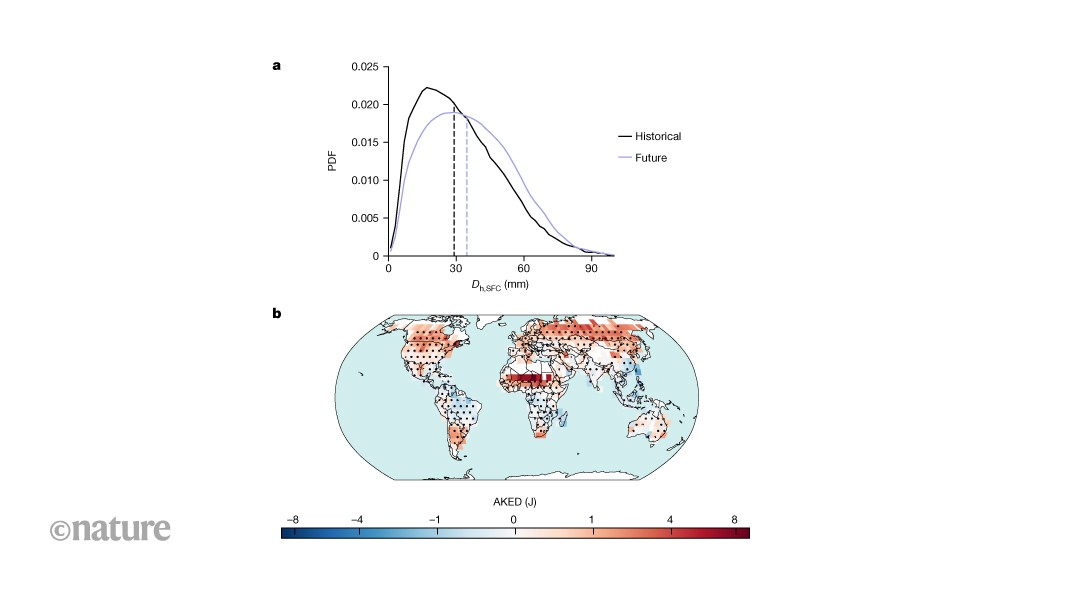
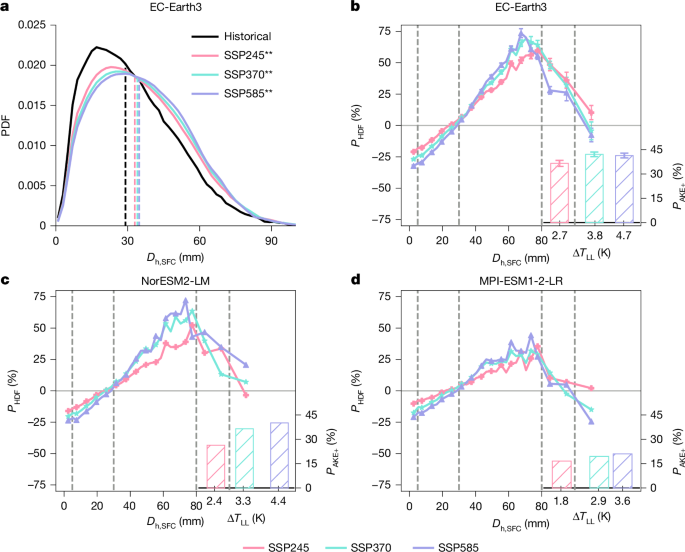
Hailstone trajectory simulations conducted under historical and future scenarios show a shift towards larger hailstones, resulting in global hailstorm-induced damage potential increasing by around 40% by the late twenty-first century.
4,139 words~19 min read