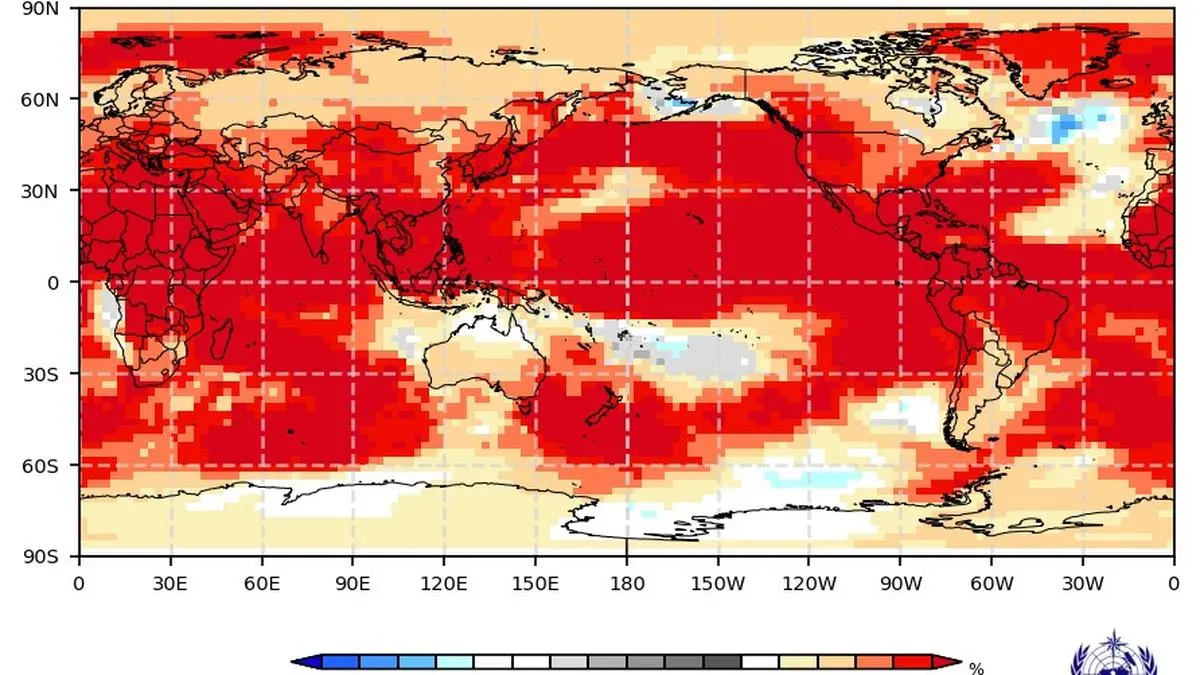
Global temperatures are expected to remain at or near record highs over the next five years, with the Arctic warming faster than the global average, says a World Meteorological Organization (WMO) report, produced by the UK’s Met Office.There is a high probability of temporary breaches of the 1.5°C threshold, along with increasing chances of El Niño conditions by 2027, says the report, Global Annual-to-Decadal Update.It takes into account the climate of the last five years and gives regional projections for temperature and precipitation for the next five years.Climate driver“The five-year predicted average temperature in the central tropical Pacific (Nino 3.4 region) leans towards El Nino conditions, especially in 2027 and 2028,” says the report.There is an El Niño predicted for the end of 2026, which increases the chances of the following year, 2027, being the next record-breaking year,” says Leon Hermanson, the lead author of the report.Warming trendThe global mean near-surface temperatures are estimated to be 1.3°C–1.9°C higher during 2026–2030 than during 1850–1900. The update indicates a high likelihood (86 per cent chance) that a year between 2026 and 2030 will be warmer than 2024, the warmest year on record.There is a 91 per cent probability that the global mean near-surface temperature will temporarily exceed 1.5°C above the 1850-1900 average levels for at least one year between 2026 and 2030.This level was also temporarily exceeded in 2024, when the global average surface temperature was approximately 1.55 °C above the pre-industrial baseline.Temperature outlookThere is a 75 per cent chance that the five-year mean for 2026-2030 will exceed 1.5°C above the 1850-1900 average.There is less than a 1 per cent chance that any one year in the next five will exceed 2°C above the 1850-1900 average.Climate targetsThe 1.5°C (and 2.0°C) levels mentioned in the Paris Agreement refer to long-term warming sustained over a long period of time, usually evaluated over 20 years.While individual years with annual global mean temperatures above these levels do not mean the long-term temperature goals of the Paris Agreement are not achievable, temporary exceedances are expected to become more common as the underlying rise in global temperature approaches these levels, the report said.Published on May 28, 2026
Global temperatures likely to stay near record highs through 2030: WMO
WMO report predicts global temperatures will stay near record highs until 2030, with increased El Niño risks and temporary 1.5°C breaches.
359 words~2 min read