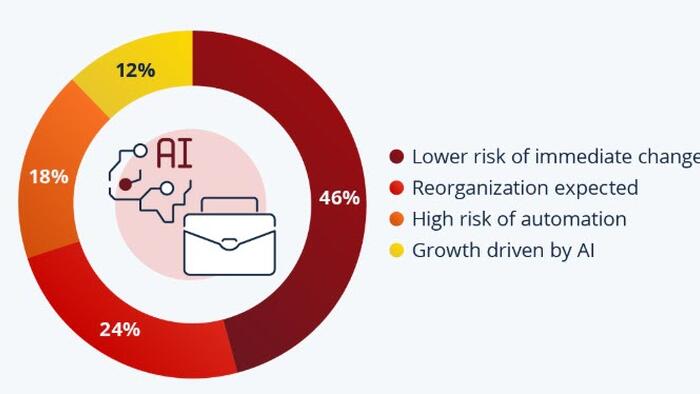
Want to know if your job is at risk of being taken over by artificial intelligence?Researchers at the Massachusetts Institute of Technology have developed an online tool to help you figure it out. The AI Labor Exposure Map is a point-and-click resource that breaks down specific workplace tasks, then shows which of them can also be performed by AI. At a glance, workers can see whether they’re on the verge of becoming obsolete.Pierre Bouquet, a doctoral candidate at MIT’s Center for Transportation and Logistics, says the map wasn’t created in an effort to predict how many jobs would be lost to AI. “It would be a very doomsday thing to do,” he said. And besides, he noted, the rise of AI may create many new jobs one of these days.Instead, Bouquet and visiting student Luca Mouchel built a tool that anyone can use to find out which of their activities can be performed by AI, and which are still beyond a computer’s abilities. This could help workers better plan their careers. And employers can also use it to identify AI services that could help their businesses run better.Get Starting PointA guide through the most important stories of the morning, delivered Monday through Friday.Enter Email“It’s not a forecast,” said Bouquet. “It’s a measurement.”Bouquet and Mouchel broke down jobs into a set of specific tasks, as defined by data from the US Labor Department. Then they used information from major AI vendors Anthropic and OpenAI to determine which of these tasks can presently be performed by an AI system, and the amount of time spent on these tasks by human workers. For instance, the report estimates that about 20 percent of a mechanical engineer’s time is spent on tasks that AI could perform, such as reading blueprints. That means about 80 percent of the time, the engineer is doing something that only a human can do, at least for now.But if you’re a marketing specialist, look out. Nearly three-quarters of your time is spent on tasks that today’s AI systems can handle, such as conducting market research or analyzing a competitor’s products. Only a few tasks, such as assessing customer satisfaction, still require a human touch.The researchers estimated the types of jobs found in every part of the United States, so they could calculate the geographic impact of AI and display it on an interactive map. In much of the United States, AI has a relatively low penetration — for instance, in Wyoming, where only about 11 percent of the workforce face serious AI competition. But in Greater Boston, 15 percent of workers are exposed, and 17 percent in Silicon Valley. A user can point and click on any part of the website’s map for an assessment based on local economic conditions. Nationwide, about 13 percent of workers now face serious AI competition, according to the map. However, many of these workers are concentrated in relatively high-paying fields such as software development, accounting, and law, where AI systems perform well. The researchers estimate that current AI systems are capable of performing $1.4 trillion worth of work throughout the economy. This suggests that companies could find massive savings by shifting this work to computers.However, they’re not predicting mass layoffs. In many cases, the human-centric parts of a job are still essential. Instead of laying off workers, an employer could use the research to identify tasks that could be automated, so that the workers can be reassigned to handle only the uniquely human tasks.Bouquet said he’s planning to keep the map up to date by tracking the latest AI news reports. Every new AI feature that can match human performance will be added to the database. So if you think your job is safe from AI, you might want to check back in a few months.Hiawatha Bray can be reached at hiawatha.bray@globe.com. Follow him @GlobeTechLab.
AI’s impact on jobs? It’s all over the map. - The Boston Globe
MIT researchers created an interactive view that lets you see how vulnerable your role might be.
641 words~3 min read