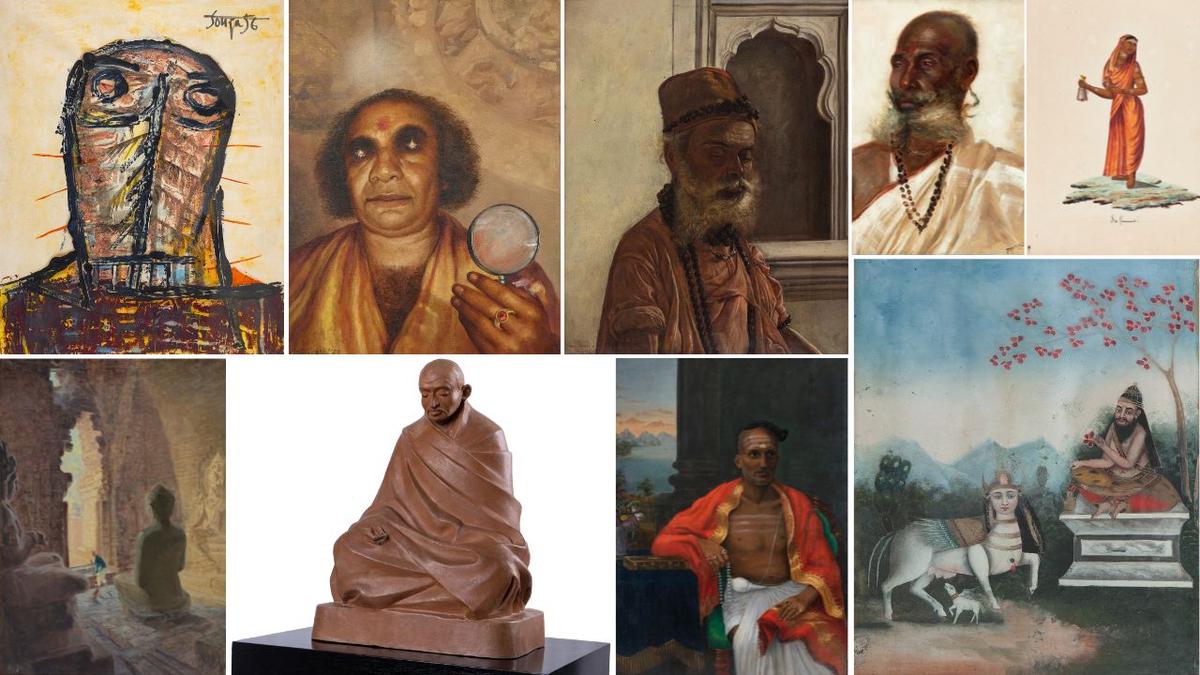
On an unusually quiet Friday evening, I walk into a time zone bearing the weight of centuries. Figures who chose denial over indulgence, discipline over comfort, have made their home on the walls of Delhi’s DAG. Curated by art historian Gayatri Sinha, the gallery’s ongoing exhibit The Body of the Ascetic showcases a rich and diverse collection of 70 artworks, comprising mostly paintings, one textile and a few sculptures that depict the ascetic figure across cultures.Amid the traditional re-imaginings sit some of the more modern interpretations from the 20th century that blend the personal and the social. F.N. Souza’s iconic untitled 1956 painting shows a bristling head, marked by lines, geometric pattern and textured background; Amit Ambalal’s indolent saint is stretched on a tiger skin; and Gogi Saroj Pal’s emaciated figure in Young Monks (1980) contemplates the solitary lives of ascetics.
F.N. Souza’s Untitled work from 1956.
| Photo Credit:
Courtesy DAG
“There is a personal axis in the works, which defies caste-based readings of acts of devotion or indeed sectarian divisions,” says curator Sinha. “There is a very fine set of watercolours by Nandalal Bose that has been interpreted as his mourning at the seaside at the death of his father. At the same time, it may signify the passing of the Vaishnava saint Shri Chaitanya, who is believed to have entered the waters at Puri and was never seen again.”An evolving figureSome of the world’s richest traditions of ascetic art can be attributed to the Indian subcontinent and its expansive archive spanning millennia. The Body of the Ascetic draws from this genre.