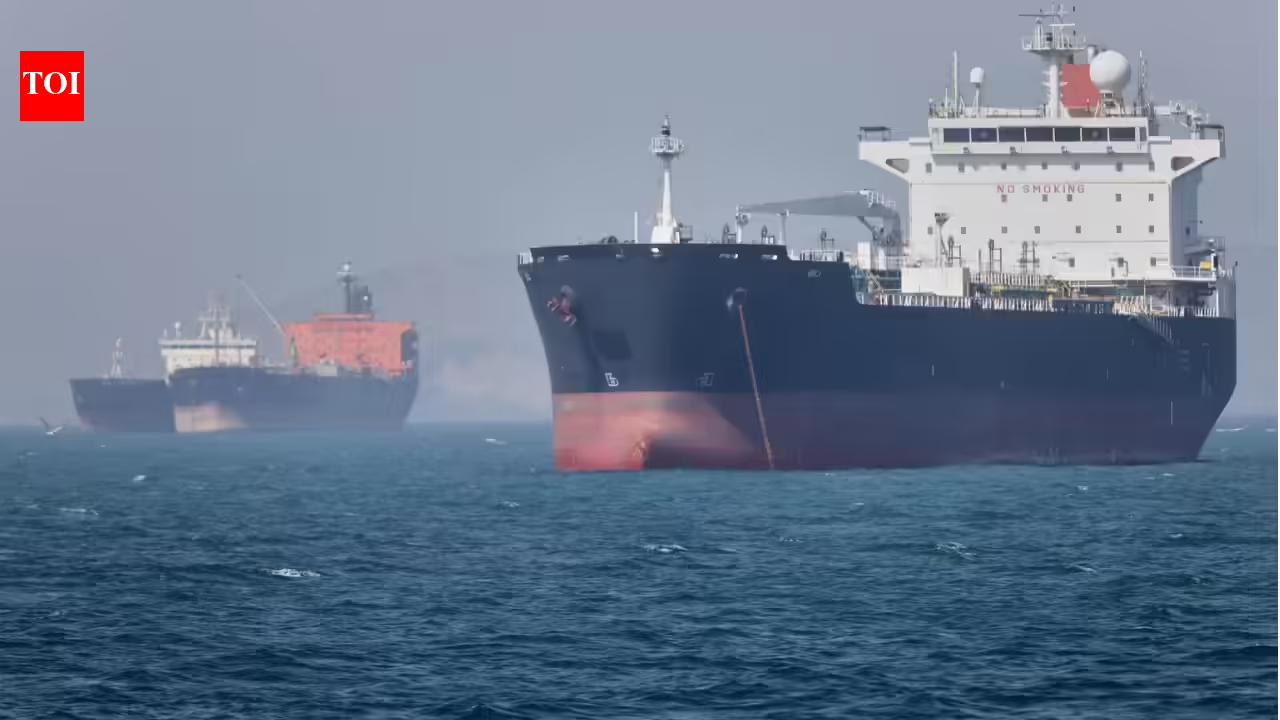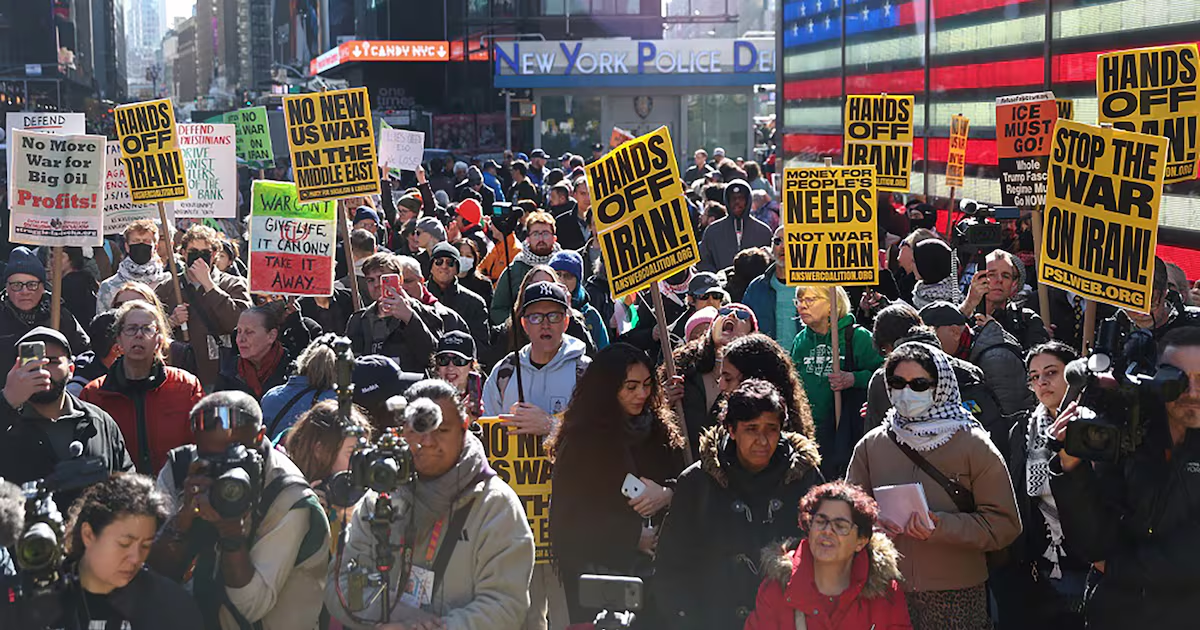
For more than four decades the Islamic Republic of Iran has lived under the longest and heaviest unilateral sanctions regime yet imposed on a developing economy. Successive layers of US and EU measures ― tightened dramatically after Washington’s withdrawal from the Joint Comprehensive Plan of Action in 2018 ― have not only constrained Iran’s oil exports and its banking system, but they have also held back one of South Africa’s most natural and historically valuable trading relationships. The bond between Pretoria and Tehran is not new, and it is not opportunistic. Iran was among the very first countries to lift its own trade boycott against South Africa as apartheid ended, and full diplomatic relations were restored in May 1994. By the late 2000s Iran was the single largest supplier of crude oil to South Africa, providing about 380,000 barrels per day ― about a third of the country’s crude demand ― feeding refineries that had specifically been engineered to process Iranian grades. Joint ventures followed, most visibly the Sasol–Iran National Petrochemicals Company partnership in Iran, then valued at more than $900m. (Karen Moolman) However, under the weight of sanctions bilateral trade fell from about $1.3bn in 2012 to less than $30m by 2015. South African refineries were retrofitted away from Iranian crude, Sasol exited its Iranian polymer joint venture and an entire generation of investment and technology co-operation in mining, agriculture, health, transport and energy was shelved. The South African government has consistently described these unilateral measures, in its own diplomatic language, as irrational and illegal and has opposed them at the UN and international forums. The cost has not been borne by Tehran alone; it has fallen on every South African business that lost a market and every consumer who now pays more because supply chains were forcibly redirected away from their most logical source. Endangered global economy That long economic pressure has now been compounded by something far more senseless: the illegal military aggression launched against Iran on February 28 by the US and Israel. The strikes on peaceful nuclear facilities, on the South Pars gas field that supplies about 70% of Iran’s gas production, on Mahshahr, Asaluyeh and Bandar Abbas and on the Iranian leadership itself represent a frontal assault on the sovereignty of a UN member state and a blatant breach of article 2(4) of the UN Charter, which prohibits the threat or use of force against the territorial integrity of any state. Furthermore, committing ecocide and targeting a country’s infrastructure constitute war crimes and have serious consequences, including causing a humanitarian crisis. The economic shock has been instantaneous. Brent crude has risen by more than 40% since the strikes began, with physical Brent touching $141.36 a barrel ― the highest level since 2008 ― before settling above $120. Naphtha breached $1,000/tonne, surging nearly 74% in two weeks. The ICIS petrochemical index recorded a 32.7% month-on-month jump in March, the steepest since the index was launched in 2000. European ethylene contracts settled at a record €1,595/tonne, an unprecedented €450/tonne single-month increase. With nearly 84% of West Asian polyethylene exports normally moving through the Strait of Hormuz, the ongoing aggression against Iran has wiped out an enormous share of global polymer supply. How the shock hits SA South Africa imports most of its refined fuel and crude. After the considerable increase in fuel prices the National Treasury reduced the general fuel levy to protect consumers, at a cost of about R17.2bn. That is money diverted away from health, education and infrastructure to absorb the pressure from a crisis South Africa did not create. The downstream consequences are even broader than just fuel prices. Transport and logistics costs are rising across every road-freight corridor. AgriSA estimates that fuel already accounts for 12%–18% of farm-level production costs, while fertiliser ― itself surging because of disruptions to Western Asia’s urea, ammonia and natural gas ― represents 35%–50%. Polymer and petrochemical inflation feeds directly into packaging for milk, maize meal, bread, cooking oil and chicken; into pipes and fittings for water and sanitation projects; into vehicle components and into virtually every fast-moving consumer good on the shelf. Unprovoked aggression South Africa’s foreign policy underscores nonalignment, anticolonialism and the inviolability of state sovereignty. It was forged in the same struggle in which Iran stood with the liberation movements when much of the West did not. It is clear that the unilateral sanctions regime against Iran has always been unjust, that the military attacks of June 2025 and February 2026 are unlawful and the naval blockade of Iran constitutes a violation of the agreed ceasefire. Iran is a country with an extensive coastline along the Persian Gulf and with the Strait of Hormuz lying within its territorial waters it is fully entitled to benefit from this strategic waterway and to play a role in its management. Any country that permits the bombing of another state’s energy and civilian infrastructure has placed the food and energy security of every importing nation in jeopardy. The entire global community ― the AU, Brics+ and every member of the Non-Aligned Movement ― must call unambiguously for an immediate and full end to the aggression and a return to diplomacy under the UN Charter, not only in line with the principles of foreign diplomacy but also to protect their national interests and economies. • The author is ambassador of the Islamic Republic of Iran in South Africa.
MANSOUR SHAKIB MEHR | Why SA cannot afford silence on the war against Iran
US and Israel’s illegal aggression has hit consumers and businesses
899 words~4 min read