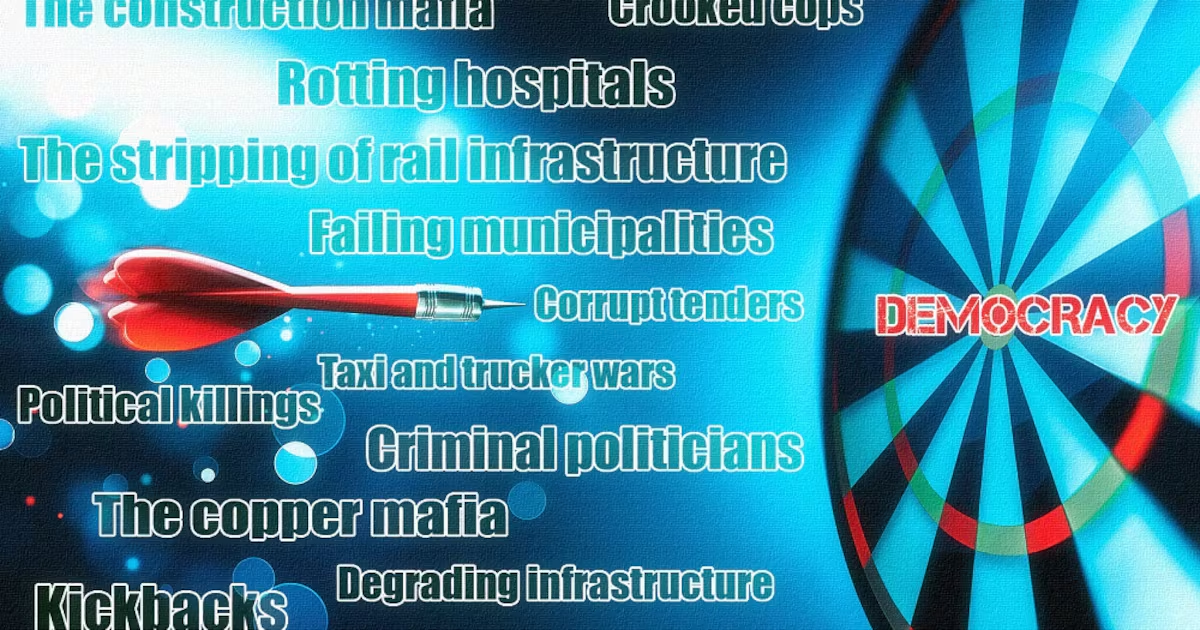
Latin America’s experience provides a cautionary note for what could happen if South Africa fails to bring to an end, or at the very least disrupt, the intersection of criminal organisations, politics and the public service.As a recent report by a Brazilian political scientist shows, in parts of Latin America criminal organisations are now shaping municipal contracting, policing appointments and who runs for public office. This in turn has made insecurity an electoral variable, influencing how campaigns are fought and “what voters are willing to trade for law and order”.There is a good supply of politicians who offer “expanded coercive authority in exchange for the promise of control, rather than the slower work of institutional reform”.Such offers have appeal for voters whose patience has thinned. This is because rebuilding or strengthening institutions takes time. And voters who have long suffered from crime and violence have lost the willingness to sit through several years of institutional reform.South Africa has these strands, and the existence of the political killings task team in the South African Police Service is one proof of this.The country is also at a socio-political tipping point, where the promise by populist politicians of a quick turnaround is gaining more appeal among some voters than a message of an improvement in conditions over the medium to long term.In a report for The British Academy and the Carnegie Endowment for International Peace, political economist Robert Muggah said criminal pressure on the political and governance systems in parts of Latin America plays out in three ways:First, there is coercion. This includes selective killings, threats and intimidation, which narrow the field of who runs for public office and what alliances can be formed.Second, violence by criminal enterprises increases the cost of participation and can reduce civic engagement and the availability of candidates. Voter turnout can also be affected.Third, when citizens feel helpless “repression is then marketed as a substitute for the slow work of reforming police, courts, prisons and anti-corruption systems”.Muggah warns that the main risk of the impact of crime and violence on democracy “is not stolen elections but hollowed ones ― contests that remain formally competitive yet are substantively constrained by intimidation, fear and a policy menu narrowed to punitive spectacle.“The problem is therefore not simply criminal violence but the political economy of control: a structure that rewards visible coercion and short time horizons while discounting institution building.”South Africa already has elements of what Muggah describes, including political parties, such as MK, that peddle practices that run counter to constitutional democracy. MK has previously called for a referendum on the death penalty for specific crimes such as murder and rape.The Global Initiative Against Transnational Organised Crime said in a 2024 report on political killings in South Africa that there was a 108% increase in these crimes over a decade.The initiative describes political killings as those involving people who hold political or administrative office, whistle-blowers and political activists. These killings intersect with organised crime and criminal networks. They spike ahead of elections and are most pronounced at municipal level.The report warned that political killings “are used to silence political opponents, take control of succession battles, infiltrate local governance and influence political outcomes”.If political killings aren’t brought under control in South Africa, it won’t be long before they turn the electoral process into a hollow spectacle choreographed by organised crime.• Sikhakhane, a former spokes person for the finance minister, National Treasury and South African Reserve Bank, is editor of The Conversation Africa. He writes in his personal capacity.
JABULANI SIKHAKHANE | Organised crime threatens local democracy and public service
Voters face stark trade-offs as insecurity shapes election campaigns
586 words~3 min read