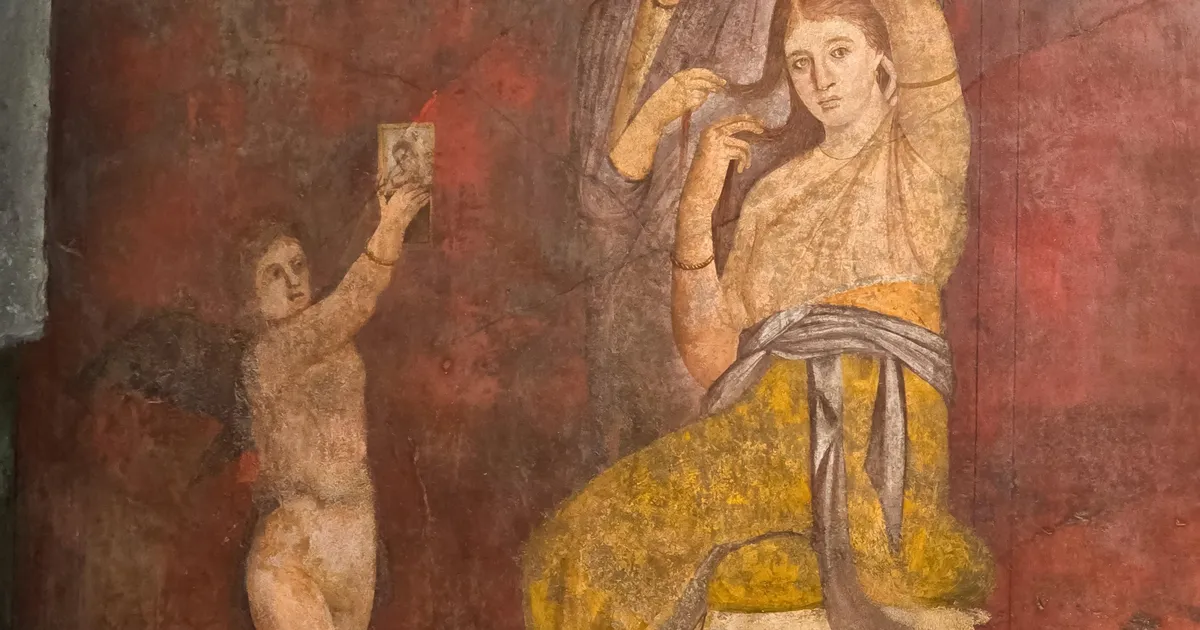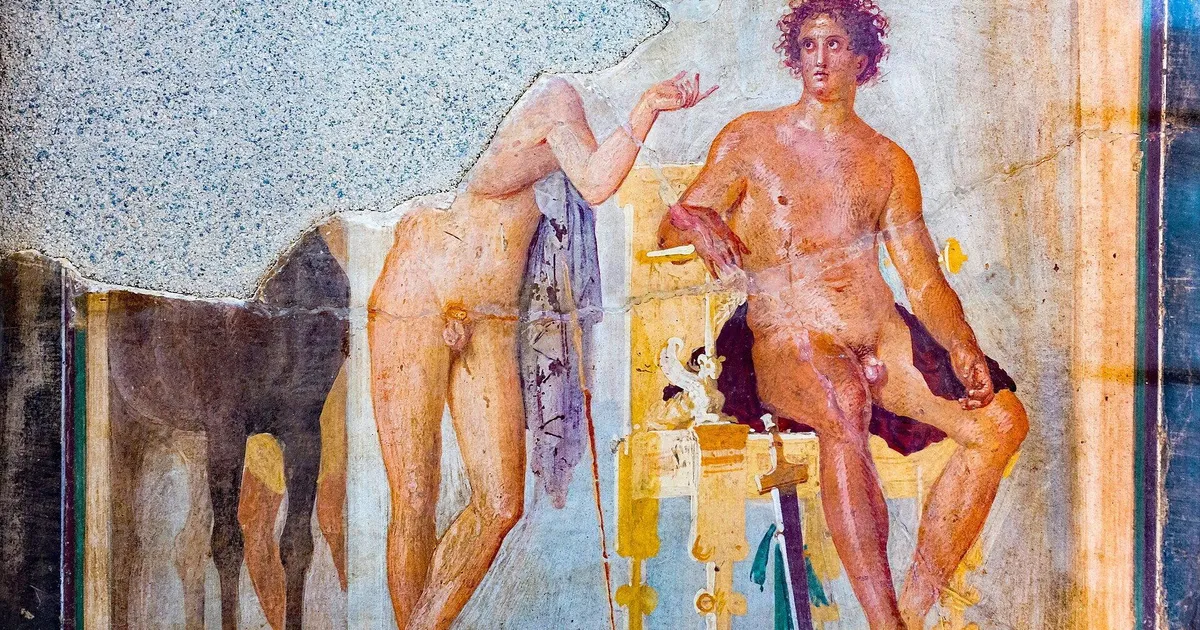
Current sectionArchaeologyThe Greeks viewed color through a poetic lens tied to nature and myth, but under the Romans it transformed into a language of status, power, piety and self-promotionShare to FacebookShare to XArticle printing is available to subscribers onlyPrint in a simple, ad-free formatSubscribeComments: Zen reading is available to subscribers onlyAd-free and in a comfortable reading formatSubscribeA Roman wall painting. Credit: ArchaiOptix/WikipediaA Roman wall painting. Credit: ArchaiOptix/Wikipedia01:40 PM • May 26 2026 IDTWhen it comes to color, few understood its magic better than Ovid. The first-century Roman poet was preoccupied not only with matters of the heart but also with style and beauty. In his famous poem on "The Art of Love," he offered Roman women a treasure trove of beauty advice, proving that color theory is far from a modern invention. Ovid's insights into complexion and contrast were remarkably ahead of their time. He argued that clothing should elevate a person's natural skin tone rather than work against it. For women with very pale, cool-toned skin, the poet suggested opting for darker colors to produce a striking contrast. He famously pointed to Briseis in the Iliad, noting that her dark attire made her pale skin appear luminous. Conversely, for women with warmer, olive, or darker skin tones, Ovid recommended lighter, more delicate shades such as white or pale yellow. Here, he used the mythological Ethiopian princess Andromeda as his muse, arguing that bright white garments were the most flattering choice to highlight her deep complexion. Essentially, the poet acted as antiquity's fashion consultant. Ovid reminded his readers that style is never one-size-fits-all, and that choosing the right color palette is key to looking one's best. He encouraged women to be playful and experimental, but ultimately grounded his advice in individuality, writing, "A woman should choose from these what suits her best ... Not every color fits everyone."While he did not use vocabulary like "cool undertones" or "high contrast," he understood the fundamental principle of "value contrast" the visual spectacle where a surrounding color changes our perception of a subject's brightness. A Roman wall painting – Flora-Stabiae (Vlla di Arianna) – Napoli. Credit: ArchaiOptix/WikipediaA Roman wall painting – Flora-Stabiae (Vlla di Arianna) – Napoli. Credit: ArchaiOptix/WikipediaYet, while Ovid championed individuality and the choice of shades that suited one's unique skin tone, the Roman elite were soon consumed by colors that emphasized rank, wealth, and divine might. At the absolute zenith of this socio-chromatic hierarchy stood a single hue.At the heart of Phoenician prosperity spanning about 1200 B.C.E. to 800 B.C.E.) was a pigment named after the city-state of Tyre. Trade in it became so synonymous with their identity that they became known as the "purple people." For millennia, Tyrian purple reigned supreme as the ancient world's most costly pigment. Harvested from the mucus of the Murex sea snail, the production process was extremely labor-intensive. It required approximately 10,000 shells to produce a single gram of pigment. The monumental dimensions of the ancient operation are revealed by the billions of discarded shells rising in massive mounds. This was the earliest known chemical industry of the ancient world. Naturally, the dye's rarity made it the ultimate status symbol. It became valued at its weight in gold, cementing its place as the era's most luxurious commodity. But beyond its scarcity lay another unique property.Wool fibers dyed with royal purple, 1000 B.C.E. in the Timna Valley, Israel. Credit: Dafna Gazit, courtesy of the Israel Antiquities AuthorityWool fibers dyed with royal purple, 1000 B.C.E. in the Timna Valley, Israel. Credit: Dafna Gazit, courtesy of the Israel Antiquities AuthorityTyrian purple was not just a color; it was a sensory experience. Unlike vegetable dyes like madder for red or woad for blue, where the color appears flat on the fabric's surface, Tyrian purple uniquely contained organic compounds that interacted with light, . According to ancient writers, the color would shift: In the shade, it looked like dark, clotted blood, which the Romans called purpureus. When the fabric was exposed to sunlight, instead of fading, the hue would transform into a vibrant, glowing crimson or violet. Because the dye was applied in multiple dips, the fabric took on a somewhat "three-dimensional" luminous dimension. It didn't just look like purple fabric; it was said to look like the fabric itself was purple. Or was it just good ancient marketing? What made it even more remarkable was its reported durability. It was a fabric that could last generations. The Roman naturalist Pliny the Elder, however, observed a stinky irony in the production of Tyrian purple. The extraction process required rotting sea snails, resulting in a stench so foul it was apparently legendary. As Pliny remarked: "It has a most unpleasant smell when it is fresh ... yet for this, luxury finds a way to pay a king's ransom." For all its prestige, Tyrian purple came with a distinct aromatic bonus: the stench of rotting shellfish apparently lingered in the fabric. It turns out smelling like the ocean at low tide was a privilege reserved for the few, and it was quickly adopted by ancient rulers. Julius Caesar is said to have been the first Roman ruler to wear a fully purple robe in public – a decision that was far more than a fashion choice. The decision did not go unnoticed. Rome was still formally a republic, with a longstanding hostility toward the idea of kingship. By draping himself in a color so strongly associated with royalty, Caesar, who was a master of self-promotion, was making a deliberate political statement, which, of course, did not go unnoticed. To the Senate, the kingly conduct confirmed their worst suspicions as to his ambitions, intensifying the political tensions that eventually led to his brutal assassination.Born into the purpleThere was another prominent case of assassination that was actually linked to purple. The Roman historian Suetonius claims that Caligula invited King Ptolemy of Mauretania to Rome and received him with great honor. The situation changed dramatically during a public gladiatorial event, when Ptolemy appeared wearing an extravagant purple cloak. Caligula, notorious for his volatile temper and narcissism, was allegedly so enraged at being outshone or simply at someone else daring to dress in purple in his company that he ordered Ptolemy's immediate arrest and execution. A wall painting – Phaidra conversing with the nurse – Pompeii. Credit: ArchaiOptix /WikipediaA wall painting – Phaidra conversing with the nurse – Pompeii. Credit: ArchaiOptix /WikipediaWhile the incident is often portrayed as an impulsive outburst of a made emperor, the purple garment was probably a convenient pretext. Ptolemy descended from the distinguished Ptolemaic dynasty of Egypt and from Mark Antony, giving him enough legitimacy that may have led Caligula to view him as a potential political rival. In addition, Ptolemy had earned the Senate's respect for his role in suppressing the Berber revolt led by Tacfarinas, which might have boosted his popularity among both the Roman military and the wider public. Caligula, who lacked notable military accomplishments of his own, may have perceived it as a threat. Not to omit that Mauretania was a wealthy and strategically valuable kingdom. By eliminating his opponent, Caligula annexed the territory and seized its substantial treasury, which helped him fund his extravagant spending in Rome.Nero was also particularly fond of the color. According to Suetonius, while the musician-poet emperor was performing on stage (the emperor considered himself a world-class artist), he spotted a noblewoman in the audience wearing purple. Enraged at the sight of such insolence, he allegedly ordered his agents to drag the miserable woman from the theater and strip her publicly. Suetonius further claims that Nero confiscated her entire estate as a warning to others so no one else would dare wear the forbidden color. Suetonius adds that Nero went to extreme lengths to enforce his purple monopoly. He supposedly sent a secret agent to a market to sell a few ounces of the dye. When unsuspecting merchants bought it, Nero used the violation as an excuse to shut down all the dye shops in Rome and seize their stock, to ensure he was the only "purple" person in the room. Although Suetonius was known for having a taste for tabloid news, the story has endured as an example of Nero's vanity and pettiness. Critics accused him of putting personal image above governance, and purple became the ultimate symbol of that obsession. By the late third century, during the reign of Diocletian, the color had become a state-controlled monopoly. Having risen to power through the ranks of the Roman army, this self-made emperor established the Dominate – a system in which the ruler was no longer an elevated citizen, but a Dominus (lord and master). To reflect the new order, Diocletian dressed in robes made entirely of Tyrian purple silk, often heavily embroidered with gold thread and jewels. The imperial extravagance extended even to his footwear, which was dyed a rich purple and adorned with precious gems. His purple absolute control reached into the economy as well. To combat rampant inflation, he issued the Edict on Maximum Prices. The decree set price ceilings on over 1,000 goods and services, among them Tyrian purple, thus ensuring it remained a luxury reserved for the ultra-rich. It was, however, Theodosius I who made the imperial monopoly on Tyrian purple effectively absolute. By late antiquity, the finest shades of purple dye were tightly controlled by the state, and wearing all-purple garments could be interpreted as laesa maiestas, or treason against the emperor, which, at its worst, was synonymous with a death sentence. Tyrian purple became officially reserved only for emperors and the imperial family. Later, under the Byzantine Empire (330 C.E. to 1453 C.E.), purple evolved essentially from a symbol of power into a dynastic privilege. The connection between the hue and imperial authority became so literal that it fundamentally reshaped the rules of succession. This tradition centered on the Porphyra (Purple Chamber) in the Great Palace of Constantinople. The room was said to be lined with slabs of rare purple porphyry, sourced from a single remote quarry in Egypt in Mons Porphyrites. Children born to a reigning emperor in this room were called Porphyrogennetos, meaning "born in the purple." This was not an empty honorary title: it was a potent instrument of political legitimacy. To be born surrounded by the imperial purple was to inherit a divine right to rule, one that completely overrode traditional birth order. The tradition was ironclad: it allowed a younger, purple-born brother to jump the line of succession ahead of an older, capable brother. Because everything must eventually come to an end, the 1,500-year reign of the snail ended with the Fall of Constantinople in 1453. Bloody redAnother color, however, endured throughout Rome's history and would play a defining role in its legacy: red. A Roman wall painting. Credit: Ad MeskensA Roman wall painting. Credit: Ad MeskensFor the ancient Romans, this was far from a mere aesthetic choice. It was a visual weapon, a divine shield, and the psychological scaffolding of an entire empire. To understand the Roman obsession with the color, one must look to the bloodstained myth of the city's foundation. The Romans regarded themselves as direct descendants of Romulus and Remus, the twin sons of Mars, the god of war. In the Roman pantheon, Mars was associated with fire and blood. By adopting red as their primary martial color, Roman commanders and soldiers were engaging symbolically in a religious act. They were wrapping themselves in the identity of their patron deity. Putting on a red tunic or painting a shield crimson was an act of invocation: a visual prayer meant to channel the ferocity of Mars and ward off evil spirits before stepping onto the battlefield. Also, the sight of red legions was a calculated move in a game of psychological warfare against the enemy. Beyond its striking appearance, the Roman red uniform served a grim, pragmatic purpose. Roman writers noted that red tunics and shields partially masked the sight of blood. If a soldier was wounded, the red fabric made the bleeding less visible. This concealment was meant to serve a dual psychological purpose, preserving the morale of fellow legionaries while convincing the enemy that their strikes were failing to inflict lethal damage. Red's influence extended far beyond the palisades of military camps; it was woven into the very fabric of Roman civic, domestic, and political life. In the crowded forums and street corners of Roman cities, the public walls served as giant, white-plastered billboards where official decrees, legal notices, and election posters (programmata) were painted in vivid red. While the Roman state used red for grand, official decrees, the streets themselves were a chaotic, democratic canvas that also hosted ordinary advertisements, often painted in red as well. These public walls displayed a vibrant mix of daily life, featuring all kinds of announcements: from gladiatorial games and real estate listings to even notices about runaway slaves. Painting or scratching on a wall was completely legal and culturally accepted. There was no concept of modern "vandalism." In the domestic sphere, on the other hand, red stood for protection and new beginnings. Far from the modern tradition of bridal white, a Roman bride was veiled in the flammeum, a deep orange-red veil. When a young woman transitioned into her new life as a wife, a flame-like veil symbolized the warmth of the new household, fertility, and devotion, while shielding her from evil spirits. For wealthy Romans, a similar passion for the color extended to their walls. The deep, rich hue that once graced the villas of high society is known today as "Pompeian Red." Exorbitantly expensive, this legendary pigment was derived from cinnabar, a rare mercury sulfide mined in Spain, and served as the ultimate status symbol of the elite.Live up to your white Yet while a bride's journey began in this vivid, protective flame, the daily life of the city she inhabited was governed by a very different one: white. To an untrained eye, it may have looked like a monotony of wool. But to a Roman, the shade of a man's tunic was the visual currency displaying power, purity, and political ambitions. Latin distinguished sharply between two shades: albus and candidus. The vast majority of the plebeians moved through the city in albus, the matte, unbleached gray-white of natural wool. It was practical, resilient, and well-suited to endure the urban environment. By contrast, the patrician elite draped themselves in candidus, which was a radiant white. This shade was deliberately manufactured, serving as a highly visible declaration of wealth and of the "noble" character of its wearer. White-robed priests of Isis perform a water ritual. Credit: Yair HaklaiWhite-robed priests of Isis perform a water ritual. Credit: Yair HaklaiNowhere was the deployment of candidus more deliberate than in the Roman political arena. To achieve its signature, brilliant gleam, the garment was heavily rubbed with fine white chalk. This served a dual purpose: it made the office-seeker instantly recognizable in a crowded assembly, while visually suggesting a character free of blemish. The 1st-century C.E. Roman satirist Persius brilliantly captured political hypocrisy with the term cretata ambitio or "chalked ambition." It is from this chalk-whitened robe that our modern word "candidate" comes from- a linguistic legacy born of ancient image management.Maintaining the pristine appearance of a toga pura, the everyday outfit of an adult male citizen, required significant resources. In the absence of modern laundry soap, the city's fullers relied on complex chemical processes to cleanse and bleach the heavy wool. Because this maintenance was both labor-intensive and costly, a spotless toga served as a subtle economic indicator, for affluence in Roman society, the appearance of cleanliness was inseparably linked to wealth.Beyond the realms of politics and class, white was also reserved for the sacred. When magistrates offered sacrifices to the celestial deities, particularly Jupiter, ritual law dictated that the priests wear unblemished white garments, and the victims, typically cattle, be entirely white.This association with the divine was mirrored in the state religion. The Vestal Virgins, tasked with maintaining Rome's sacred fire, were dressed in white linen. Here, the absence of color signified ritual purity and strict devotion to looking after the well-being of the state – a symbolism that followed the citizen to the grave. While the living adopted the dark, undyed toga pulla during periods of mourning, the deceased were shrouded in white. In life, Rome was fractured by color: the mega-elite jealously wrapped themselves in sea-scented purple, while the masses wore grey wool and lived in red brick. But before the gods, every citizen was stripped of these fleeting earthly colors. In death, all would come together in white – the ultimate equalizer of a rigid hierarchy, and the empire's final symbol of order, piety, and passage.In the NewsDressed to Oppress: Purple and Other Colors That Ruled and Divided Ancient RomeNeanderthals Seasonally Ate Snails on the Seashore of Spain 115,000 Years AgoIsraeli Day Trip: The Ancient Mound Where Philistines and Crusaders Cross Paths'We Know What It Wasn't': Strange Tunnel Exposed in Jerusalem Near Ramat RahelThe First Dentist: How a Single Tooth Changes What We Thought About NeanderthalsRemembering and rebuilding two years laterICYMIBen-Gvir Posts Video of Police Dragging Detained Gaza Flotilla ActivistsFreed Gaza Flotilla Activists Report Sexual Abuse, Rape in Israeli CustodyThe Most Consequential Republican Primary for Israel Is Happening in Kentucky'It Was Okay to Be Crazy': IDF Soldiers Discuss Moral Decay in LebanonWill Trump Forgive Netanyahu Over Iran? The Emerging Deal Suggests NotOn Israel, Gaza and Palestine, Bigmouth Tucker Carlson Spoke Nothing but Truth
Dressed to oppress: Purple and other colors that ruled and divided ancient Rome
The Greeks Viewed Color Through a Poetic Lens Tied to Nature and Myth, but Under the Romans It Transformed Into a Language of Status, Power, Piety and Self-promotion
2,918 words~13 min read