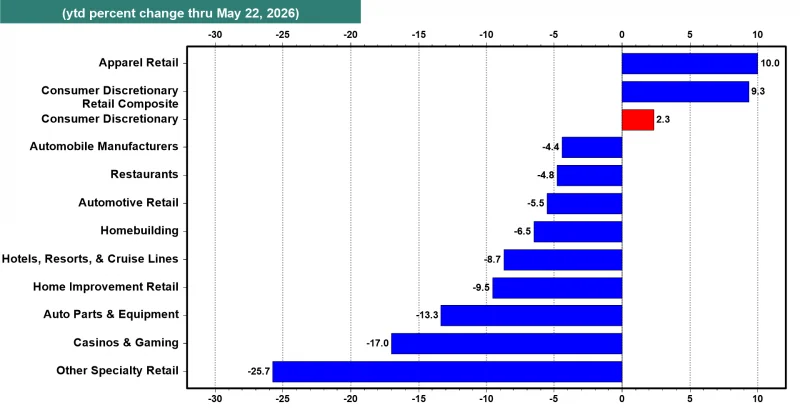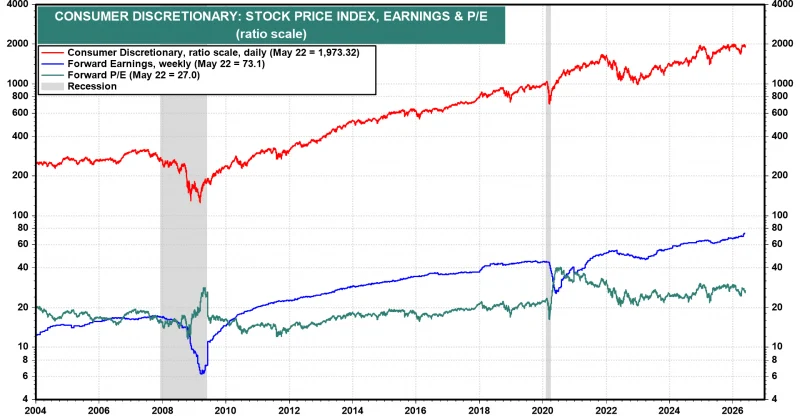
Something unusual is happening in American equity markets. The S&P 500 keeps grinding higher, yet consumer discretionary stocks, the companies that sell things people want but don’t strictly need, are performing at their weakest level relative to the broader index in roughly 20 years.
The numbers behind the split
The S&P 500 Consumer Discretionary sector has been underperforming the broader S&P 500 since late 2025, and the trend has only accelerated into 2026. In February alone, consumer discretionary stocks posted a decline of approximately 5%, even as the S&P 500 held positive during certain stretches of the same period.
As of mid-May, the sector index has been trading near the 1,950 level with modest daily fluctuations. That’s not a dramatic crash in absolute terms, but relative to a thriving broader market, the weakness is historically significant.
Amazon and Tesla alone make up about 38% of the consumer discretionary index’s major holdings. When two of the most closely watched companies on the planet can’t drag their sector upward, you know something structural is going on.