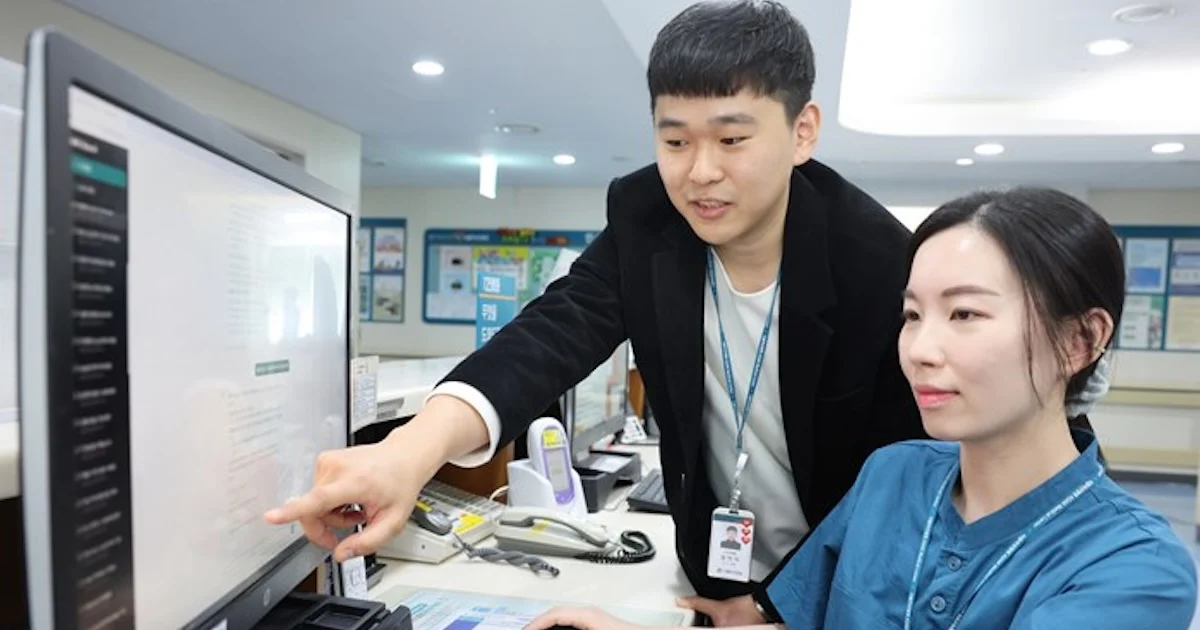
Photo courtesy of Asan Medical Center
A new AI-driven knowledge search system based on a private network has gone live at Asan Medical Center, one of South Korea's largest hospitals. The hospital's IT team took an on-premises approach to developing the system, which "runs in a closed network environment, completely disconnected from the external internet," AMC said in a statement.WHY IT MATTERSAMC said its new search system demonstrates how AI can be fully deployed in a private network, preventing sensitive data from leaking while achieving the "highest level of data protection" without relying on third-party solutions.Staff users can type in their queries on this search system and obtain answers "within seconds," with the reference provided below. "For example, in emergencies where manual verification is essential, such as emergency treatment and re-intubation protocols for endotracheal tube removal, or reporting procedures for confirmed cases of legally designated infectious diseases, they can respond quickly and calmly based on objective evidence provided by the AI," the hospital explained in a statement.A vector database and retrieval-augmented generation (RAG) form the technical core of this system, according to AMC. The vector database converts and stores content from large document sets, including clinical guidelines and operational regulations, in semantic units, allowing the system to search by context and meaning rather than keyword matching alone. RAG then requires the AI to search and reference stored documents before generating a response, reducing the risk of unsupported or fabricated answers, a problem in AI known as “hallucination.”In addition, AMC said it plans to introduce a separate "sandbox-type" external search engine for retrieving the latest necessary medical information. The hospital said this addresses the limitation of a closed network environment in obtaining the latest external information in real time. THE LARGER TRENDLast year in April, Seoul National University Hospital introduced its medical large language model (LLM), which is also based on RAG and department-specific knowledge bases. It reportedly scored 86.2% on the Korean Medical Licensing Examination, higher than the average score over the past three years.In December, it unveiled an upgraded version of its LLM, called KMed.ai, which it co-developed with Naver. It sees this model as the foundation of future medical artificial general intelligence. Another Korean hospital, Korea University Medical Center, also developed its own LLM based on vectorised data.ON THE RECORD"This system is highly significant in that it simultaneously addresses the two challenges of security and AI utilisation, and directly demonstrates that AI can be fully utilised even in a closed network environment," said AMC head of Digital Information Innovation Division and professor Young-hak Kim.