"The museum" is one of the most powerful spatial forms of the modern regime of knowledge. As indicated by the structure that Tony Bennett defines as the “exhibitionary complex,” a museum is not merely a space where objects are displayed, but also an apparatus of power in which knowledge is classified, visualized and legitimized.
In this context, the Istanbul Archaeological Museums are not only Türkiye’s oldest museum complex but also one of the epistemological turning points of Ottoman modernization. Viewed from today’s perspective, this ensemble – comprising the Archaeology Museum, the Museum of Ancient Orient and the Tiled Kiosk Museum – reveals not only the artifacts themselves, but also how a civilization perceived the world.
For this reason, it is more fruitful to interpret the Istanbul Archaeological Museums not merely as a “collection,” but as a “map of the mind.”
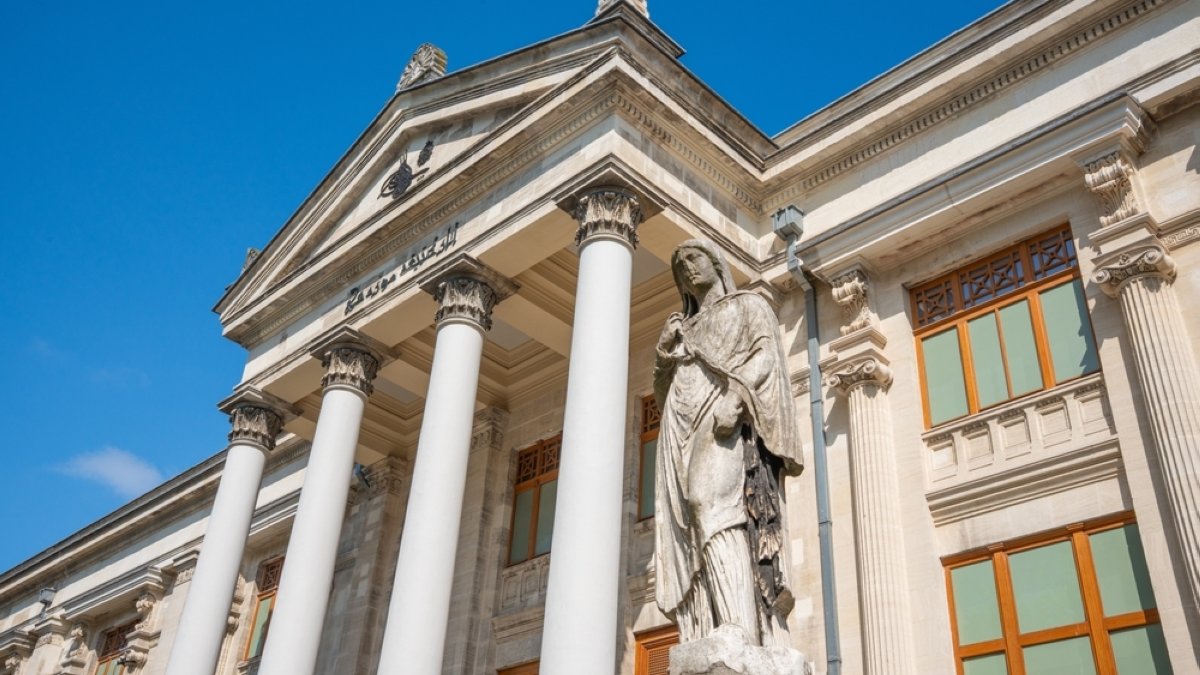
This undated photo shows preserved architectural details displayed in front of the Istanbul Archaeological Museums, Istanbul, Türkiye. (Shutterstock Photo)
Empire’s oldest exhibition space