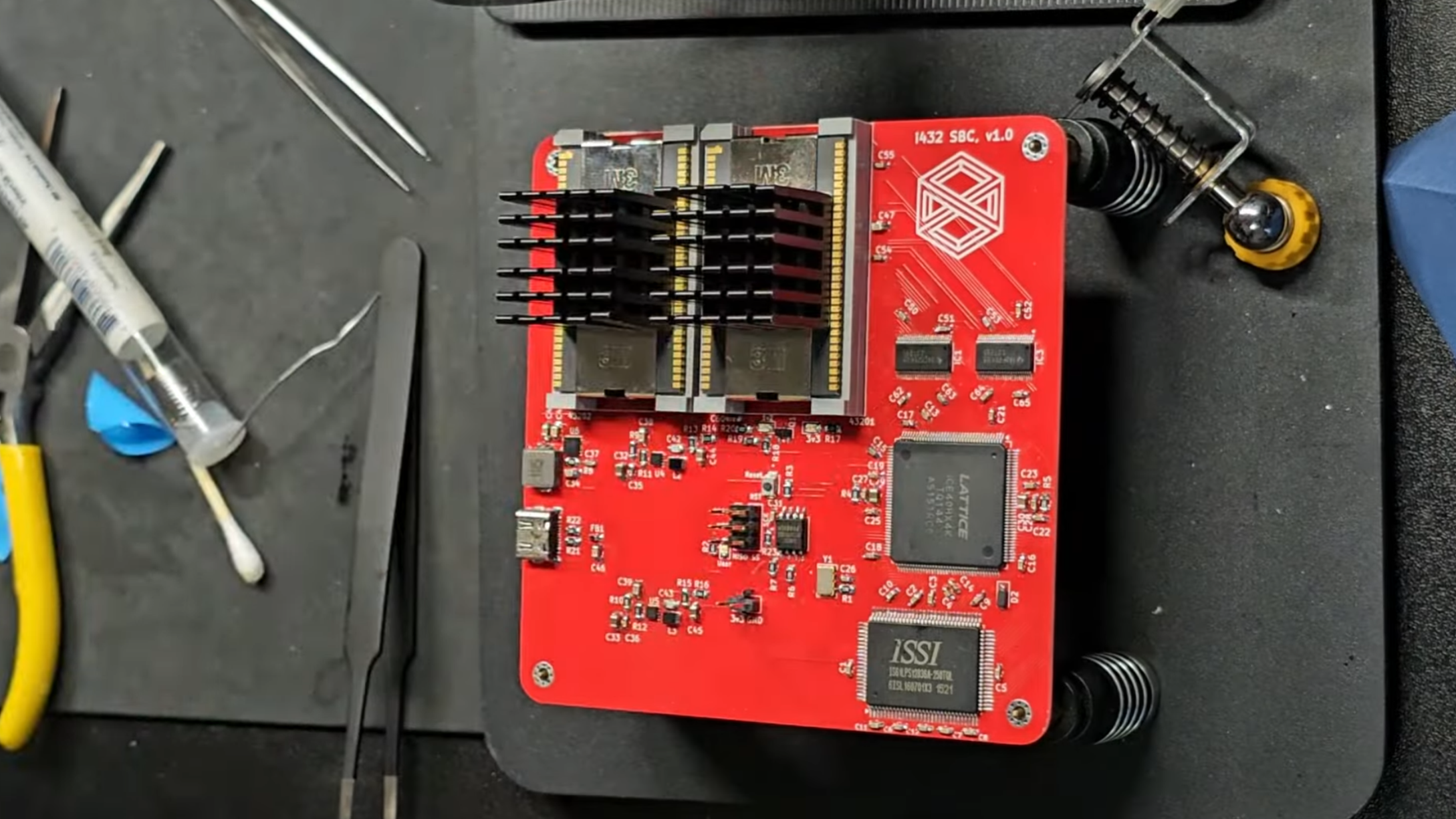
Processor design over the last few decades has moved toward RISC processors that aim to implement a few simple operations very efficiently. For a while, though, the trend was toward ever-more-complex CISC designs that let programmers implement complex behaviors using as few instructions as possible. Few processors took this approach further than the Intel iAPX432. This hyper-CISC processor was a commercial failure, largely due to its notoriously poor performance, but [MarkTheQuasiEngineer]’s benchmark suggests that this notoriety wasn’t totally deserved. The first step before running a benchmark was to build a computer around the processor. The iAPX432 was implemented in three chips, two of which acted as the general data processor (GDP), and one of which handled input and output. [Mark] built an SBC (design and code here) that houses the two GDP chips and an FPGA for I/O. The 432 did have a well-deserved reputation for efficiently turning electricity into heat, and the original voltage regulator failed rather quickly.The 432 was designed to use machine code which was almost a high-level language, with built-in object-oriented programming. It had over 200 operators, some of which implemented complex object-oriented operations, and a wide variety of data types, but it had no directly-accessible general-purpose registers. In addition to the lack of registers, it also had a very complex addressing system, allowing both direct and indirect addressing. For better performance, [Mark] used direct addressing.
Just How Bad Was The Intel IAPX432?
Processor design over the last few decades has moved toward RISC processors that aim to implement a few simple operations very efficiently. For a while, though, the trend was toward ever-more-compl…
322 words~1 min read