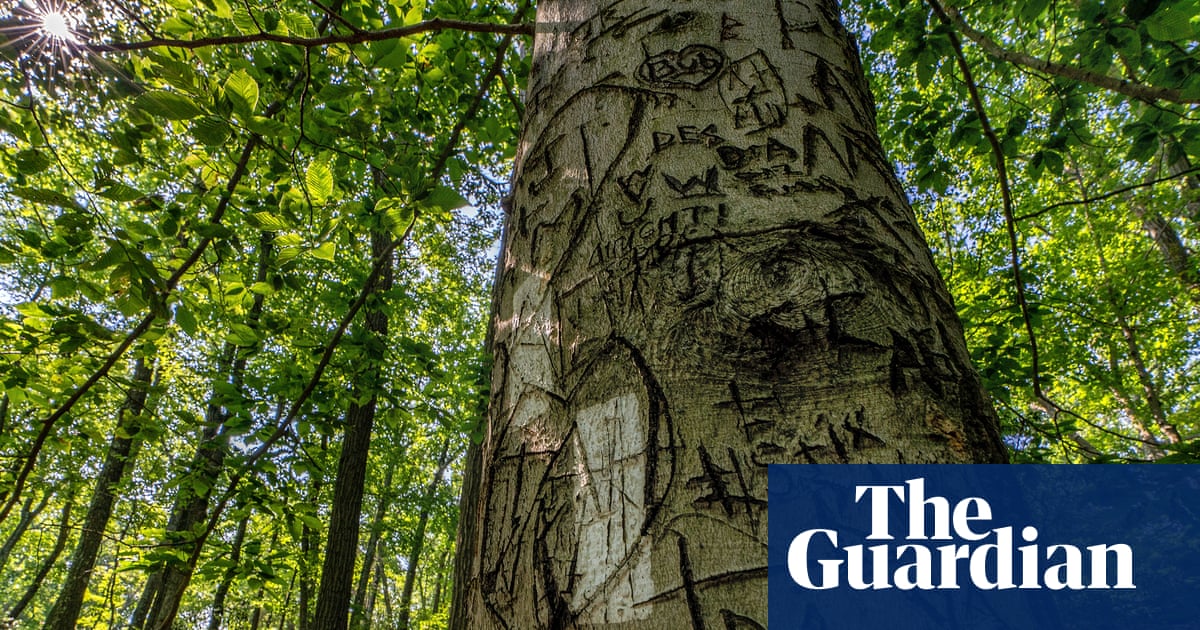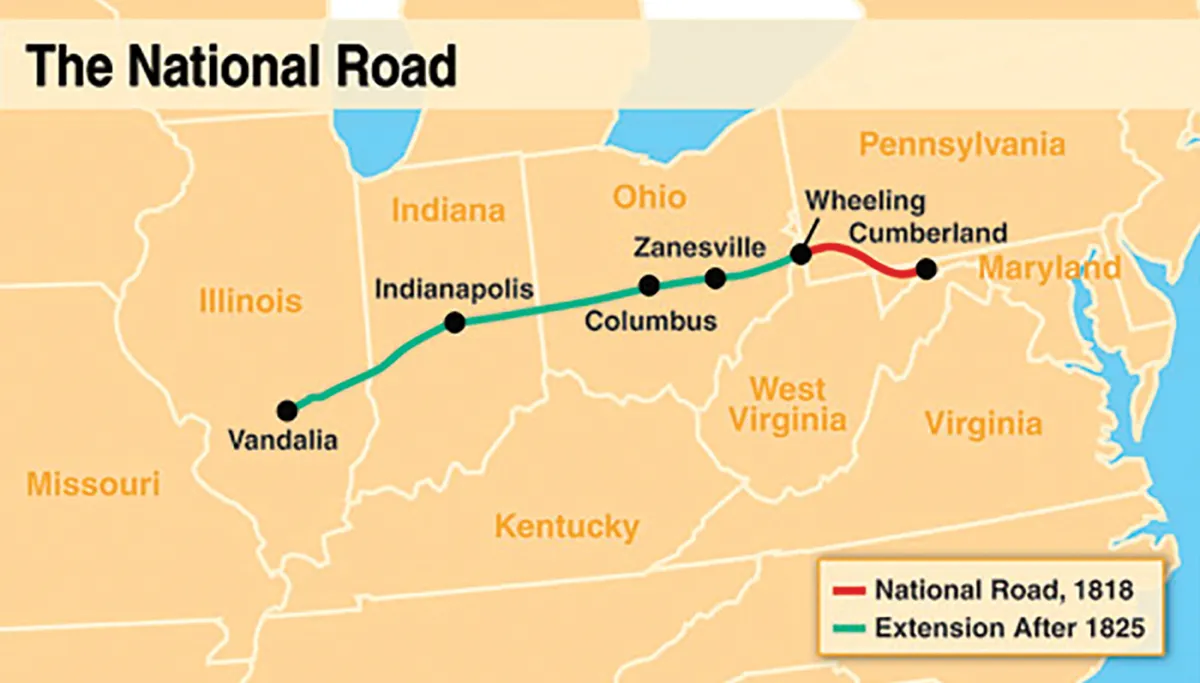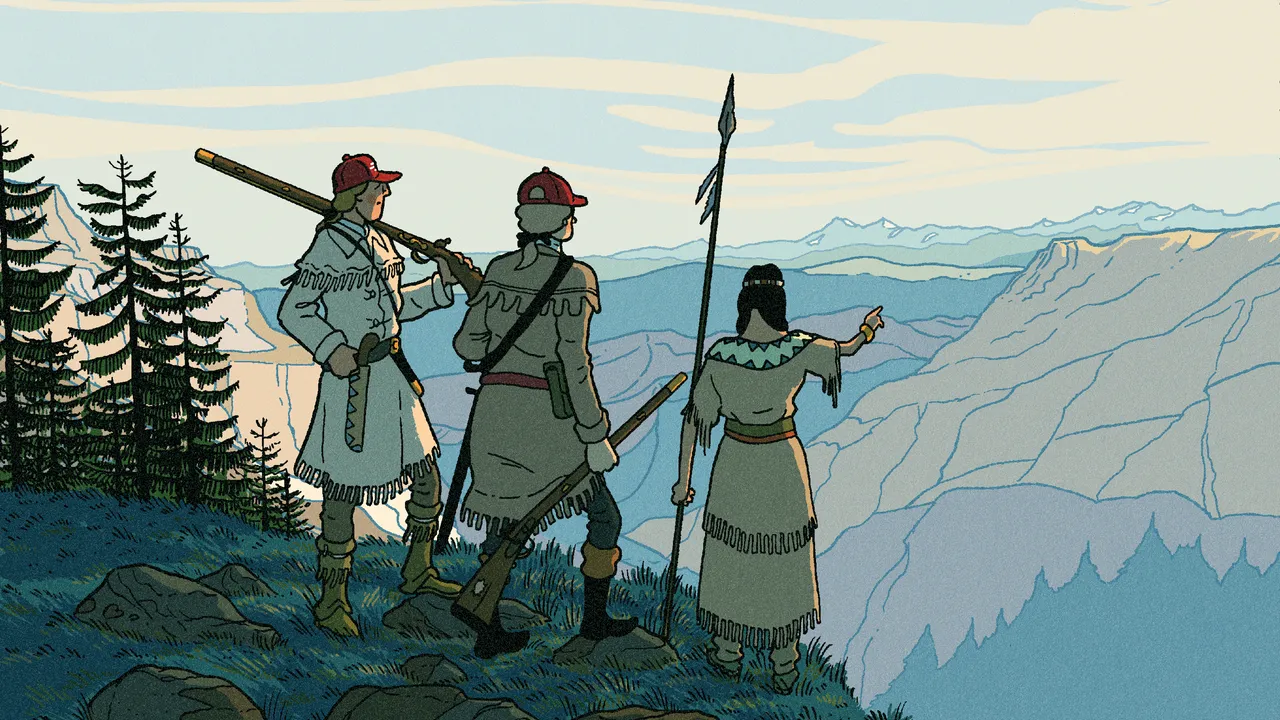
Looking Back at Lewis and ClarkThe explorers’ crossing of the continent is America’s most famous camping trip. What was it all for?May 25, 2026In the national mythology, the expedition belongs to the morning of the story—back when the waterfalls hadn’t been choked by dams and there were still bands of Native Americans in the Rockies who had never seen a white person.Illustration by Ruby FressonIf Meriwether Lewis and William Clark hadn’t gone up the Missouri River in 1804 and then down the lower Columbia River in 1805, there might today be less United States and more Canada. Lately, I have been having trouble imagining how that could be seen as a bad thing.Lewis and Clark have long had their skeptics. “The crossing of the continent was a great feat, but was nothing more,” Henry Adams wrote, more than a century ago, in his history of Thomas Jefferson’s Presidency. An inventor named Robert Fulton was about to assemble a steamboat in New York City that would make more money and, in Adams’s opinion, advance civilization much further.Of course, Adams was an Adams, self-serious and dour; Lewis and Clark are favorites with the sunny-minded. When Stephen E. Ambrose, in his best-seller “Undaunted Courage,” from 1996, narrated the explorers’ encountering of the White Cliffs of the upper Missouri River, he not only quoted at length Lewis’s rhapsody about those Gothic-looking towers of eroded sandstone (“So perfect indeed that I should have thought that nature had attempted herre to rival the human art of masonry”), he also supplied, in a footnote, the name of a local boat-rental company, in case readers wanted to witness the glory for themselves.In the national mythology, Lewis and Clark belong to the morning of the story—back when the waterfalls hadn’t been choked by dams and there were still bands of Native Americans in the Rockies who had never seen a white person. The tale is scenic. There are stirring ups and downs. But if the American idea—the experiment of letting people rule themselves, in the hope that they will grow into the necessary trust and wisdom—is now foundering, or better instantiated in other countries, what sets the expedition apart from any other long camping trip, full of rain, mosquitoes, and, intermittently, the sublime?As Craig Fehrman notes in “This Vast Enterprise” (Avid Reader Press), an innovative new history of the expedition, Lewis and Clark weren’t the first white men to cross the continent north of Mexico. A Scottish fur trader named Alexander Mackenzie led a group over the Canadian Rockies in 1793, and, after descending the Fraser River, painted his name in vermillion on a rock near the Pacific Ocean, along with the words “from Canada by land” and the date. The possessive flourish piqued Jefferson, who worried that the British claim might end up extending to territory he wanted for the United States. Mackenzie hadn’t found the fabled Northwest Passage, the long-hoped-for all-water route across the continent, which would have connected the lucrative fur trade in North America to markets in Asia, but he had come close: along a ridge in the Rockies, he counted out only eight hundred and seventeen paces between a lake that drained into an east-flowing river and a lake that drained into a west-flowing one. At the time, geographers thought that the Rockies were shorter farther south, roughly the height of the Appalachians, so, in 1802, after reading an account that Mackenzie wrote, Jefferson decided to send someone northwest up the Missouri River, where it seemed plausible that Mackenzie’s discovery might be improved upon.He chose an ambitious and high-strung ex-soldier named Meriwether Lewis, who had been working for him as a secretary. Lewis, then twenty-eight years old, had served in the U.S. Army, where drinking and a Southern prickliness about honor had nearly involved him in a duel, a situation that embarrassingly turned into a court-martial, in 1795. He was acquitted, told not to do it again, and transferred for a few months to a rifle company led by William Clark, a scion of Kentucky’s planter élite.Lewis went on to become a regimental paymaster. He was hired away as the President’s secretary because Jefferson wanted the advice of a fellow Democratic-Republican as he pruned the officer corps, then mostly Federalist. Living together in the White House—“like two mice in a church,” as Jefferson put it to one of his daughters—Jefferson and Lewis came to recognize each other as kindred spirits who shared the Enlightenment values of curiosity and precision. Lewis, Jefferson later wrote, had “a fidelity to truth so scrupulous that whatever he should report would be as certain as if seen by ourselves.” Like the President, Lewis came from a family of Virginia slaveholders. The two weren’t alone in the White House, however cozy Jefferson made it sound; they lived with servants and one or two enslaved people whom Jefferson had brought from Monticello. One of the servants, a free mixed-race man named John Pernier, would be present, seven years later, when Lewis died, from self-inflicted gunshot wounds, at a roadside inn in Tennessee.“Really? I thought we were one and done.”Cartoon by Barbara SmallerAfter Jefferson asked Lewis to go West, Lewis wrote to Clark, his comrade of eight years before, itemizing the expedition’s likely dangers and honors, and confessing that “there is no man on earth with whom I should feel equal pleasure in sharing them as with yourself.” “My friend,” Clark replied, “I do assure you that no man lives whith whome I would perfur to undertake Such a Trip.” They had Jefferson’s approval, Lewis claimed, to share the same rank, captain—a breach of the military principle later known as unity of command. Army brass were never able to bring themselves to commission Clark at a rank higher than lieutenant. He and Lewis simply pretended they were both captains, and then never quarrelled about it.Along with a sextant, a telescope, fishhooks, mosquito netting, cannisters of “portable soup,” and twenty-one bales of trade gifts to distribute to Native Americans, Lewis packed paper, pencils, ink powder, a hundred quills, and six inkstands. Seven people on the trip kept journals, Lewis reported to Jefferson partway through; it’s possible that as many as ten did. Six of these accounts survive, amounting to more than a million words—almost five times as many as in “Moby-Dick.” When Jefferson, trying to finagle passports, misleadingly told Spain’s minister to the United States that the expedition was “purely literary,” he spoke more truly than he meant to.“Your observations are to be taken with great pains & accuracy,” Jefferson ordered, giving Lewis a list of queries about the land’s animals, vegetables, and minerals, as well as about the language, the culture, and the technology of its resident peoples. At the somewhat cynical suggestion of one of his Cabinet secretaries, who thought it would help win funding from conservatives in Congress, he even threw in a question about their religious beliefs—almost the only mention of religion in the whole enterprise, apart from a description of a Catholic Mass in St. Charles, in what’s now Missouri, which many of the men attended, in an almost anthropological spirit, as they were just starting out. Gary Moulton, the modern editor of the journals, gives the consensus on the captains’ literary style: “Lewis appears as the moody, sensitive intellectual, Clark as the pragmatic, less literate frontiersman.”History is usually written in the third person, even though it has to be lived in the first, and Fehrman takes advantage of the rich and deep documentation of the Lewis and Clark expedition to try to reconcile the discrepancy. The book adopts the perspectives not only of Lewis and of Clark but also of other members of the expedition, including an enslaved Black man named York, whom Clark brought along as a personal servant, and of five Native Americans whom the explorers encountered. Fehrman doesn’t attempt to speak in the voices of his subjects. He merely focusses on what each individual experienced and knew, while keeping in mind how much they didn’t experience and didn’t know—an analytic technique that historians have always been free to borrow from novelists but often lose sight of in the scramble to accumulate data. With subjects who haven’t left journals or letters, Fehrman guesses their state of mind by making inferences—some credible, others less so.Fehrman tells the story of the expedition’s first winter camp from the perspective of John Ordway, a sergeant who grew up on a farm in New Hampshire. To climb out of poverty, Ordway had enlisted in the Army, at the time a violent and hierarchical institution. Officers flogged enlisted men, with or without the courtesy of a court-martial, and sometimes had them branded or even executed. One in four enlisted men deserted. When Lewis went looking for recruits, almost everyone at the fort where Ordway was stationed volunteered.Ordway comes across as methodical and reliable. He carried his journal on a cord around his neck and wrote in it every day, though he unfortunately didn’t start the writing until May, 1804, when the expedition got properly under way, so Fehrman is forced to rely in this section on notes by others and a couple of letters that Ordway mailed home. Fehrman wonders whether, after the Army’s harsh discipline, the milder treatment that Lewis and Clark meted out puzzled Ordway. During that prefatory first winter, living in close quarters without much to do, the expedition’s young men distracted themselves with drinking, brawling, and stealing a neighbor’s hog, and the captains responded only with lectures and an order to build the camp’s laundress a hut. The lenity, in Fehrman’s opinion, was part of a conscious experiment, a decision to “bend the army’s rules not toward cruelty but toward generosity, consensus, and trust.”As the winter deepened, Lewis and Clark dealt with their own boredom by making long visits to nearby St. Louis, leaving Ordway in charge. Several men refused to follow his orders; at least two threatened him, one while loading his gun. When the captains got back to camp, they convened a court-martial. Military law specified a jury of officers, but Lewis and Clark sometimes impanelled expedition members instead, a move that Fehrman sees as an extension of their democratic experiment, and he thinks they did so on this occasion. The rebels, upon conviction, “promised to doe better in future,” Clark reported in his journal, and weren’t punished for these crimes. Mercy worked so well, in fact, that a few days after the court-martial, when Lewis and Clark divided the expedition into three squads, the soldier who had menacingly loaded his gun “asked to serve under Ordway, the man he’d threatened to kill,” Fehrman claims. He may be overestimating the democratic spirit here. What Clark wrote was that the men were “duly ballotted for,” and that could mean they were sorted by lot, not that they chose their sergeants.In any case, the mildness didn’t continue. In June, one soldier got fifty lashes, and another a hundred, for privately tapping a keg of whiskey, and in August a sentry who fell asleep got a hundred lashes in the course of four days. When a soldier tried to desert that month, Clark authorized George Drouillard, a half-French, half-Shawnee scout and tracker hired by the expedition, “to put him to Death” if he resisted recapture. Once caught, the deserter had to run the gantlet four times—that is, walk four times through facing lines of fellow-soldiers holding weapons to strike him with, a punishment that Fehrman grimly describes as “one of the regular army’s few democratic flourishes.” A Missouria and an Oto chief who happened to be present pleaded unsuccessfully for his pardon. An Arikara chief “Cried aloud” at a later flogging, Clark reported, and told the explorers that “his nation never whiped even their Children, from their burth.” That seems to have been the last instance of corporal punishment on the expedition, but was it because a democratic spirit had taken hold? Or fear?Fehrman gives three chapters to York, who played with Clark when the two were boys and became his property in 1799, when Clark’s father died. Clark was not lenient as a slave master. “I have been obliged [to] whip almost all my people,” he wrote one of his brothers, a couple of years after the expedition. “And they are now beginning to think that it is best to do better and not Cry hard when I am compelled to use the whip.” He placed ads when slaves ran away and often mused about selling refractory ones to masters even more severe.Fehrman tries to reconstruct the tricky position York was in. He had married a woman owned by another family, and the expedition separated them without his consent. (When the expedition’s keelboat reaches St. Louis, Fehrman notes that an ordinance there prohibited splitting up married slaves.) He and the Native American woman Sacagawea were the only people on the expedition who were not rewarded with a cash bonus and three hundred and twenty acres of land for taking part. As a body servant, he was on intimate terms with Clark, probably acting as his cook and, when Clark was ill, his nurse, which would have necessitated a delicate social performance. He was most likely the object of a certain amount of racial hostility from the other men on the team: Clark reports in his journal that one day York came “verry near loseing his Eyes by one of the men throwing Sand at him in fun,” and Fehrman suspects racial animus beneath the ostensible humor.On the other hand, while on the expedition, York was allowed to carry a gun, which wouldn’t have been possible back in Kentucky, and on many days he probably ate better than he had at home. In April, 1805, he sent Native American buffalo robes to his wife and a friend named Ben, and, after he returned from the expedition, he showed off “his Indian trophies to the ‘oh’s’ and ‘ah’s’ and prideful joy of his parents,” a nephew of Clark’s reported in a family letter. The expedition met several Native American nations who had never seen a Black person before, which imparted to York a complicated form of charisma, and he seems to have enjoyed playing that up, somewhat to the disgruntlement of Clark. “The Inds. much astonished at my black Servant,” Clark wrote, on October 10, 1804, “who made him Self more turrible in their view than I wished him to doe[,] as I am told telling them that before I cought him he was wild and lived upon people, young children was verry good eating.” The Native American children loved it, according to Ordway, who wrote that they “would follow after him, and if he turned towards them, they would run from him and hollow as if they were terreyfied.”One facet of this charisma was sexual. Some Native American nations felt that the explorers had, or were, “medicine,” a Native concept that Lewis once defined in his journal as “something that eminates from or acts immediately by the influence or power of the great sperit; or that in which the power of god is manifest by it’s incomprehensible power of action.” Medicine could be shared through sex, and sex with Native women was offered to the explorers, sometimes by the women themselves and sometimes by men on their behalf, as a way of making contact with it. (Like most cultures, Natives also had sex with foreigners for reasons of trade and diplomacy—and, no doubt, pleasure.) Clark claimed that he and Lewis refrained from this “curious Cuistom,” but in general the men did not, and York, by virtue of being Black, had “big medison” in the Natives’ eyes. Clark was to recall in 1810 that an Arikara man invited York to sleep with his wife and stood guard outside his lodge, to keep the couple from being interrupted.Fehrman believes that York’s quiet competence as a swimmer, a hunter, a canoer, a cook, a guard, and a builder gradually overcame the suspicion of his colleagues, who started to refer to him in journal entries by name. In late 1805, when the captains polled the crew about where on the Pacific Coast to build their winter camp, York was polled, too—last, but nevertheless. Ambrose, in “Undaunted Courage,” called this “the first time in history that a black slave had voted.” In Fehrman’s opinion, the voyage strengthened York in his determination to ask for his freedom, which he did after it came to an end. Clark didn’t free York for another decade, however. In the meantime, he beat him, complained that he wouldn’t “give over that wife of his,” and hired him out to a harsh master. Fehrman tries to see an upward arc in York’s story, but if there was one it didn’t much outlast the expedition.“Remember, it can be literally anything.”Cartoon by Asher PerlmanFehrman’s willingness to make inferences clarifies some aspects of Lewis and Clark’s interactions with Native Americans. The explorers let their guard down after a friendly encounter with the Yankton Sioux, just prior to meeting the Brule Sioux, or Sicangu, a related but more dangerous band. Fehrman guesses that the explorers mistook one band for the other. Puzzling out violence that followed an attempt by eight Blackfeet to steal horses from the expedition, Fehrman notices that the white side of the story doesn’t add up, and decides that one of the men must have fallen asleep while on guard duty—a crime that deserved at least a hundred lashes—and panicked upon waking. Unfortunately, not all Fehrman’s conjectures are so plausible. I wasn’t persuaded by his guess that Piahito, an Arikara chief who spoke at one of Lewis and Clark’s councils, was the same person as Too Né, a chief who gave Jefferson a buffalo-skin map of Native villages along the Missouri.For the most famous Native American associated with the expedition, Sacagawea, Fehrman imagines an arc somewhat like the one he gives York—appropriately enough, since she, too, was enslaved. She was about sixteen years old when Lewis and Clark found her living with the Hidatsa; she was, in the words of one trader, a “woman, who answered the purpose of wife” to Toussaint Charbonneau, a Frenchman who had either purchased her or won her in a bet, and who sometimes hit her. Over the last decade, there has been an intriguing revisionist effort to claim that Sacagawea was Hidatsa, but Fehrman, supplementing the contemporaneous written record with Shoshone oral tradition, sticks with the traditional understanding: she was a Shoshone captured as a girl by Hidatsa in a raid. The explorers hired Charbonneau as a translator for the sake of Sacagawea’s proficiency in Shoshone—they knew they were going to need Shoshone horses to cross the Rockies—and Fehrman points out that, as the expedition approached her people’s territory, she recognized elements of the landscape, such as a rock formation shaped like a beaver’s head and a bank of red earth her tribe used for paint. At a moment when Charbonneau wasn’t present, she showed Ordway and another member of the expedition the site where she had been captured. Her nickname for the child she brought with her on the expedition was Pahmpi, a Shoshone word for “head” or “hair.” Clark was to recall that when the expedition met the Shoshone, she signalled that they were her people by “sucking her fingers,” a gesture that indicated kinship in Plains Sign Language. And then there’s the testimony of her dancing with joy and bursting into tears during the reunion, and of her embracing a man she recognized as her brother and a woman she recognized as a childhood friend, who had been abducted with her but escaped. “The meeting of those people was really affecting,” Lewis commented.Like York, Sacagawea served the expedition in practical ways. When Charbonneau nearly capsized one of the canoes, she had the presence of mind to scoop up instruments, medicine, and merchandise floating in the water. Lewis had been tasked by Jefferson with collecting botanical specimens, and she showed him wild artichokes, breadroot, and wild licorice. But, as a woman carrying an infant, she also performed a more abstract function, which may be why she’s the one figure of the expedition who seems to have passed from history into myth. “The wife of Shabono our interpretr we find reconsiles all the Indians, as to our friendly intentions,” Clark wrote. “A woman with a party of men is a token of peace.” In Fehrman’s opinion, she found her voice in the course of the expedition—piping up, even though she hadn’t been polled, about where to locate the Pacific Coast camp, and insisting, when a beached whale was discovered, that she get a chance to see it, and the ocean, too. “She observed,” Clark wrote, “that She had traveled a long way with us to See the great waters, and that now that monstrous fish was also to be Seen, She thought it verry hard that She Could not be permitted to See either.”What was it all for? As the poison of our political moment seeps backward, I find I don’t much care that the expedition later helped cement claims the United States made on Western territory. Assigning enlisted men instead of officers to the jury of a court-martial might have been a democratic gesture, but to me it looks more like an improvisation rendered necessary by isolation from the rest of the Army. The prelapsarian aura that invests the memory of the expedition in popular culture can’t withstand much scrutiny. The mission could never have succeeded without the generosity and forbearance of Natives, and the spirit in which the explorers took their gifts was sometimes ugly. The Nez Perce, for example, were extraordinarily forthcoming with food, guides, and horses, and as the expedition waited among them for snowdrifts in the Rockies to melt, in order to be able to re-cross them and head home, Clark had to order his men “not to croud their Lodge[s] in serch of food,” a habit of bullying they had fallen into “at most lodges we have passed.” Encounters with Natives schooled Clark in diplomacy with them, a favor he was to repay, during three decades when he served as a federal agent for Indian affairs, by negotiating the surrender of four hundred and nineteen million acres of their land.In the short run, the point of the journey seems to have been to muscle in on the British share of the fur trade, to judge by a report that Lewis wrote after the expedition and by what a significant number of the group’s members, including Clark and maybe Lewis, too, did next for income. Before the expedition had even returned to St. Louis, the captains discharged a man who wanted to turn right around and head back upriver with two Americans who planned to trap beaver.What it’s remembered for, in any case, is the writing. The explorers took their literary mission seriously. “Continued Hear as the Capts is not Don there Riting,” one of the sergeants put in his journal on July 25, 1804, at the mouth of the Platte River, where the expedition stayed five days. Writing was a record of ambition as well as information; the explorers inscribed their names on at least three trees on the Pacific Coast, as if by repetition they could overwrite Mackenzie’s mark, which had been left six hundred miles to the north. Clark has his moments, such as his famous exclamation, “Ocian in view! O! the joy,” when he thought he saw the Pacific for the first time (in fact, he was looking at an estuary), or when he ate a birthday dinner of venison, elk, beaver tail, cherries, plums, raspberries, and currants and exulted, with spectacular misspelling, “What a Field for a Botents & a natirless” (a botanist and a naturalist). But there’s a fair amount of lumber in his prose—complaints about “Musquitors emencely noumerous and troublesom,” for example, or about sweating “a greater preposn” (proportion) “of Swet than I could Suppose Could pass thro: the humane body.”It’s Lewis who has the born writer’s flair for self-dramatization. “We were now about to penetrate a country at least two thousand miles in width, on which the foot of civilized man had never trodden; the good or evil it had in store for us was for experiment yet to determine,” he writes, as the explorers set out from their second winter camp. The moment, he declares, is “among the most happy of my life.” He has a painter’s eye, describing a river’s water as possessing “a peculiar whiteness, being about the colour of a cup of tea with the admixture of a tablespoonfull of milk.” He can play with philosophical niceties, as when he contrasts two cascades of the (now tamed and unexceptional) Great Falls of the Missouri River by writing that “this was pleasingly beautifull, while the other was sublimely grand.” And he has a scientist’s dispassionate precision, as when he itemizes the parts of the “Indian dog,” which he ate so many of that he became “extreemly fond of their flesh”: “The head is long and nose pointed[,] eyes small, ears erect and pointed like those of the wolf, hair short and smooth except on the tail where it is as long as that of the curdog and streight.”Jefferson noticed “sensible depressions of mind” in Lewis while they lived together, and fellow-writers will recognize the shape that that darkness took. There are long gaps in his journal, in one case almost eleven months long, which have never been explained, and, unlike others on the expedition, Lewis kept his journal mostly private, sharing it only with Clark. He’s the patron saint of writer’s block: he got the big grant, did all the research, took copious notes, and then, when it came time to actually write the book, drank too much, took opiates, and shot himself. It wasn’t until 1814, five years after Lewis’s death, that the journals were published, with an editor found by Clark named Nicholas Biddle, a brilliant young lawyer and polymath in Philadelphia, who had married too much money to need to work and had time on his hands.Clark asked a Philadelphia botanist, who before the expedition had taught Lewis how to preserve specimens, to compile a volume of Lewis’s natural-history observations, but the botanist’s health failed, and Clark and Biddle went ahead without it. Lewis therefore missed out on credit for dozens of plant and animal species that he would have been the first to publish a description of, and it’s the descriptions of animals, in an abundance that vanished long ago, that I find most poignant: plains “black with buffalow”; Carolina parakeets, today extinct, in “a great number”; a flock of pelicans so large that a slick of their white feathers covered three miles of the Missouri downstream; antelope so fleet and graceful that Lewis described their movement as more like “the rappid flight of birds than the motion of quadrupeds.” It almost sounds like a nice place. ♦A scientist with a Ph.D. from Harvard fatally shot three of her colleagues. Then revelations about her family history came to light.Caleb Crain is the author of the novel “Overthrow,” among other books. He is a recipient of a 2026 American Academy of Arts and Letters award.
Looking Back at Lewis and Clark
The explorers’ crossing of the continent is America’s most famous camping trip. What was it all for?
4,541 words~21 min read