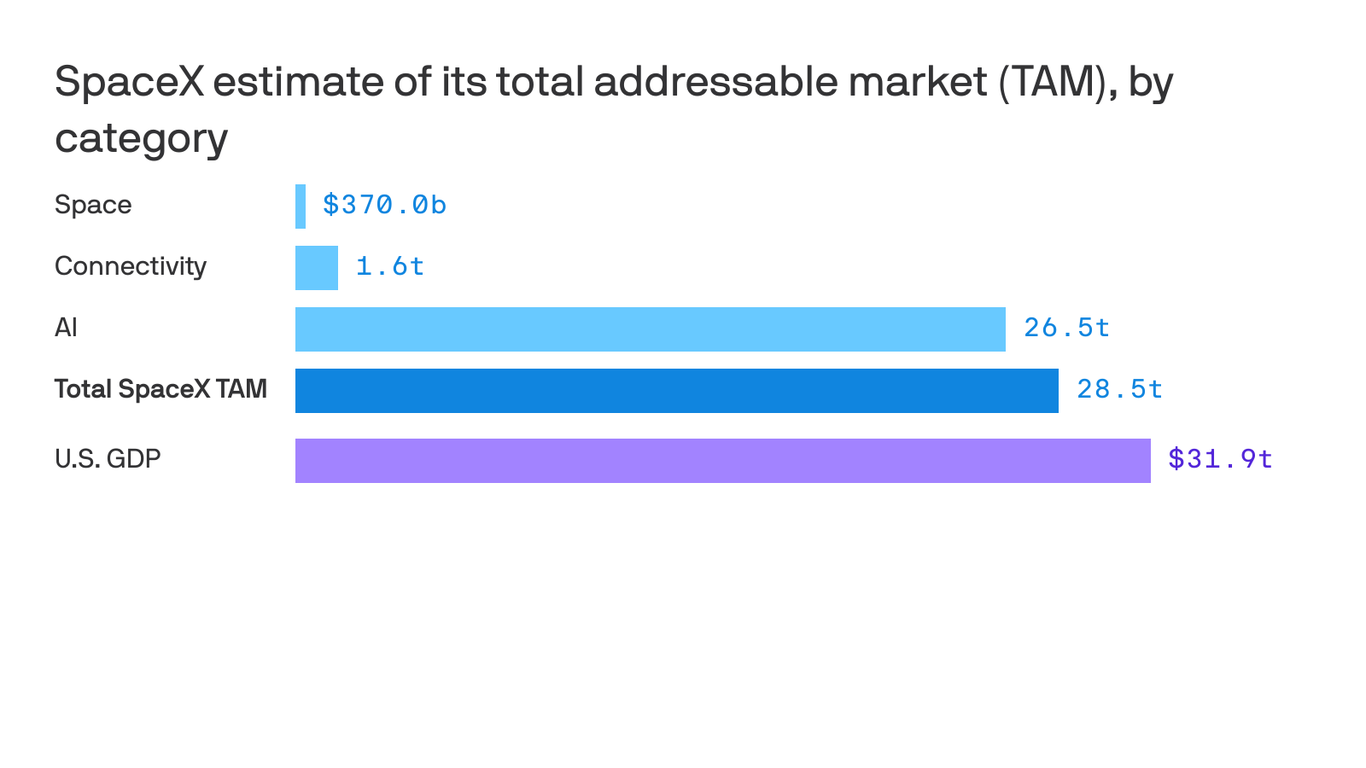
Elon Musk claims SpaceX can tap into a $28.5 trillion market for its business, the largest "in human history," per the company's prospectus.Why it matters: It's an astoundingly huge number — only slightly less than U.S. gross domestic product, which is the value of everything the biggest economy on earth produces.Zoom in: In the IPO filing, SpaceX says it has a total addressable market, or TAM, of $28.5 trillion.That's the maximum potential revenue the company could make were SpaceX able to land every potential customer in existence (and it explicitly excludes Russia and China, the world's second largest economy).The bulk of the number comes from the company's AI business, estimated at a potential $26.5 trillion.For the record: The estimate doesn't capture the revenue potential of colonizing Mars, a stated milestone in the prospectus.Yes, but: OK, to be fair, SpaceX is not simply saying that it can somehow sell to nearly all of the U.S. economy. It provides services across 164 countries, after all.Fine. Global GDP is nearly $111 trillion — so the company is looking only to capture about a quarter of all the economic activity of the planet.Reality check: Even in that context, SpaceX's number appears wildly ambitious."In one word, it's farcical," says Ryan Cummings, an economist and chief of staff at the Stanford Institute for Economic Policymaking.Yes, but: An estimate like this is by its nature imprecise — it's an optimistic take on the potential for your business.And Musk is certainly known for tossing big numbers into the mix. He famously promised to cut $2 trillion from the federal government's budget. He did not. Flashback: Others have reached for the sky in their TAM estimates. Uber in its 2019 IPO prospectus estimated a $5.7 trillion global market in ride-hailing, which as Robert Cyran of Reuters Breakingviews noted, would equate to "essentially all journeys made in 175 countries, including public transit."That same year, office space company WeWork was criticized for estimating a $1.6 trillion market in its IPO filing (which it later withdrew).Yet this can go the other way, too. Amazon's prospectus in 1997 simply talked about its potential to sell into the worldwide book market — a $90 billion market at that time. We all know how that went.Between the lines: In theory, the SEC will scrutinize and comment on exaggerated claims, says Dorothy Lund, a professor at Columbia Law School who studies securities law. "That's very unlikely here." The agency did settle a case with a small biotech firm in 2024 over allegations that it misled investors over its market potential and sales prospects. How it works: SpaceX says it can create new "multi-trillion-dollar" markets across space, AI and something it calls "connectivity," essentially the satellite internet services provided through its successful Starlink business."We believe space represents the largest economic frontier in human history. Our innovations and technological advancements are redefining existing industries and creating new market opportunities."
How SpaceX's galaxy math adds up
Elon Musk's company says its potential market is $28.5 trillion — only slightly less than U.S. gross domestic product.
481 words~2 min read