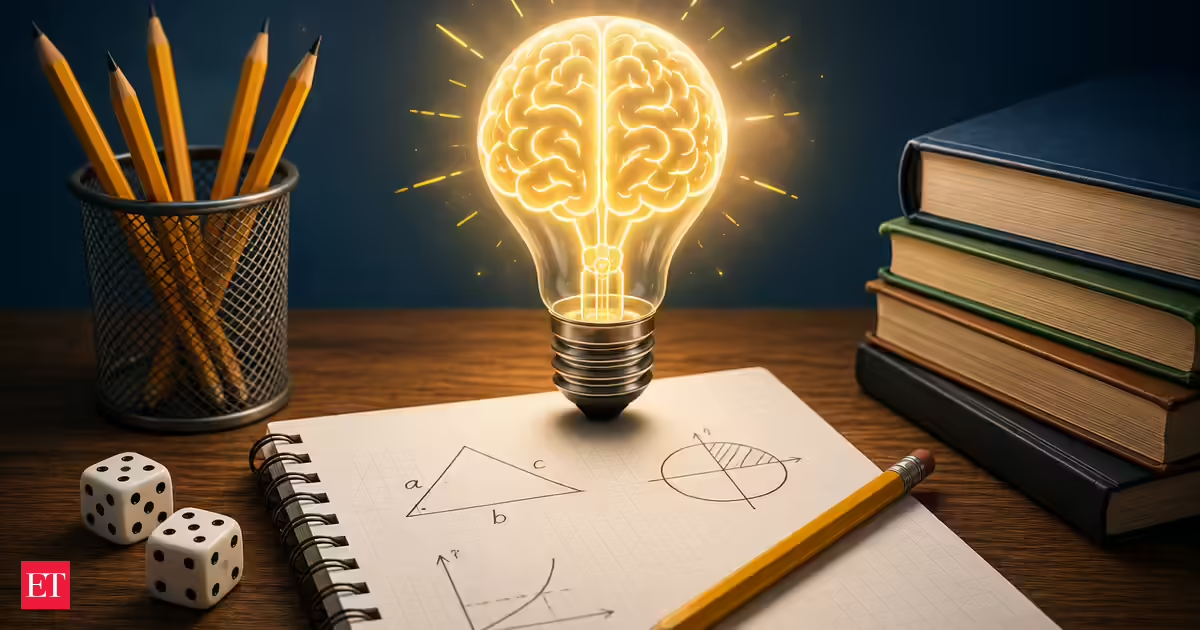
Have you ever felt that learning, creativity, or innovation is only possible for people with expensive tools, elite laboratories, or privileged opportunities? As society’s obsession with technology, premium courses, and costly resources continues to grow, it is easy to believe that intelligence itself has become expensive. Yet some of history’s most influential innovations began with almost nothing at all. The World Wide Web, for instance, was originally proposed by Tim Berners-Lee as a simple way for scientists to share information more efficiently, an idea that started with basic computer systems and a written proposal rather than billion-dollar infrastructure. Decades earlier, mathematician George Pólya offered a similarly simple reminder: powerful thinking does not always require powerful machines. Sometimes humanity’s biggest breakthroughs can begin with nothing more than a pencil, paper, and curiosity. George Pólya’s quote for the day: "Mathematics is the cheapest science. Unlike physics or chemistry, it does not require any expensive equipment. All one needs for mathematics is a pencil and paper."Quoted by Goodreads, George Pólya’s lines highlight something timeless about learning and human thought: curiosity and disciplined thinking often matter more than resources. At a time when education and scientific advancement can sometimes feel financially out of reach, his words remain both practical and inspiring.Also Read: Why some people pretend to be angrier than they actually are? Scottish DJ Calvin Harris says, ‘I'm not an angry person, but I do sometimes like playing with the perception of anger…’What the quote is actually suggestingNo doubt this quote is about mathematics, but on a more rigorous read it can help explain the power of the human mind and how perspective can push you to go beyond your imagination.George Pólya, one of the most respected mathematicians' and educators' words of the 20th century, is suggesting that mathematics is uniquely accessible because its foundation is reasoning, imagination, and problem-solving rather than physical equipment. A person does not need a laboratory, expensive machines, or advanced infrastructure to think deeply about numbers, patterns, or logic. In many ways, mathematics becomes a symbol for intellectual freedom.The quote also quietly challenges excuses people often make about learning. Many individuals believe they cannot grow intellectually because they lack resources or ideal conditions. Pólya’s statement argues that some of the most important forms of thinking begin with simplicity. A notebook, a pencil, patience, and curiosity can sometimes be enough to unlock extraordinary ideas.In everyday life, the quote can apply beyond academics. It reminds people that creativity, discipline, and analytical thinking are not reserved for the wealthy or privileged. Whether someone is solving a work problem, planning a business, studying for exams, or simply trying to understand the world better, thoughtful thinking itself remains one of the most affordable and powerful tools available.George Pólya: The thinker behind the ideaGeorge Pólya was born on December 13, 1887, in Budapest, Hungary. He grew up in a Jewish family during a period of major political and cultural changes in Hungary. His father, Jakab Pólya, originally carried the surname Pollák before changing it as Hungary increasingly emphasized Magyar national identity during the Austro-Hungarian era.Pólya’s early life was shaped by both intellectual ambition and personal hardship. His father trained as a lawyer and later pursued interests in economics and statistics, hoping to secure an academic career. However, he died when George was just ten years old, leaving the family facing financial and emotional challenges. Despite these difficulties, Pólya developed a strong academic foundation and eventually became one of the world’s leading mathematicians.Also Read: Why are some incredibly talented people bad at teaching? Karate Kid star Ralph Macchio explains: ‘Just because you have experience driving doesn't necessarily mean…’Over the course of his career, Pólya worked in probability, analysis, number theory, geometry, combinatorics, and mathematical physics. But beyond his research contributions, he became especially influential for the way he taught people to think. His ideas about problem-solving transformed mathematics education around the world, encouraging students to approach difficult questions through logic, experimentation, and persistence rather than memorization alone.George Pólya’s thinking style and philosophy behind the quotePólya believed mathematics was not merely about formulas or calculations. For him, it was fundamentally about learning how to think clearly. Much of his teaching philosophy centered on problem-solving as a human process. Instead of giving students direct answers, he encouraged them to ask questions, break problems into smaller pieces, test ideas, and remain curious even when confused. This practical and thoughtful approach made mathematics feel less intimidating and more connected to everyday reasoning.The quote reflects that same philosophy perfectly. By emphasizing how little equipment mathematics requires, Pólya shifts attention away from material limitations and toward intellectual discipline. His words suggest that the greatest scientific tool is ultimately the human mind itself.This perspective likely came from both his academic experience and the era in which he lived. Having witnessed war, political instability, and economic uncertainty across Europe, Pólya understood that access to resources could disappear quickly. But logical thinking, creativity, and education remained skills that individuals could carry anywhere.Also Read: Quote of the Day by Steve Carell: ‘I love my wife dearly, and, therefore, I’ve never cooked a meal…’ - what The 40-Year-Old Virgin actor's funny confession reveals about love, honesty and long marriagesWhy this idea still matters todayPólya’s quote feels especially relevant in today’s world, where education is increasingly tied to technology, expensive institutions, and competitive systems. Many students and young professionals feel pressured to constantly buy new tools, courses, software, or certifications just to stay relevant. Yet the quote reminds people that meaningful learning often begins with focus rather than consumption.The idea also carries importance in conversations about equal opportunity and access to education. Mathematics remains one of the few disciplines where a person can begin learning independently with minimal resources. Across the world, students continue studying advanced mathematics using little more than books, notebooks, and determination.Beyond academics, the quote speaks to self-growth itself. Modern life often convinces people that success requires ideal conditions before they can begin. Pólya’s words outrightly reject that mindset. Sometimes progress starts not with expensive resources, but with simple tools used consistently and thoughtfully.
Why do some of the world’s greatest ideas begin with almost nothing? Hungarian mathematician George Pólya once said, 'Mathematics is the cheapest science, unlike physics or chemistry, it does not require…’
George Pólya's quote highlights that powerful thinking, particularly in mathematics, requires only a pencil and paper, not expensive tools. This emphasizes that curiosity and disciplined thought are more crucial than material resources for learning and innovation. His words remain a practical and inspiring reminder that intellectual growth is accessible to all.
1,010 words~5 min read