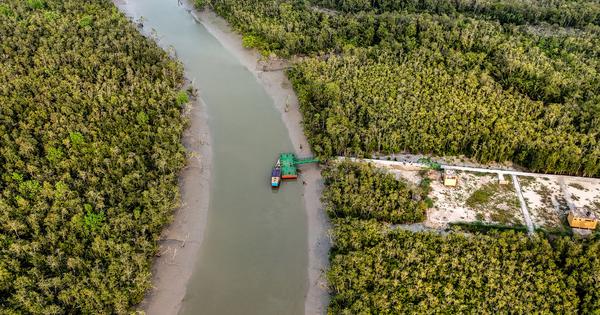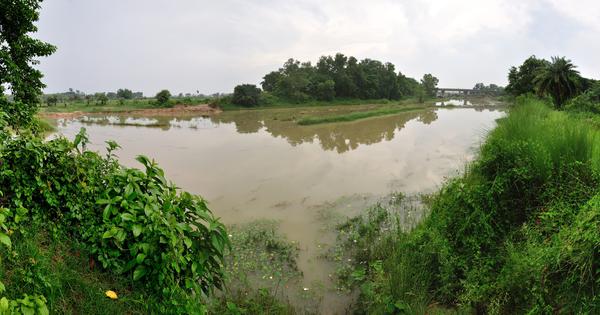
Before the barrages, before the embankments, before the United Nations missions and the billion-dollar loans and the ECNEC approvals – before any of this – there was a sari tied to the roots of a babla tree.The tree stood at Hansuli Turn, a sharp bend in the Kopai River, in what is now West Bengal’s Birbhum district. The Kahar community, a marginalised group whose traditional livelihood of palanquin-bearing had collapsed under modernity’s advance, lived at this bend. And every year, before the monsoon, the women of the community would tie an old sari around the roots of the babla tree that held the embankment together.This was not superstition. It was not an empty ritual. It was, in the most precise sense, river management – the kind that understands that an embankment is not merely a pile of earth but a relationship, a covenant between a community and the water that sustains and threatens it.Tarashankar Bandyopadhyay’s 1947 novel Hansuli Banker Upakatha – translated into English by Ben Conisbee Baer as The Tale of Hansuli Turn – captures this world at the moment of its breaking. It is one of the great river novels of modern Bengal, and it asks a question that has become more urgent with every passing decade: what is lost when we sever the ritual from the river?The river as goddessThe Kopai, in Bandyopadhyay’s rendering, is not a hydrological channel. It is a living presence, named for Kopavati – a wrathful woman who can destroy everything during monsoon yet remains fertile with sediment and yields good crops. The river is addressed, appeased, and negotiated with. The embankment that holds it is maintained not through the logic of public works departments but the logic of worship.The elder Suchand is the keeper of this knowledge. He walks the bank at dawn, reading the water’s mood as another might read a scripture. He knows when the river must be allowed to spill – not without guidance, but to deposit its gift of silt on the floodplains. This was the system the British engineer Sir William Willcocks, in his remarkable 1930 lectures at the University of Calcutta, described as “overflow irrigation” – an indigenous practice that was admirably suited both to agricultural productivity and to malaria control. The colonial administration ignored him. In Bandyopadhyay’s novel, the knowledge is still alive, but barely. The Kahars maintain what scholars have called an animistic relationship with their landscape. The river is a goddess, the embankment is a covenant, and the community’s myths – stories of the sacred snake kattababar bahan and other guardian spirits – are not separate from the physical work of maintaining the bend. They are the reason the work gets done.This is what we mean when we speak of river management as ritual. It is not that the Kahars were too simple to understand hydrology – but that they understood it through relationship rather than abstraction.Tarashankar Bandyopadhyay’s Hansuli Banker Upakatha.The technical details of this system are worth recovering, for they reveal a sophistication that the modern dismissal of indigenous practice has obscured.The Kahar community used what were called osthomasi badh – eight-month embankments – and doser badh, temporary structures that were deliberately breached during the monsoon. The purpose was not to keep all water out – as modern polders attempt to do – but to manage the water’s entry. To allow the silt-laden flood to spill onto fields, deposit its fertility, and then recede. The embankments breathed with the seasons. They were maintained collectively, through shared labour and shared ritual, because the community understood that no individual could sustain a relationship with the river alone.Willcocks, the unusual knighted imperial engineer, recognised the genius of this system. Working with the malariologist CA Bentley, he argued that the pre-colonial overflow irrigation system was not merely effective for agriculture but was also a public health measure. Stagnant water bred mosquitoes; flowing, silt-laden water did not. The colonial administration’s rigid embankments, by contrast, created precisely the conditions for malaria to flourish.Willcocks’s 1930 lectures were published by the University of Calcutta, later reprinted by BR Publishing Corporation in Delhi in 1984. They were widely accepted among scholars. But they were never allowed to change policy. To accept Willcocks’s argument would have been to admit that the colonial approach to water management in Bengal was not merely imperfect but actively destructive. The knowledge was institutionally buried.The drama of Hansuli Banker Upakatha lies in what happens when the covenant is broken.Karali, a young Kahar who has seen beyond the bend, returns with visions of railroads, wage labour, and brick kilns. He is not a villain. He wants his people to survive in a world that has rendered their traditional livelihood obsolete. But his method severs the ritual relationship with the river. He breaks from the community’s myths. He dismisses Suchand’s knowledge as superstition. And in doing so, he breaks the social contract that maintained the embankment.The novel does not resolve this conflict neatly. Bandyopadhyay understood that the old ways could not simply be preserved in amber, that modernity was coming whether the Kahars willed it or not. But he also understood, with a clarity that feels prophetic now, that something irreplaceable was being lost. The embankment that the Kahars maintained as a ritual would be replaced by an embankment that the state built and abandoned. The river they negotiated with would become a river they defended against.Today, the river Bandyopadhyay immortalised is just a trickle. The sari is no longer tied to the babla tree. The covenant is broken, and the land bears the scars.The cordon and its costsWhat Bandyopadhyay captured in fiction had a parallel in policy that unfolded across decades.In the 1950s, after devastating floods, the United Nations dispatched the Krug Mission to East Pakistan. Its recommendation – the “Cordon Approach” of uninterrupted embankments separating floodplains from rivers – was precisely the logic Willcocks had warned against and Bandyopadhyay had mourned. Dutch engineers, coming from a delta that carries 2.7 million tonnes of sediment annually, advised on a delta that carries between 1.5 and 2 billion tonnes. They were solving a problem their rivers did not pose, using methods their landscape could sustain, and imposing them on a delta that works by entirely different rules.From 1961 to 1964, the Coastal Embankment Project constructed approximately 4,800 kilometres of embankments, creating 139 permanent polders. The osthomasi badh – the embankment that breathed – was declared obsolete. Within decades, riverbeds silted up. Land inside polders subsided below river level. Permanent waterlogging began affecting over two million people.The colonial cordon had become the post-colonial default, and its consequences were written across the delta's landscape.Then, in the 1990s, something remarkable happened in Bangladesh.In the southwest delta, in districts like Satkhira and Khulna, communities facing permanent waterlogging did what their ancestors would have done – though the knowledge had to be painfully reconstructed. They broke open a polder embankment. The state sued them for destroying government property. But the tidal water rushed in, deposited sediment, raised the land, and the waterlogging receded.This was not superstition. It was not a ritual in the narrow sense. It was the same principle the Kahars had practised at Hansuli Turn: the deliberate, controlled breaching of an embankment to let the river do its work. Tidal River Management, as this practice came to be known, was the osthomasi badh rediscovered through an act of civil disobedience. The community had to break the law to prove what the law had made inaudible.The local communities in the southwest helped institutionalise this knowledge. Paani committees were formed. People’s Plans of Action were developed. The practice was eventually recognised in the Bangladesh Delta Plan 2100 – though it remains chronically underfunded, an afterthought in a planning framework still oriented toward large-scale engineering.Bandyopadhyay did not live to see Tidal River Management. He died in 1971, the year Bangladesh was born. But his novel anticipated its necessity. The Kahars’ sari tied to the babla tree and the community’s deliberate breach of the polder are acts in the same tradition: river management not as command but as covenant, not as the imposition of static design on a shape-shifting world but as a negotiated relationship renewed each season.The dominant approach to water in South Asia has, for more than a century, moved in the opposite direction. It has favoured barrages over distributaries, concrete over sediment, permanent structures over seasonal rhythms. It has treated the delta as a machine to be controlled rather than a living system whose rhythms need to be understood. The results – waterlogging, salinity intrusion, dying rivers, displaced communities – are visible across the landscape.Bandyopadhyay’s novel, now, reads less like fiction than like an elegy. But it is also an invitation for discovery. The knowledge the Kahars practised did not disappear. It was carried by communities who maintained their relationship with the river despite the restrictions. It resurfaced in the TRM movement, in the paani committees, in the People’s Plans of Action that communities in the southwest delta developed when the state’s solutions failed.At Hansuli Turn today, the Kopai is a ghost of itself. The brick kilns burn. The embankment that the state built sits in disrepair. But the question Bandyopadhyay asked in 1947 has never been answered, only deferred. What would it mean to treat the river not as a resource to be tamed, but as a relationship to be ritually sustained? The Kahars knew the answer. It involved a sari, a babla tree, and the courage to let the water in.Zakir Kibria is a Bangladeshi writer, policy analyst and entrepreneur based in Kathmandu, Nepal. His email address is zk@krishikaaj.com
‘The Tale of Hansuli Turn’: What Tarashankar Bandyopadhyay’s novel says about preserving a river
As Bangladesh approves the Padma Barrage, a 1947 novel reminds us that the best river management looks less like engineering and more like worship.
1,608 words~7 min read