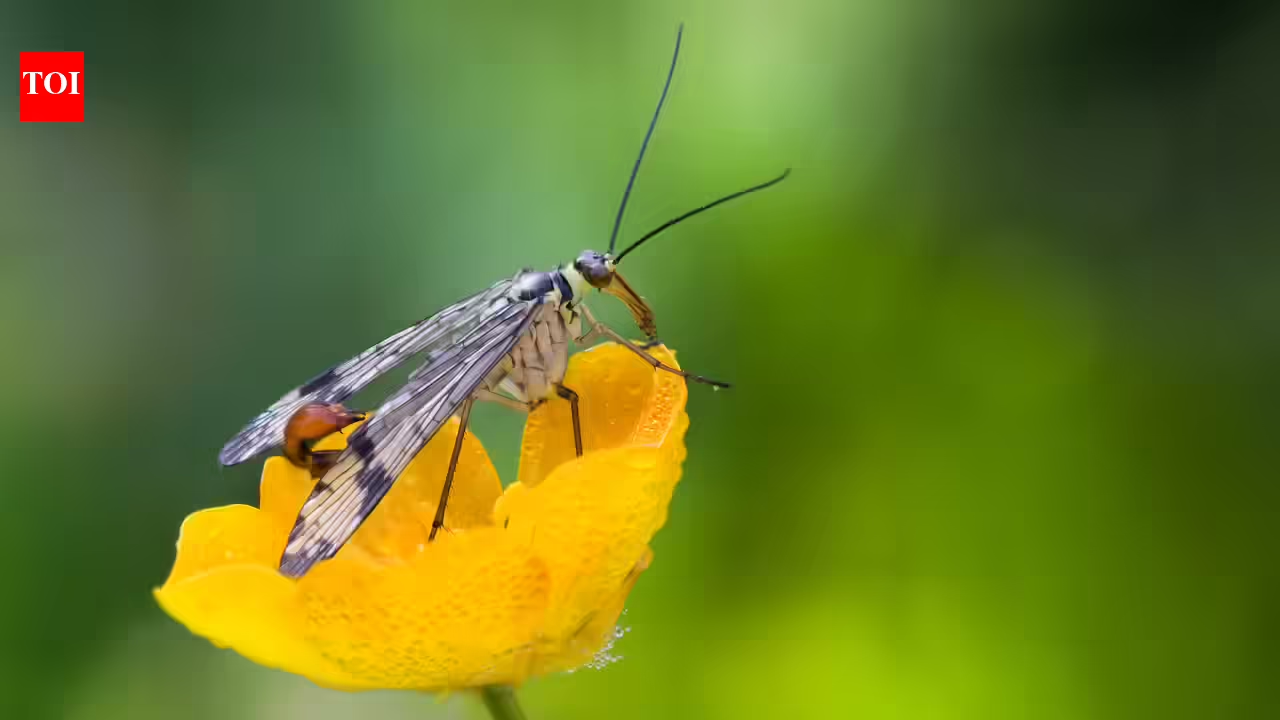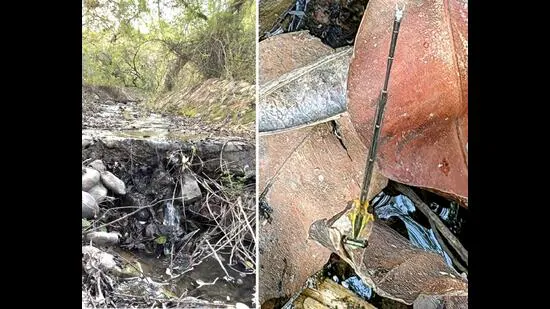
It would seem that all around us, there are disturbing visions of vanishing insects. As creatures vital to pollination and micro-scavenging, insects are the subject of media reports with global studies auguring their catastrophic declines and extinctions. But Mother Nature has a way of flowering her pristine beauty in niche habitats hidden from the envious gaze of humanity.Parchh dam waterfall; and (right) a damselfly. (VIKRAM JIT SINGH)On Wednesday afternoon as temperatures soared to 44.4 degrees Celsius, I stumbled upon a little oasis in the Shivalik foothill jungles. It was a waterfall flowing over a gentle incline and gurgling like a human baby. It was water released from the Parchh check dam, which lies a few kilometres behind the PGIMER as the falcon flies. The course of the waterfall was shaded from the blistering sun by a pavilion of trees. Along the sailing waters were cheering stands of aquatic reeds and scrub. The stream itself was devoid of a speck of pollution, clear as distilled water.Little wonder that in this micro-habitat, insects of every variety buzzed about in large numbers without any threat to their right to life on the blue planet. Moths and butterflies flitted everywhere like ethereal spirits of an air oxidised by thousands of trees acting like hoses of a natural oxygen bar. There were insects whose names I did not know but they circled and swam on the water surface like mermaids or merry children enjoying a recess. Red-veined Darter dragonflies indulged in courtship rituals over beckoning waters, weaving and evading and then uniting like Bollywood lovers running around trees.One did not have to get the infamous pollution control board to check water quality. It was the presence of an insect that bestowed unimpeachable integrity upon this tiny piece of paradise — the Yellow Bush Dart damselfly. It lays eggs in clear water and its nymphs (young ones) develop in water. If water is not clear, damselflies vanish due to impaired breeding success.A survivor’s bold talesBirds and trees are perceived as synonymous. But when it comes to the red-wattled lapwing (titeeri), the probability of observing one on a tree is about as remote as the pink-headed duck bobbing on the Sukhna lake’s rippling surface. This is so because the lapwing lacks the toes required for gripping branches, especially the critical hind toe which is absent or very underdeveloped in the species.The lapwing thus prefers open ground where it can glimpse a long distance and secure ‘early warnings’ of predators. If there are too many trees around lapwings, then it can work to their disadvantage as the leafy boughs can hide hawks that can swoop down and surprise lapwings.“Lapwings are strictly ground perchers as they lack the hind toe to grasp branches. They can sit on other flatter surfaces like a rock, building roofs, etc., but not on trees,” Prof. Gurpartap Singh told this writer.I collated some fascinating facts and anecdotes from the lapwing’s natural history to reveal the wondrous world of this ‘commoner, not rare, plain Jane’ bird that has adapted marvellously to survive all the proverbial stones hurled at it by ‘manunkind’.(i) Strongly territorial and bold, the lapwing does not tolerate any kind of intruder...observed driving away a cobra...a pair defended its nest/chicks by attacking a tiger at Jogi Mahal, Ranthambore (HS Sangha)(ii) A pair laid its eggs amid a heap of ballast between railway tracks in Ghosrana (Rajasthan), 1941, and every time a train came, the incubating lapwing flew up, returning immediately as the train left! (Charles McCann)(iii) in the days of shikar, lapwings (like ruddy shelducks) were a great source of annoyance to sportsman, spoiling his stalk by its ceaseless vigilance and frantic screaming, betraying him to the quarry...Flight rather slow but capable of astonishingly agile turns and twists and other antics when hunted with trained hawks (Dr Salim Ali)(iv) Historical data of IAF stations revealed that lapwings were notably involved in nocturnal aircraft bird strikes particularly around full-moon nights (V. Sharma and S. Srinidhi)vjswild2@gmail.com
Wildbuzz | A little Eden of insects
As creatures vital to pollination and micro-scavenging, insects are the subject of media reports with global studies auguring their catastrophic declines and extinctions
661 words~3 min read