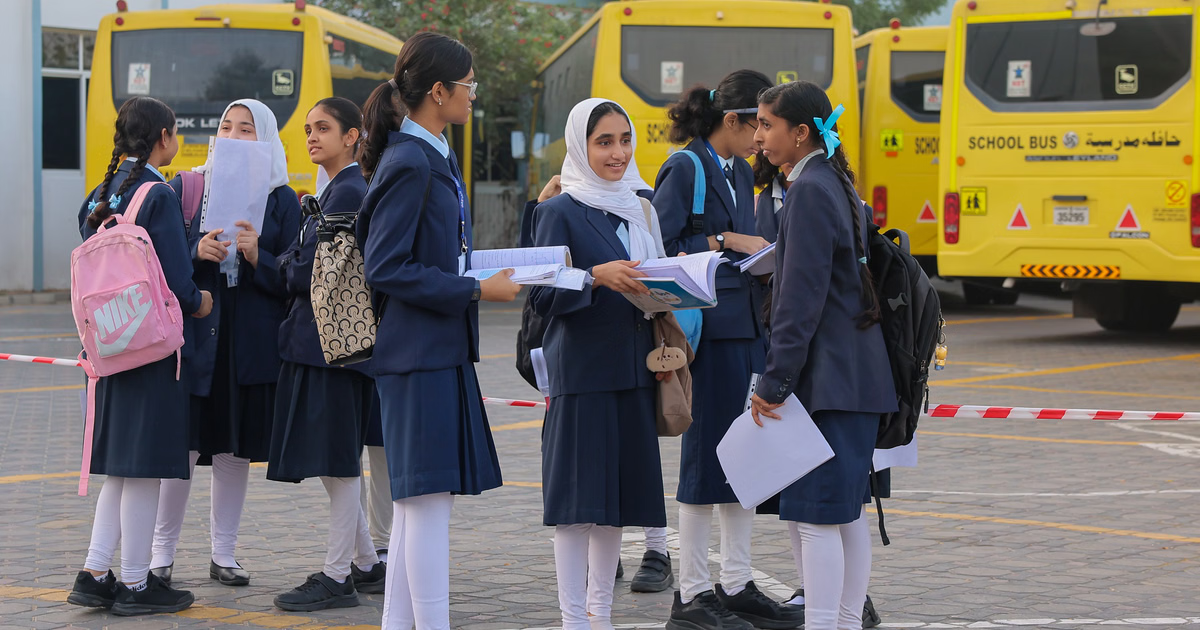
In alignment with NEP 2020 and NCFSE 2023, the Central Board of Secondary Education (Central Board of Secondary Education) has issued an update announcing the introduction of a third language (R3) at the secondary level starting from Class IX in the 2026–27 academic session. The new three-language framework has also been introduced, with phased implementation set to begin from 2026 for Classes 9 and 10.Focus on multilingual learningThe initiative is aimed at strengthening multilingual education and ensuring that every learner studies at least two native Indian languages, supporting the broader goal of promoting India’s linguistic diversity.CBSE said the rollout will follow a phased implementation model and a structured R1, R2 and R3 framework, giving schools flexibility to choose languages from the approved list. Three-language framework under CBSE R3 rolloutUnder the new system, languages will be organised as:R1: Any language offered by CBSER2: A language different from R1R3: A third language distinct from both R1 and R2Students must ensure that at least two of the three languages are native Indian languages.Example combinations include:Hindi (R1) + English (R2) + Malayalam (R3)Telugu (R1) + English (R2) + Sanskrit (R3)CBSE offers Hindi, English and 42 additional languages, including all Scheduled Languages under the Constitution, along with other Indian and foreign languages. Illustrative language combinationsCBSE has shared sample combinations to guide schools, including:Hindi (R1) + English (R2) + Malayalam (R3)English (R1) + Bengali (R2) + Hindi (R3)Telugu (R1) + English (R2) + Sanskrit (R3)Marathi (R1) + Kannada (R2) + English (R3)Punjabi (R1) + Tamil (R2) + Dogri (R3)Students who have not studied any native Indian language in Classes VI–VIII will be required to take a native language as R3.Phased implementation of R3 (third language)The implementation will be carried out in a phased manner, beginning with Class IX in 2026–27 and expanding across subsequent academic years.Academic rollout plan2026–27: Class IX (transitional) – R3 compulsory2027–28: Class IX and X – R3 compulsory2028–29 onwards: R3 continues as a compulsory componentCurriculum structure (transitional phase)Class IX students (2026–27) will study Class VI-level R3 textbooksClass X students (2027–28) will follow Class VII-level materialsOne local literary text will also be included in each classCBSE confirmed that R3 textbooks for Class VI will be available by June 2026, while Class IX-level materials for the next batch will be released by December 2026.UAE schools and exemptionsFor CBSE-affiliated schools in the UAE, the R3 framework offers greater flexibility in language selection to reflect the diverse expatriate student population. Schools outside India may be exempt from the requirement of offering two native Indian languages, while still following the structured R1, R2 and R3 system.Special provisions will also apply for Children with Special Needs (CwSN), foreign and transient students, and CBSE schools abroad.Assessment and evaluationR3 will be evaluated through school-based internal assessment and marked as “Qualified/Not Qualified.” Students who do not qualify will require remediation, and schools are encouraged to include internal grades (A–E) and qualitative feedback in the Holistic Progress Card.Implementation challengesTo address implementation challenges, CBSE has suggested shared teaching models, digital classrooms, guest faculty and regional academic support systems.R3 will remain a low-intensity subject, with around 2–3 periods per week, focusing on oral communication, reading and basic fluency rather than extensive grammar or writing.CBSE has also outlined key concerns raised by schools and suggested mitigation strategies: Teacher shortage: Schools may use Sahodaya hubs, digital classrooms, retired or guest faculty, and qualified language specialists.Curriculum load: The R3 course will require only 2–3 periods per week and will focus mainly on oral and reading skills rather than extensive grammar or writing.Student engagement: Although there is no Board exam for R3, it remains a mandatory qualifying subject. Compliance and school guidelinesSchools have been directed to update their R3 offerings on the OASIS portal by June 30, 2026 and ensure strict adherence to CBSE-prescribed textbooks, with any modifications subject to official approval.CBSE reiterated that R3 remains a mandatory qualifying subject and must be completed for the award of certification, with internal assessment forming the basis of evaluation.
CBSE third language rule: Board issues R3 phased rollout update, structural changes detailed
CBSE’s new R3 rule makes a third language compulsory from Class 9 in 2026–27. Know the phased rollout, exemptions for UAE schools and key assessment changes.
658 words~3 min read