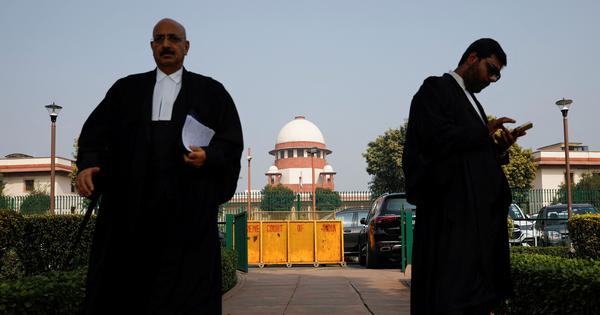
The Supreme Court on Wednesday agreed to examine whether the Central Board of Secondary Education’s mandatory three-language policy for Class 9 students places undue pressure on students and if there are logistical challenges in implementing it, The Hindu reported.In a circular issued on May 15, the Central Board of Secondary Education said that studying three languages would be mandatory for Class 9 students from July 1. Among the three, at least two must be Indian languages.On Wednesday, a bench led by Chief Justice Surya Kant sought responses from the CBSE, the Union government, and the National Council of Educational Research and Training on the petitions challenging the circular.The bench said that it was concerned about whether schools had adequate teachers, textbooks and infrastructure to implement the policy, The Hindu reported.Appearing for the petitioners, advocate Mukul Rohatgi argued that students were already “saddled with academic load and peer pressure”.He submitted that the burden would increase further as students would now need to pass an additional language for Class 10 certification, even though the assessments are said to remain internal and school-based.The bench initially proposed listing the matter on June 15. However, following a request by the Additional Solicitor General Aishwarya Bhati, it postponed the hearing to the second week of July.The petitioners had urged the court to direct the CBSE not to implement the policy from July 1, when the academic session begins. The bench declined to pass any interim order.‘Violates constitutional rights’The petitions, filed by a group of parents and teachers from Delhi, Gurugram, Noida and Chennai, have argued that the circular violates constitutional protections, including the right to equality and the right to education.The petitioners have contended that the policy’s implementation in the middle of an academic session would impose an additional burden on students and disrupt preparation for Class 10 Board examinations, Bar and Bench reported. They also argued that many schools lack trained teachers, textbooks and the infrastructure needed to implement the policy effectively.They also flagged concerns about unequal regional impact and the absence of clarity on evaluation patterns for the additional language.The CBSE has maintained that there will be no Board examination for the third language in Class 10 and that assessments for the additional language will remain internal to schools. As part of the transition, schools will temporarily use Class 6 textbooks for the third language until dedicated material is introduced, the board had said in its circular.Edited by Tanya Shrivastava.
Supreme Court to examine CBSE’s three-language policy for Class 9 students
Petitioners argued that the policy, set to take effect from July 1, would increase academic pressure and there are logistical challenges in its implementation.
406 words~2 min read