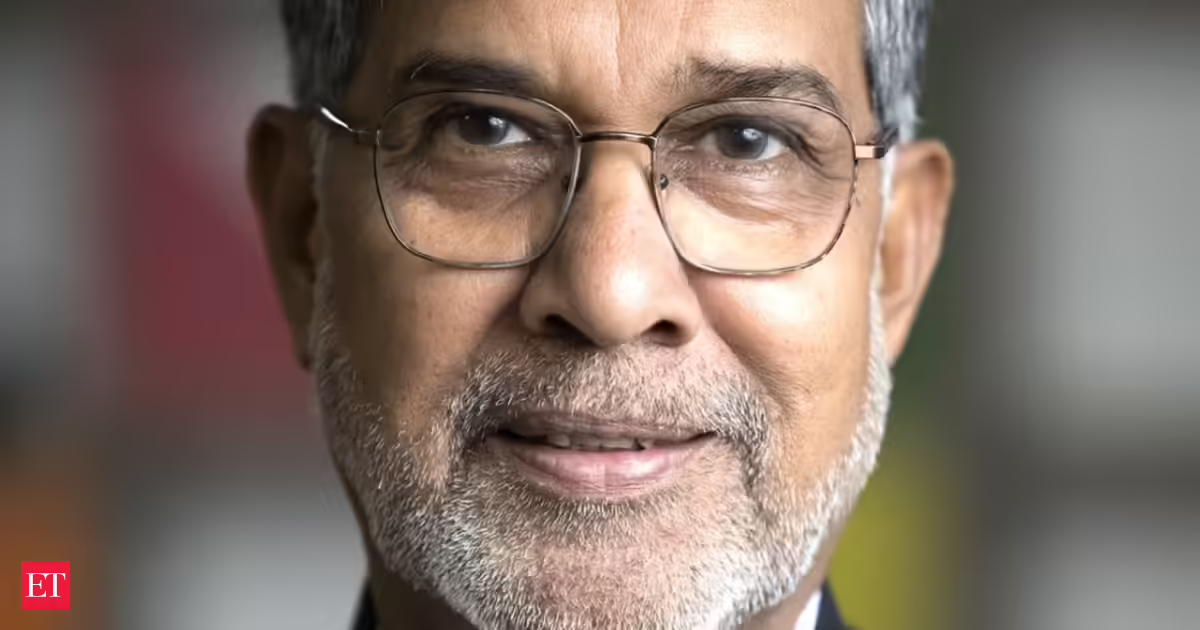
Most people grow up hearing the same advice whenever anger appears: stay calm, stay quiet, and control yourself. From classrooms to workplaces to family life, anger is often treated as something dangerous that must be suppressed before it causes trouble. But what happens when anger comes from witnessing injustice, inequality, or suffering that should never have existed in the first place?That is the question Kailash Satyarthi once raised while reflecting on human emotion, activism, and social responsibility.Quote of the Day by Kailash Satyarthi: “For centuries, we were taught that anger is bad. Our parents, teachers, priests, everyone taught us how to control and suppress our anger. But I ask: why can't we convert our anger for the larger good of society?”The quote is widely associated with the Nobel Peace Prize-winning activist, who spent decades fighting against child labor, trafficking, and exploitation. Even today, his words continue to resonate because they challenge the traditional belief that anger is always destructive. Instead, Satyarthi argues that anger, when guided with purpose, can become a force for justice and reform.Also Read: Quote of the Day by Amal Clooney: ‘As women, we may not be a minority, but there is a bond that we all share; it is...’ - What the Lebanese-British human rights advocate understood about the struggles of womenWhat the quote is actually suggestingQuoted by Goodreads, Kailash Satyarthi’s line is not encouraging rage or violence. Instead, it has a constructive side that speaks about transforming emotional pain into meaningful action.People often feel angry when they witness unfairness, corruption, discrimination, abuse, or helplessness. Most are taught to hide those feelings to avoid conflict. But Satyarthi suggests that suppressing anger completely may also suppress the desire to change broken systems.The deeper message behind the quote is that emotions themselves are not necessarily bad. What matters is how people choose to use them.Constructive anger can push individuals to speak up against injustice, protect vulnerable people, demand accountability, or improve society. Throughout history, many reform movements began because ordinary people refused to quietly accept suffering around them.The quote also reflects a broader human truth: frustration often becomes dangerous only when it has no direction. But when combined with empathy, discipline, and moral purpose, it can inspire courage and long-term change.Kailash Satyarthi: The thinker behind the ideaKailash Satyarthi was born on January 11, 1954, in the Indian state of Madhya Pradesh. Trained as an electrical engineer, he gave up a promising professional career in 1980 to dedicate his life to ending child labor and child slavery.His activism began early in life. As a young boy, he was deeply disturbed after seeing children forced to work instead of attending school. Those experiences shaped his lifelong belief that every child deserves dignity, education, freedom, and opportunity.Over the decades, Satyarthi founded Bachpan Bachao Andolan (Save Childhood Movement), which rescued more than 83,000 children from exploitation, trafficking, bonded labor, and slavery. He also led major global campaigns against child labor and helped influence international laws protecting children’s rights.Also Read: Everyone talks about layoffs; few talk about the survivors: 25-year tech veteran lifts the lid on a silent struggle inside Big TechHis work was not without danger. He and his colleagues faced violent attacks, death threats, and assaults during rescue missions against trafficking networks and labor mafias. Yet he continued advocating for vulnerable children across India and beyond.In 2014, he was awarded the Nobel Peace Prize jointly with Malala Yousafzai for their struggle against the suppression of children and for the right to education.Kailash Satyarthi’s philosophy behind the quoteSatyarthi’s philosophy has always centered around moral courage, compassion, and action-driven activism. His life shows that he never believed silence alone could solve injustice.Throughout his journey, he repeatedly challenged social norms that treated inequality as “normal.” Whether it was caste discrimination, bonded labor, trafficking, or child exploitation, he questioned systems many people had accepted for generations.That is why his quote about anger carries deeper meaning. For Satyarthi, anger was never about hatred. It was about refusing to become emotionally numb in the face of suffering.Even while facing violence, Satyarthi consistently argued against retaliation. He focused on long-term solutions, policy reforms, rehabilitation, and public awareness rather than personal vengeance.Also Read: Quote of the Day by Jon Bon Jovi: ‘Falling in love is painful on the knees’ - a relationship lesson from the ‘Bed of Roses’ singer for people who dare to careWhy this idea still matters todaySatyarthi’s message feels especially relevant in today’s world, where people regularly experience frustration over social inequality, workplace pressure, political division, online hostility, and rising emotional exhaustion.Many people suppress emotions because they fear judgment or conflict. But unaddressed frustration can often turn into hopelessness, anxiety, or emotional detachment.The quote reminds people that emotions can also become productive forces when directed toward empathy and positive action. Anger about bullying can inspire advocacy. Anger about injustice can inspire reform. Anger about inequality can push societies toward progress.The idea also resonates strongly with younger generations increasingly speaking openly about mental health, social justice, discrimination, and systemic problems. Satyarthi’s words encourage people not to ignore difficult emotions but to channel them responsibly and meaningfully.His larger message remains simple yet powerful: emotions become dangerous when they destroy people, but they can become transformative when they help improve the lives of others.
Quote of the Day by Kailash Satyarthi: ‘For centuries, we were taught that anger is bad...’ - What the Nobel laureate understood about turning frustration into social change
Quote of the Day by Kailash Satyarthi challenges the notion that anger is always destructive. He advocates for transforming anger stemming from injustice into a powerful force for societal good, also urging constructive action rather than suppression. His philosophy emphasizes channeling emotional pain into meaningful reform and protecting vulnerable populations.
875 words~4 min read