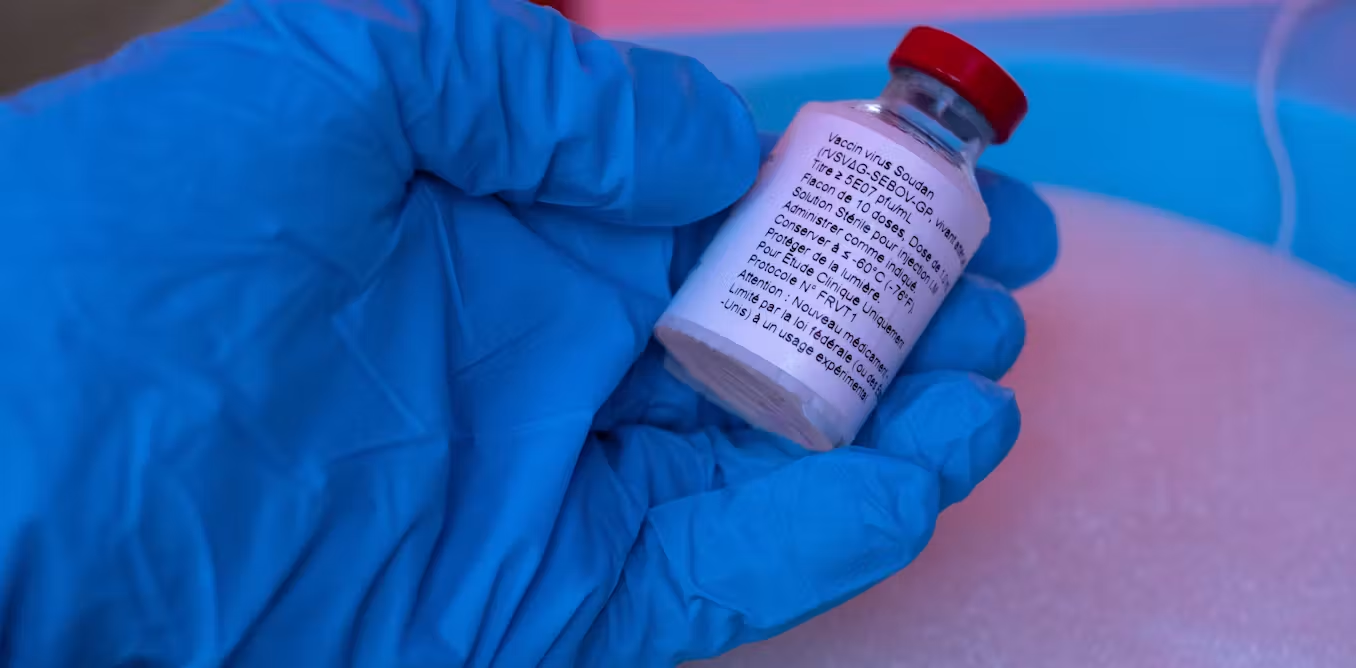
Oxford University scientists are developing an Ebola vaccine that could help tackle a deadly outbreak of the disease within months.The rare species of Ebola currently spreading in the Democratic Republic of the Congo - known as Bundibugyo - kills 30 to 50 per cent of those infected but there is no proven jab.The outbreak has so far resulted in 750 suspected cases and 177 deaths, with suspected cases tripling in a week.The Oxford Vaccine Group (OVG) is now using the same technology that underpinned its Covid-19 jab to develop one specific to Bundibugyo.The species has only caused two previous outbreaks, one in Uganda in 2007 and one in the Democratic Republic of the Congo in 2012, the World Health Organisation (WHO) said.The WHO today upgraded the risk of the current outbreak in the DRC from ‘high’ to ’very high’ as the virus is ‘spreading rapidly’ in the country.The risk in the wider region is also now considered to be high but it remains low internationally, it said.The reassessment comes after the UN health agency declared a public health emergency of international concern on Sunday, when it stressed that the outbreak was not a pandemic. A Congolese police personnel stands guard at the burning Ebola treatment center, as aid agencies intensify efforts to contain a new Ebola outbreak involving the Bundibugyo strain outbreak, in Rwampara general hospital in Rwampara outside Bunia, Ituri province, Democratic Republic of Congo.Professor Teresa Lambe, Calleva head of vaccine immunology at the OVG, said: ‘My hope is that this outbreak can be brought under control quickly and that vaccines are ultimately not needed.‘Nevertheless, our team and partners will continue working to ensure that potential vaccine options are available if they are needed.'The ability to move rapidly in situations like this has been built on many years of vaccine research and close collaboration with our global partners.’The OVG previously tested Ebola vaccines in response to the 2013-2016 West Africa outbreak, which contributed to a different Ebola vaccine being approved by the European Medicines Agency in 2020.There are no guarantees the new vaccine will work and it will take animal research and trials on people to establish if it is effective.But scientists say they are working quickly in case the outbreak worsens and their experimental vaccine is needed.Dr Tedros Adhanom Ghebreyesus, director general of the WHO, described the situation as 'deeply worrisome' as he told reporters that 82 cases have been confirmed in the DRC, with almost 750 suspected cases.There have been seven confirmed and 177 suspected deaths, he added. World Health Organization Director-General Tedros Adhanom Ghebreyesus speaks during a press conference on the Ebola disease outbreak caused by Bundibugyo virus in the Democratic Republic of the Congo and Uganda, at WHO headquarters in Geneva, Switzerland.Earlier in the day, the United Nations released 60 million dollars (£44.7 million) from its Central Emergency Response Fund to accelerate the response in the region.The vaccine being developed by UK scientists uses nimble technology - known as ChAdOx1 - that can be quickly tweaked so it works against different infections.During the pandemic it was loaded with genetic code from the Covid-virus, which has now been replaced with genetic code from Bundibugyo.It uses a common cold virus that normally infects chimpanzees but has been genetically engineered to make it safe for people.Researchers use this modified cold virus to carry and deliver important genetic material about the Bundibugyo Ebola virus to cells, instructing them to recognise and fight off the actual disease.The vaccine does not cause an infection or Ebola symptoms, but trains the immune system to give protection.The WHO said earlier this week that there was no animal data yet to support the effectiveness of this particular vaccine but the BBC has reported that animal testing is already under way in Oxford.‘It is possible that doses of that could be available for clinical trial in two to three months, but there is a lot of uncertainty,’ a WHO spokesman added.The Serum Institute of India is lined up to mass produce the Ebola vaccine once Oxford can supply medical-grade material.Professor Lambe said: ‘Once we get starting material to them they can go fast and they can go big.‘People are worried about this outbreak, generally, you prepare for the worst case scenario - hopefully contact tracing and quarantine is all that's needed, but we can't take our foot off the gas.’There are six species of Ebola virus, but only three cause large outbreaks in people.There is an Ebola vaccine for the more common Zaire species of Ebola.Ebola vaccines would not be used for mass public vaccination campaigns in the same way as during the Covid pandemic.Instead, they will be reserved for the people most likely to get infected, such as close contacts of cases as well as healthcare workers who are treating sick patients.
Oxford scientists developing jab to tackle Ebola outbreak in months
The rare species of Ebola currently spreading in the Democratic Republic of the Congo - known as Bundibugyo - kills 30 to 50 per cent of those infected but there is no proven jab.
798 words~4 min read