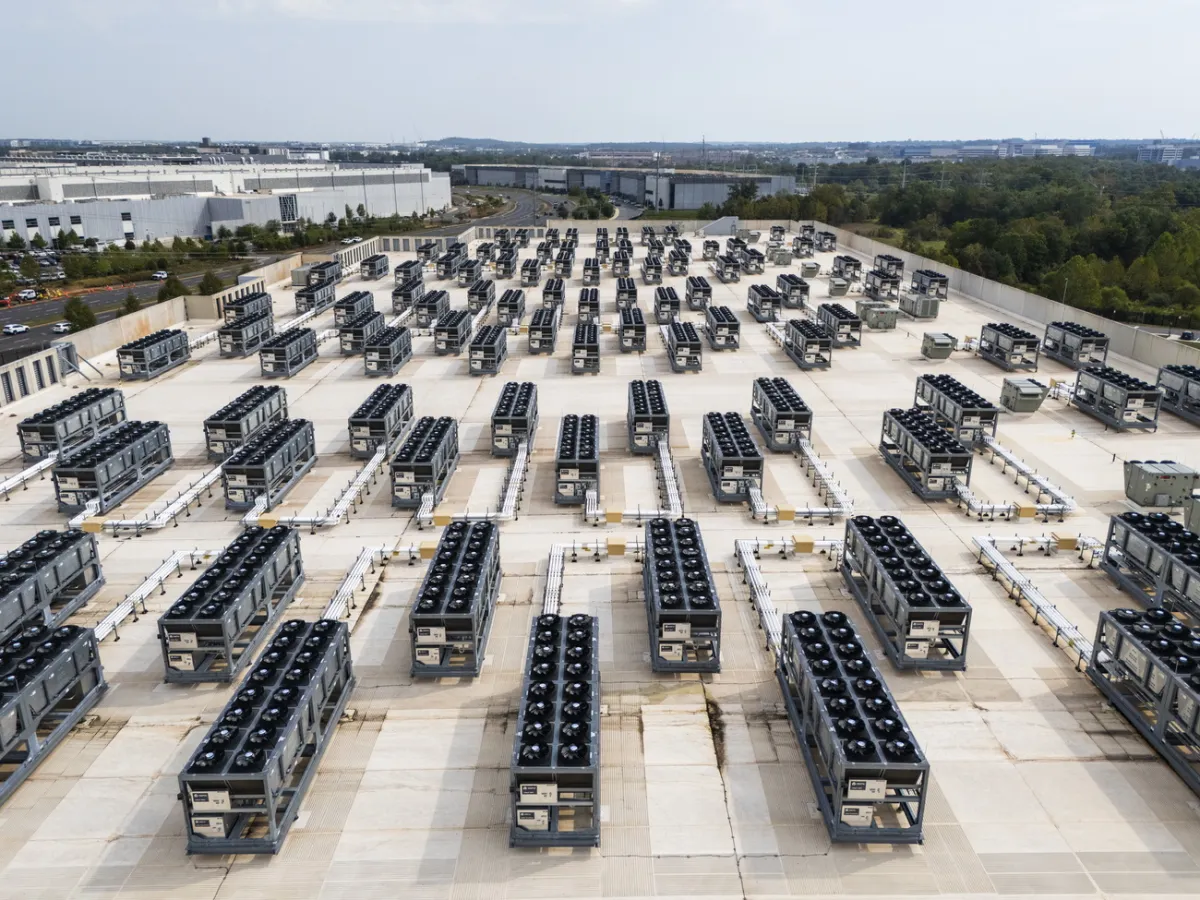
The artificial intelligence boom is creating an energy monster that the world is unprepared and unequipped to deal with. Providing enough energy to fuel the AI ambitions of the future as well as to support human demand and development will require advances in energy technologies that are as-yet undiscovered. “There’s no way to get there without a breakthrough,” Sam Altman, co-founder and CEO of ChatGPT firm OpenAI, said at the 2024 World Economic Forum in Davos, Switzerland.More accurately, it will probably require several breakthroughs. Altman was referring to the need to fund nuclear fusion research when he made his infinitely quotable statement at Davos, but reigning in the AI energy monster will not only require next-gen energy generation, it will also require a great leap forward in data center design and energy efficiency. And a team of researchers from University of Illinois Urbana-Champaign, USA may have made just such a breakthrough.An innovative form of 3D-printed copper cooling plates could revolutionize the design of data centers and slash the amount of energy needed to cool them, according to a new scientific paper published in the academic journal Cell Reports Physical Science. The team of researchers found that their innovative pure copper plate model, which was designed using a cutting-edge mathematical algorithm, uses just a fraction of the energy that conventional cooling plates use.Set OilPrice.com as a preferred source in Google here.The potential impact of this discovery is enormous. The computer chips used to run the computations for large language models create an enormous amount of thermal energy in a process known as Joule heating. In the course of one hour, a single computer chip creates roughly enough heat to boil 50 cups of water. And AI data centers typically house hundreds of thousands of these kinds of computer chips. And, as computer chips become more and more powerful, their heat emissions climb ever higher.As a result, cooling systems are of central importance to the functioning of data centers – and they require a whole lot of energy to run. Cooling systems currently represent a whopping 30 to 40 percent of AI data centers’ energy use. When implementing the new 3D-printed plates, that figure drops to just 1.1 percent, an astonishing and potentially game-changing savings.“Cooling is the bottleneck in computer-chip design,” Behnood Bazmi, mechanical engineer and the paper’s first author, was quoted in a press release accompanying the publishing of the paper. “By bridging the gap between computational design and manufacturing capability, our approach provides a pathway for more energy-efficient liquid cooling of chips and other electronics.”Cold plates are already in commercial use in data center applications, but they are designed for ease of manufacturing rather than for optimal performance. The solution presented by the University of Illinois Urbana-Champaign team addresses two critical downsides to conventional cooling systems by redesigning both the materials used as well as the way that those materials are configured.“In a technique known as topology optimization, the researchers used a mathematical optimization algorithm to redesign the tiny internal fin structures from the conventional rectangular or cylindrical geometries into far more complex, jagged, and pointed shapes that maximize heat transfer and thermal performance, while minimizing the pumping effort required to move coolant through the plate,” New Atlas reported earlier this week.To facilitate the construction of such a complex model, the team turned to 3D printing – more specifically, electrochemical additive manufacturing (ECAM), to build the plate’s intricate and craggy surface one layer at a time. This allows for an extremely delicate and nuanced approach to building a far more sophisticated – and therefore more energy efficient – cooling system. “ECAM can manufacture pure copper parts with very fine detail – down to 30 to 50 micrometers, less than the width of a human hair,” says study co-author Nenad Miljkovic.By Haley Zaremba for Oilprice.comMore Top Reads From Oilprice.comPakistan Looks to Host Crude Reserve Sites of Gulf Oil ProducersEU Warns Energy Prices Will Stay Elevated Through 2027Ukraine Hits 300,000-Bpd Gazprom Neft Refinery in Overnight Drone Strike
3D-Printed Copper Plates Could Cut Data Center Cooling Energy Use by 97% | OilPrice.com
University of Illinois researchers say 3D-printed copper cooling plates could cut data center cooling energy use from 40% to just 1.1% of total power draw.
665 words~3 min read