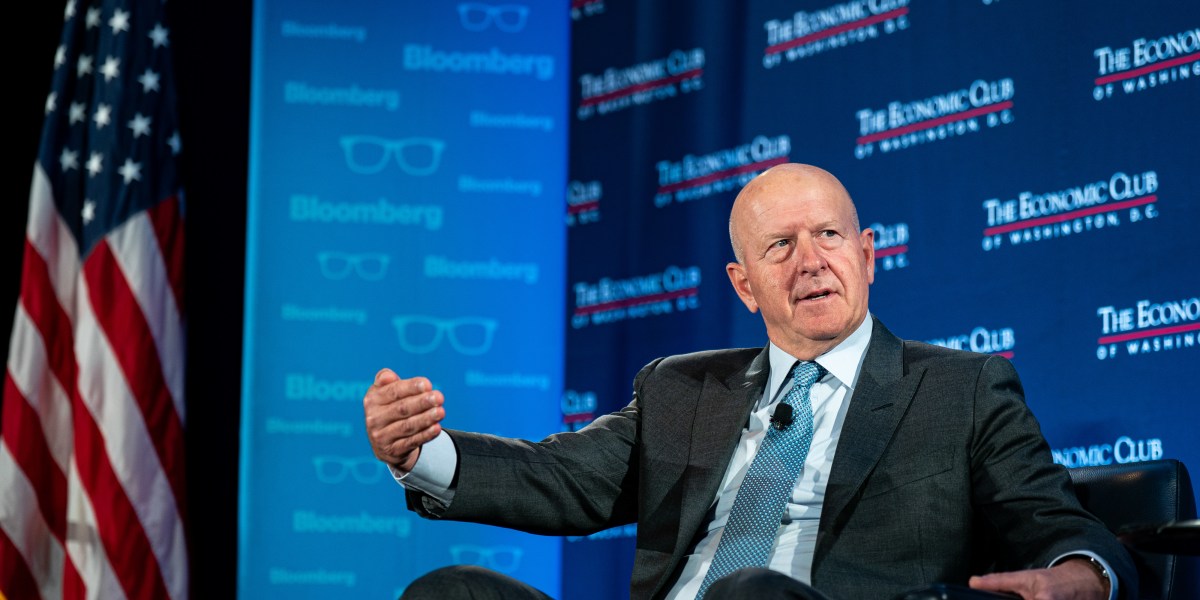
ToplineGoldman Sachs chief David Solomon believes concerns about advancements in artificial intelligence sparking a wave of mass unemployment are “overblown,” writing in a New York Times guest essay that the U.S. will be able to adapt and expand its workforce to AI advancements.David Solomon, CEO of Goldman Sachs, speaks on stage during the Italian Tech Week 2025.Photo by Nicolò Campo/LightRocket via Getty ImagesKey FactsIn the essay titled, “I’m the C.E.O. of Goldman Sachs. The A.I. Job Apocalypse Is Overblown,” Sachs posits AI presents a “a great leap forward for society” that comes with “a few caveats.”Solomon acknowledged AI’s disruption of the labor market “will entail new challenges,” citing Goldman Sachs analysis that estimates AI may automate 25% of current work hours in the next ten years.Solomon said it is difficult to understand AI’s looming impact on certain blue-collar jobs, but noted white-collar jobs in areas like accounting, banking and law “will likely see many of their tasks automated.”The Goldman Sachs CEO has three reasons he expects the U.S. economy to stay resilient as AI disrupts employment standards, believing AI will free up human workers to complete more complex tasks, enhance the standards of existing professions instead of making them obsolete and create jobs for humans to manage the AI being used by their companies.Solomon said if AI destroys jobs at an unprecedented scale, there should be a “joint effort” between the public and private sectors to help workers and institutions adapt to the new labor market.Crucial Quote“In 1930, John Maynard Keynes famously predicted that, by 2030, people would work only 15 hours a week,” Solomon said. “While his vision of a leisure-filled future remains unfulfilled, it is a good reminder that fears of a job apocalypse may very well overlook A.I.’s potential to spur an economic and productivity revival.”Chief CriticDaron Acemoglu, an economist and professor at the Massachusetts Institute of Technology who once estimated AI would only be able to profitably perform 5% of job tasks between 2024 and 2034, has warned of “excessive automation.” Acemoglu said in a 2024 interview the use of AI to automate work and not create new tasks could trigger a work shortage, lower workforce participation and more “menial, meaningless jobs.” He added if AI is able to effectively augment labor instead of replacing it, “there is no reason for future unemployment to be just like today.”Key BackgroundIn addition to impacting white-collar jobs, AI is also shedding the need for some entry-level roles, according to an analysis from McKinsey, which said 51% of organizations reported in a 2025 survey that generative AI was lessening their need for entry-level jobs. Goldman Sachs economists have found jobs like telephone operators, insurance claims representatives and bill collectors face high risk of being outright substituted by AI. Meanwhile, roles such as education administrators, physicians and surgeons, construction managers and chief executives have a higher chance of becoming augmented, not replaced, by AI. Further ReadingI’m the C.E.O. of Goldman Sachs. The A.I. Job Apocalypse Is Overblown. (New York Times)
Goldman Sachs CEO Says AI ‘Job Apocalypse’ Is ‘Overblown’
David Solomon acknowledged advancements in artificial intelligence have eliminated jobs in some industries but “may lead to job growth in others.”
499 words~2 min read