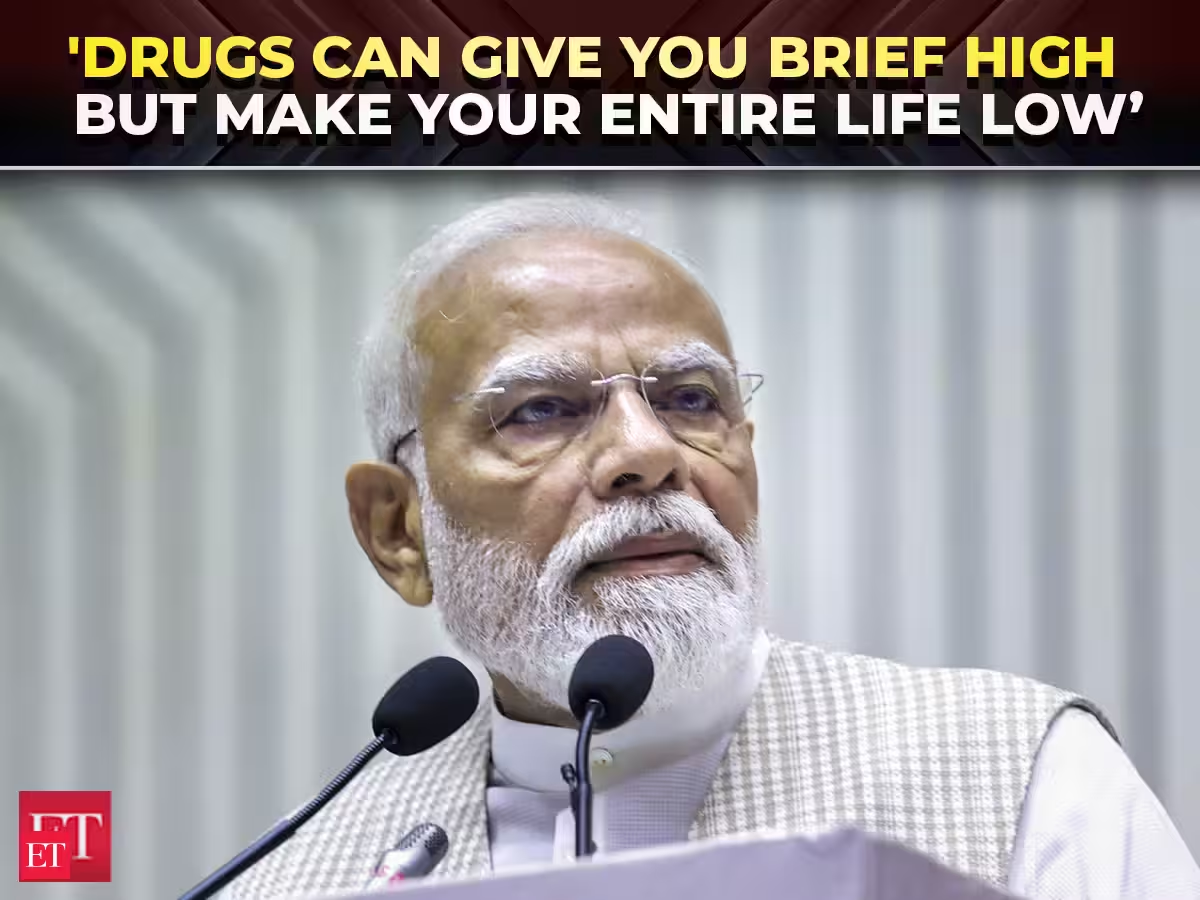
Prime Minister (PM) Narendra Modi has repeatedly stated that the youth are the driving force of a strong nation. This is the very belief that drives the vision of Viksit Bharat. The menace of narcotics poses a serious threat for a nation whose greatest strength lies in its youth.Drug abuse (Unsplash)Every consignment of narcotics that ever entered India carried the threat of destroying young lives. Therefore, the Modi government made the war against drugs as a mission to protect India’s future and safeguard its strength.India’s anti-drug agencies have adopted a ruthless approach to dismantle the menace. An outcome of the coordinated approach is that the Narcotics Control Bureau, acting under the directives of the ministry of home affairs, carried out ‘Operation RAGEPILL.' This operation led to the country’s first-ever seizure of captagon worth ₹182 crore. Captagon is globally known as the jihadi drug due to its links with conflict economies and extremist networks in West Asia. Its seizure revealed the dangerous intersection between drugs, organised crime, and terror financing. Thus, it is viewed as a preemptive action against a greater security threat.This challenge becomes even more serious, considering the geographic location of India, as it is located near the Golden Crescent (region comprising Afghanistan, Iran and Pakistan). Hence, it is highly prone to trafficking routes that have potentially funded terrorist organisations. For instance, Punjab has been considerably affected by the illicit drug menace. The state’s proximity to Pakistan reveals its vulnerability to narco-trafficking by hostile cross-border networks. Thus, the case study of Punjab reinforces the fact that drug smuggling and national security are increasingly interconnected.In response to the growing threat, the Modi government adopted a zero tolerance policy against drugs, combining enforcement, border surveillance, and financial tracking under a whole of government and whole of nation approach.The scale of the approach is reflected in statistics. Between 2014 and 2025, India seized over one crore kilograms of narcotics valued at ₹1.65 lakh crore, while drugs worth ₹71,600 crore were destroyed as part of the crackdown. The figures mark a sharp rise from the previous decade, when narcotics worth ₹8,150 crore were destroyed between 2004 and 2014. Such has been the intensified pace of anti-drug enforcement in recent years.The central government’s crackdown has not remained limited to seizures alone. With Shah spearheading the anti-drug mission, India’s crusade against drugs has transcended into a coordinated international operation. The government has conveyed that not a single gram of narcotics would be permitted to enter the country or be used as a transit route.Last month, notorious drug trafficker and Dawood Ibrahim aide Mohammad Salim Dola was extradited to India. This signals the government’s growing resolve to dismantle cartel networks operating beyond national borders.Drugs destroy a nation’s potential long before destroying lives. It weakens ambition, fuels crime, and gradually erodes social stability. The demographic advantage of India can become a vulnerability if addiction, unemployment, and social isolation continue to create ground for substance abuse. That is exactly why the central government’s vision of a drug free India by 2047 carries strategic relevance. A country aspiring to become a global power cannot afford to witness its youth succumbing to addiction and trapped by criminal networks. The vision is ultimately about ensuring that the hands meant to build the nation are not consumed by addiction.India’s war against drugs is not merely about seizures or arrests. It is more about safeguarding the nation’s aspirations and protecting the generation that will shape its destiny.(The views expressed are personal)This article is authored by Suvrokamal Dutta, senior columnist.
Ruthless approach needed to guard against narcotics
This article is authored by Suvrokamal Dutta, senior columnist.
586 words~3 min read