High‑quality 3D medical imaging data is the foundation of modern radiology AI, but access to it is often constrained by data scarcity, privacy restrictions, and the high cost of expert annotation. As a result, training reliable 3D medical imaging models is frequently bottlenecked by small, narrow, and hard‑to‑share datasets, limiting model robustness and generalization.
To help teams overcome these challenges, NVIDIA introduced Medical AI for Synthetic Imaging (MAISI) in 2024—a state‑of‑the‑art generative model that synthesizes high‑resolution 3D CT volumes with pixel‑level anatomical segmentation for privacy‑preserving data augmentation and research.
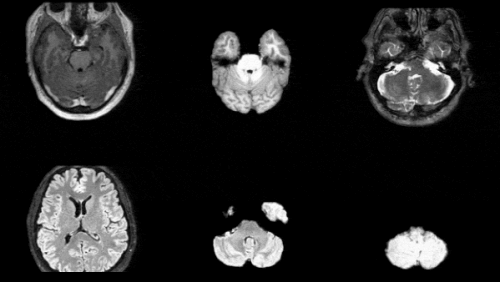
NV-Generate-CTMR, built on the MAISI architecture family, including MAISI‑v2 with Latent Rectified Flow, delivers an open source, end-to-end framework for synthetic CT and MRI generation. It enables researchers and developers to generate realistic 3D volumes and paired segmentations at scale, integrate them directly into training pipelines, and accelerate downstream medical imaging AI development.This blog post introduces NV-Generate-MR-Brain, a new model for the synthetic generation of human brain anatomy and structure segmentation built on the MAISI architecture and extending it toward scalable, open workflows for synthetic 3D medical imaging generation.