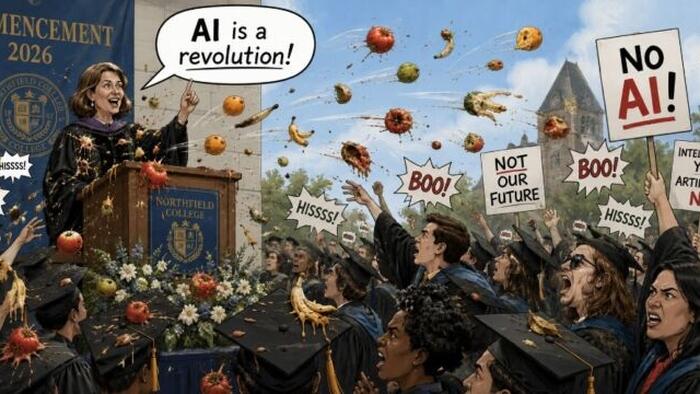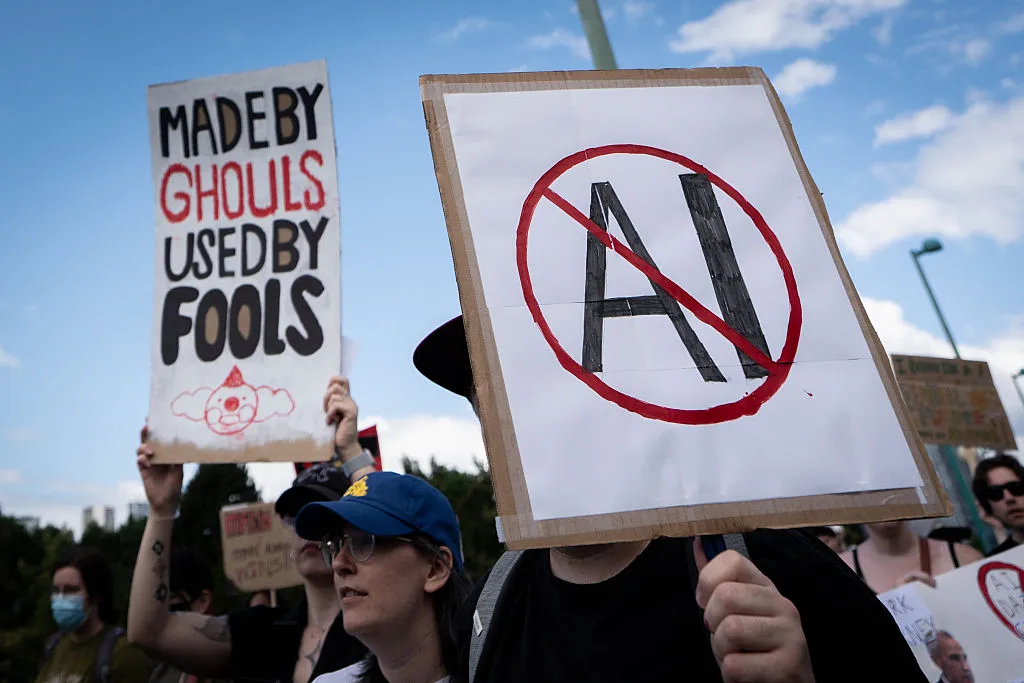
To reach people between the ages of 18-25, advertisers have long spent disproportionate sums of money. Young people make choices and develop loyalties that last a lifetime. And when they develop a preference or perspective in that era, it becomes extraordinarily difficult to dislodge.So given what’s happened on American campuses over the past week, artificial intelligence is now in a serious public relations emergency. In commencement addresses across the United States, graduates have booed any mention of AI. Twenty-two-year-old seniors booed AI at the University of Central Florida. They jeered it at Middle Tennessee State University. And they drowned ex-Google CEO Eric Schmidt in a loud, angry chorus as he encouraged them to help steer the technology’s future at the University of Arizona.At this point, who could blame them? AI’s leaders have been warning about mass job loss for years now, focusing, in large part, on the entry level roles these graduates want. And as they’ve made these warnings, the AI labs have marched toward trillion-dollar IPOs, which may come as soon as this year. It’s obviously better to warn of incoming catastrophe if you think it’s going to happen, but it’s a tough sell when you’re part of what’s causing it.AI’s perception problem doesn’t just stem from the way Silicon Valley has messaged about AI (the problem would be real enough with perfect comms), but the messaging certainly hasn’t helped. VC Marc Andreessen, on the Joe Rogan Podcast this week, told the world’s largest podcast audience that AI is great because “the bots never get frustrated with you,” adding that it “never gets sick. Never gets depressed because his girlfriend broke up with him. Never files HR complaints.”Andreessen shared this in support of his belief that AI will increase productivity and create jobs (and he may well be right), but it’s hard to imagine the messaging landing with a new grad sitting at home on their parents’ couch, unemployed in a tight job market.AI’s chances of success, meanwhile, are directly tied to the public’s approval of the technology. To expand and reach their ambitions, AI builders need more data centers. And right now, the polling on AI and data centers is horrific. Seven of ten Americans oppose building AI datacenters in their area, Gallup found last week, with 48% strongly opposed and only 7% strongly in favor.The politics of AI are still in their testing phase, but politicians will find a way to exploit something so unpopular. In Maine, a data center construction moratorium was struck down only by a veto from the state’s Governor, who seemed open to letting it go through with a few new caveats. The 2028 presidential cycle could feature talk of data center bans and a government AI “kill switch,” should the situation continue to devolve, no matter how impractical those proposals might be to implement.There’s something different today than the “techlash” of the last decade, where U.S. leaders scrutinized Amazon, Facebook, and Google’s power. Back then, despite widespread concerns of their excesses, the tech companies polled more favorably than politicians. Today, AI is polling below all major political candidates. The political costs of taking real action are lower, increasing the chances something might happen.Ultimately, what AI will do to our society is still unknown, and any definitive statement about the technology’s effects today is just speculation dressed up in confidence. We will learn more as it rolls out. But if the messaging doesn’t get better, it’s going to take a lot more time to get our answers.Aboard is a Solution Engineering firm that combines AI-accelerated software delivery with skills and craft built across two decades of software consulting.They don’t put AI in charge — they put it to work, building reliable custom software for industry leaders in a fraction of the time it used to take.That’s how Aboard created a solution for a network of non-profit healthcare orgs, including comprehensive dashboards, automated onboarding, AI-generated insights, and HIPAA-compliant infrastructure, all incredibly secure and delivered in record time.Get in touch at aboard.com to begin your AI transformation today.Learn More about AboardBoris Cherny is the head of Claude Code at Anthropic. Cherny joins Big Technology to discuss Claude Code’s explosive growth and whether the rise of AI agents is sustainable. Tune in to hear how Claude Code is changing software development, why Anthropic believes agents will spread far beyond coding, and what happens when people start running hundreds or thousands of AI agents in parallel. We also cover token maxing, rate limits, Codex competition, SaaS disruption, self-improving AI, and whether today’s models really understand the consequences of their actions. Hit play for a sharp look at the agent boom from one of the people building it.You can listen on Apple Podcasts, Spotify, or your podcast app of choiceThanks again for reading. Please share Big Technology if you like it!And hit that Like Button just think of us as anything but a consumer AI appMy book Always Day One digs into the tech giants’ inner workings, focusing on automation and culture. I’d be thrilled if you’d give it a read. You can find it here.Where we’ll talk about this story, the latest in AI, the week’s podcast, and plenty more. You can sign up via the link below:
AI’s Public Relations Emergency
A generation is being told AI is their enemy. And they’re starting to believe it.
871 words~4 min read